

Micron Technology (NASDAQ: MU) shares have faced significant selling pressure over the past two months, erasing much of their earlier gains.
As of press time, MU shares were trading at $646, down from $1,053 on September 28, 2026, a decline of 38.71%.
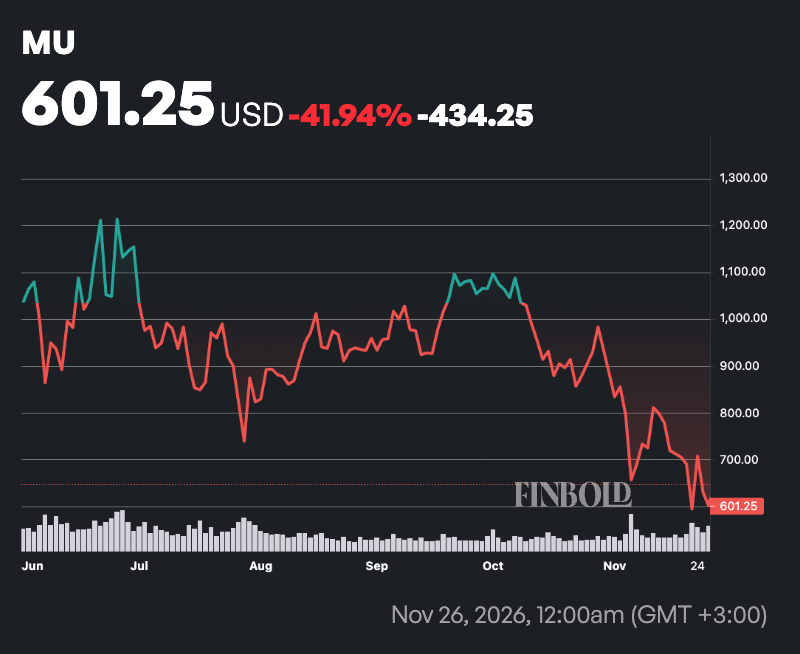
As a result, an investor who put $1,000 into Micron shares at the September 28 closing price would now have approximately $612, representing a paper loss of $387.07, excluding transaction costs, taxes, and dividends.
The decline has occurred despite Micron reporting record financial results, as investors reassess elevated AI valuations, semiconductor demand and the possibility that memory prices could peak sooner than expected.
Why MU stock is crashing
Micron’s losses have also coincided with a broader retreat from technology and AI-related stocks, as investors question whether massive investments in artificial intelligence infrastructure will generate sufficient returns.
Additionally, mixed quarterly results from major technology companies, higher-than-expected capital expenditure and pressure on free cash flow have added to the concerns.
At the same time, company-specific pressure intensified after BNP Paribas Exane downgraded Micron from ‘Outperform’ to ‘Neutral’ on November 24 and cut its price target from $1,700 to $775.
Analyst Karl Ackerman warned that DRAM and NAND supply could catch up with demand by mid-2027, earlier than the bank’s previous mid-2028 projection.
The downgrade reflected concerns about expanding manufacturing capacity, potential delays in data-centre projects and reduced memory requirements in upcoming AI server platforms.
The bank also cited weaker PC and smartphone shipment expectations as risks to demand.
Market research firm TrendForce added to the concerns, reporting that Chinese cloud service providers had reduced their 2027 memory orders.
It also warned of potential NAND flash price declines as early as the first quarter of 2027. Although DRAM supply is expected to remain tight through 2027, contract price increases could narrow and level off in the second half of the year.
Micron stock fundamentals
Despite the share-price decline, Micron’s financial performance remains strong. The company reported fiscal fourth-quarter revenue of $54.23 billion and non-GAAP earnings of $33.42 per share for the quarter ended September 3, 2026. Revenue increased 379.3% year over year, while earnings exceeded analysts’ expectations.
Management also issued strong fiscal first-quarter 2027 guidance, projecting revenue of $61.5 billion, plus or minus $1.5 billion, and adjusted earnings of $38.15 per share, plus or minus $1.
Micron’s high-bandwidth memory (HBM), a critical component in advanced AI processors, remains a significant growth driver.
However, investors are weighing its growth prospects against the risk that expanding manufacturing capacity and changing customer orders could weaken memory prices.
Micron is scheduled to report its fiscal first-quarter 2027 results on December 17. Investors will be watching revenue, HBM demand, and management’s outlook for memory supply to determine whether the downturn is temporary or signals a broader downside.
Featured image via Shutterstock