
SpaceX (NASDAQ: SPCX) shares have been highly volatile since the company’s high-profile stock market debut in June 2026, with an initial rally giving way to a sharp correction.
The pullback has tested investor confidence despite the company’s expanding operations in artificial intelligence (AI), satellite internet and space exploration.
To this end, an investor who put $1,000 into SpaceX shares every month since the company’s initial public offering (IPO) would have accumulated approximately $5,378.
The monthly investments began on June 12, 2026, when SpaceX started trading publicly, and continued through November, bringing total contributions to $6,000.
Based on the closing prices on each investment date, the investor would have accumulated approximately 40.26 shares. The first $1,000 investment was made at $160.95 per share on June 12, followed by purchases at $139.14 on July 13 and $146.15 on August 12.
Shares subsequently closed at $148.15 on September 14 and $163.42 on October 12, before retreating to $139.94 on November 12.
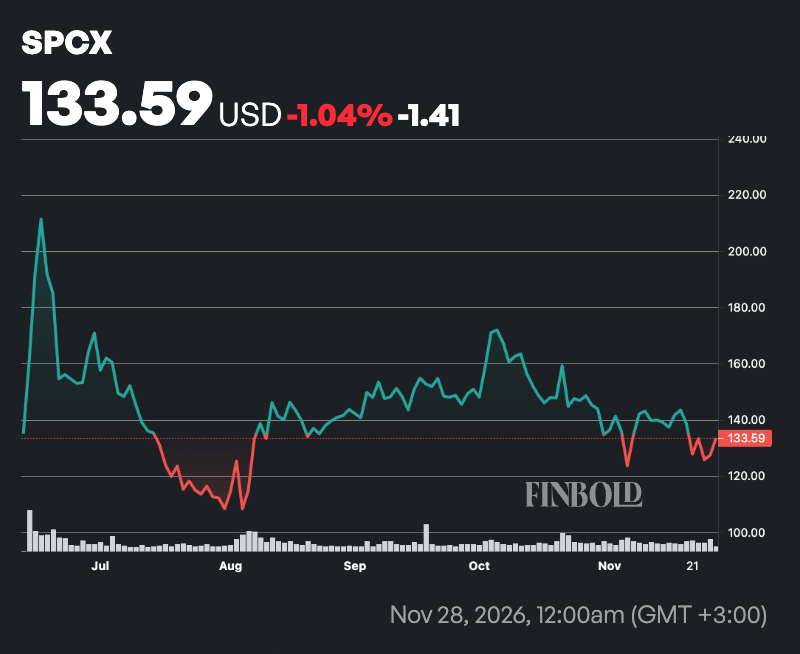
At the November 27 closing price of $133.59, the accumulated shares would have been worth approximately $5,378, representing a paper loss of $622, or 10.37%.
SpaceX record IPO
SpaceX priced its IPO at $135 per share, raising about $75 billion in the largest stock market listing on record.
After opening at $150 on June 12, shares rallied to $225.64 before retreating to $133.59 on Friday, down about 17% from their first-day close. The stock also hit a low of $104.83 during the period.
The decline has come despite substantial revenue growth and SpaceX’s expansion beyond its traditional rocket-launch and satellite internet businesses.
SpaceX reported third-quarter 2026 revenue of $14.6 billion, up 161% from $5.6 billion a year earlier, while net income reached $4.4 billion, reversing a $1.1 billion loss in the same period last year. Adjusted EBITDA surged 306% to $8.8 billion.
Growth was supported by its Starlink connectivity business and expanding artificial intelligence operations following its acquisition of xAI, which brought the Grok model family and computing infrastructure into the company.
SpaceX is expanding satellite capabilities
SpaceX is also expanding its satellite capabilities with its first revenue-generating Starship mission, delivering 26 Starlink V3 satellites into orbit, designed to provide approximately 10 times the downlink capacity of a conventional Falcon 9 Starlink launch. Its computing capacity reached 1.7 gigawatts by September 30.
Further growth opportunities emerged on November 28, when the US Federal Communications Commission authorised SpaceX to launch up to one million orbital data-centre satellites, advancing its ambitions to expand AI computing infrastructure into space.
However, the company’s expansion requires substantial capital investment and exposes it to competition in the AI and satellite industries.
The commercial viability of its orbital data-centre plans, implementation costs and potential orbital congestion also remain important considerations for investors.
Featured image via Shutterstock