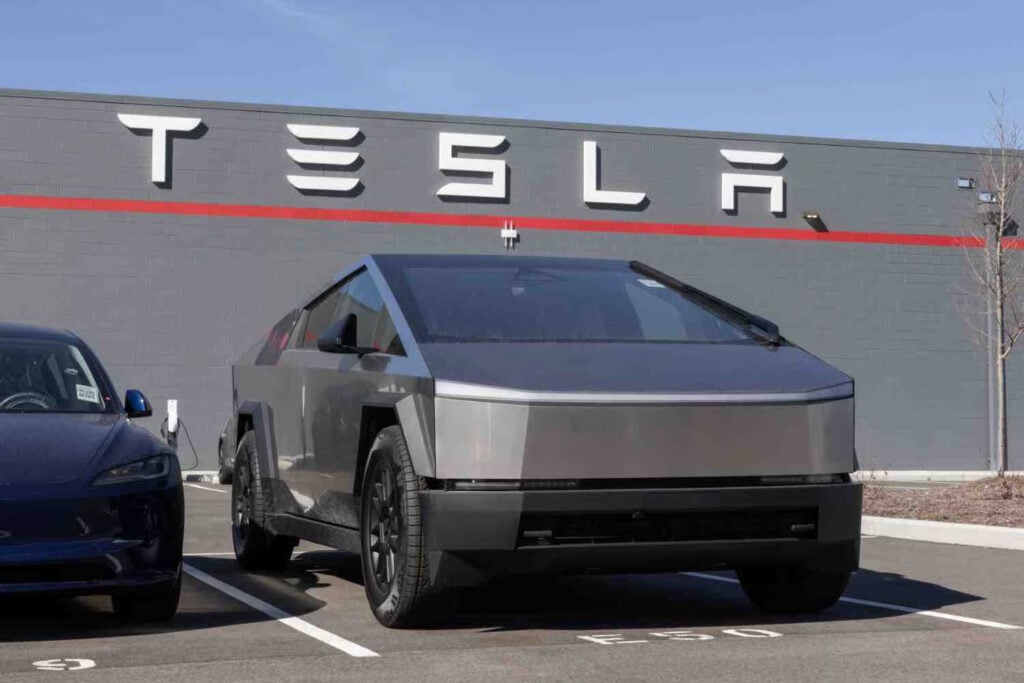

Tesla (NASDAQ: TSLA) stock closed at $240.08 when the first Cybertruck was delivered on November 30, 2026, and it closed at $343.69 on November 5, the final session before Elon Musk signalled production would be winding down.
Under the circumstances, despite the then highly anticipated vehicle underperforming in terms of sales, an investor who banked on the model ushering in a renaissance for the electric vehicle (EV) maker would have enjoyed a hefty profit.
Specifically, a $1,000 investment made at Cybertruck’s launch would have risen 43.16% – by $431.56 – by the November 5, 2026 closing bell and would have led to a position worth $1,431.56. TSLA stock’s extended-session 1.54% rally to $348.98 would have increased the unrealized gains to $453.60.
Advertisement

Is Tesla discontinuing the Cybertruck in 2027?
Simultaneously, the Tesla share price rise since late 2023 can, arguably, not be attributed to the much-hyped vehicle. Per a Finbold Research publication from mid-October, Elon Musk’s EV giant shipped fewer than 71,000 Cybertrucks since January 2024.
The underperformance of the model becomes even more evident once the fact that Tesla CEO anticipated his firm would be shipping between 250,000 and 500,000 each year, meaning it delivered 94% fewer than expected in the first half of 2026, is factored in.
While Elon Musk’s November 6 X post appears to be a concession of the weak demand, the wording leaves some room for interpretation.
Specifically, the businessman stated that the Texas Gigafactory would be winding down its Cybertruck production by mid-2027 to make room for a ramp-up in Cybercab manufacturing.
Notably, the X post does not unambiguously say that no more vehicles of the model will be produced. Still, a pivot to prioritizing Cybercab production appears a natural next step for Tesla.
Could Tesla’s drive toward the Cybercab and autonomous robots fail?
The autonomous taxi has, along with the Optimus humanoid robot, seen significant attention both from the media and from the firm’s marketing department. Furthermore, the strategy is likely to be of great importance for the EV maker since its other newest showcase, the flying Roadster, is unlikely to drive sales, despite being an impressive feat of engineering.
Advertisement
Still, both products could end up experiencing headwinds.
Humanoid robots require breakthroughs in artificial intelligence (AI) that are still generally speculative, while the self-driving cab sector is already relatively crowded, with Waymo arguably being the market leader for the time being.
Recent changes in the U.S. political landscape and mounting pressures and contradictions within the AI sector itself could also impact both of Tesla’s futuristic products.
Featured image via Shutterstock