
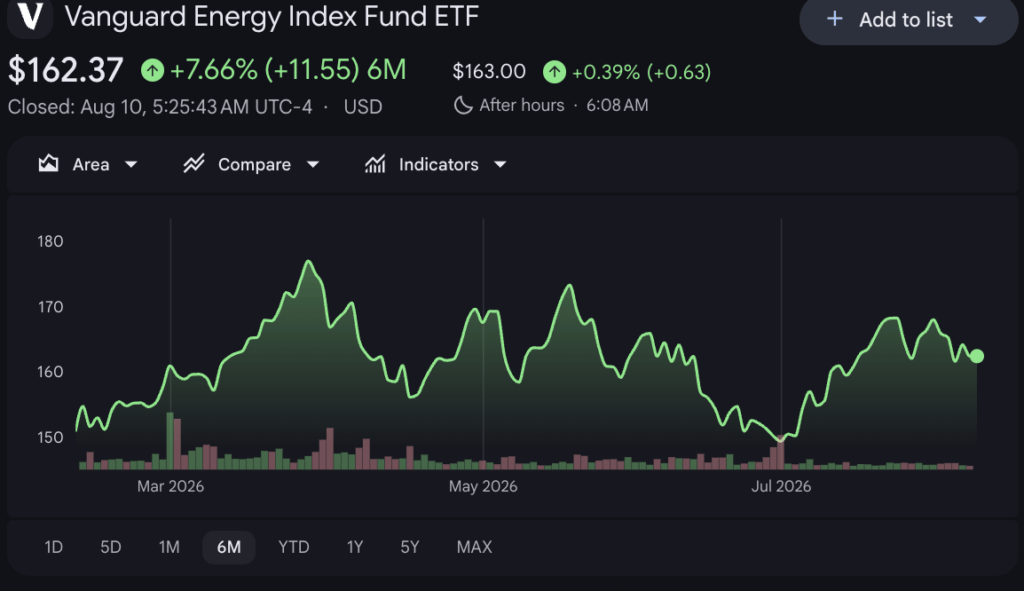
Investors who bought the Vanguard Energy Index Fund ETF (NYSEARCA: VDE) before the Iran war began have remained in positive territory, with a $1,000 investment growing to about $1,031.85, a gain of 3.18%.
The ETF benefited from higher oil prices after the conflict disrupted energy supplies and shipping through the Strait of Hormuz, a key route for global crude and liquefied natural gas trade.
Supply concerns pushed Brent crude and West Texas Intermediate above $100 per barrel at times, supporting energy stocks despite periods of market volatility.
Just after the war, the ETF initially climbed above $160 in early March before rallying toward the mid-$170 range, its highest level during the six months.
The fund later experienced several pullbacks as ceasefire discussions and diplomatic developments reduced some of the geopolitical risk premium in energy markets.
Shares fell to around $150 in early July, marking the lowest point of the period, before recovering above $160 by August. Despite the volatility, the ETF delivered a 7.66% gain over the last six months.
VDE fundamentals
The Vanguard Energy Index Fund ETF tracks a diversified portfolio of major energy companies, including integrated oil producers, refiners and exploration businesses. At the same time, VDE’s performance was driven by its exposure to major U.S. energy companies, with Exxon Mobil and Chevron among its largest holdings
As oil prices surged during the conflict, the sector emerged as one of the strongest-performing areas of the market in 2026.
Although the ETF’s gain since the eve of the war has been relatively modest at just over 3%, the fund remains above its pre-conflict level.
The recovery from July lows suggests investors continue to price in ongoing geopolitical risks and the possibility of further disruptions to global energy supplies.
Higher crude prices boosted earnings across oil producers, refiners and exploration companies held within the ETF. U.S. energy firms benefited from stronger upstream revenues and improved refining margins as global supplies tightened.
The sector emerged as one of the market’s top performers in 2026, supported by strong earnings and elevated commodity prices.
Although oil prices have retreated from their wartime highs, geopolitical uncertainty continues to underpin energy markets. Investors remain focused on the Strait of Hormuz, a vital route for global oil shipments.
VDE’s performance reflected these shifting dynamics, rallying during periods of escalation and retreating on ceasefire hopes.