

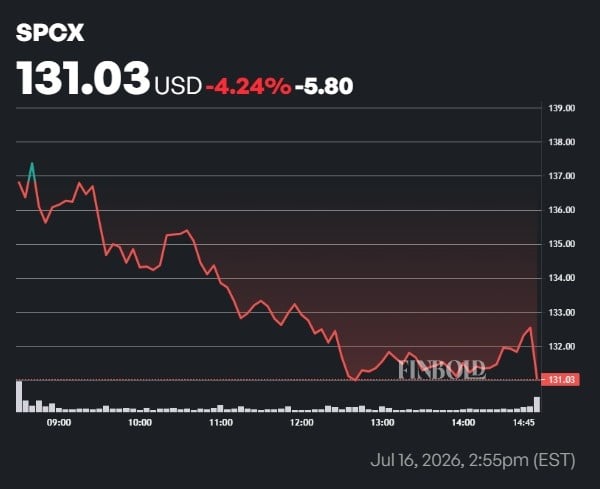
SpaceX stock price has fallen below its initial public offering (IPO) price price just one month after the company’s blockbuster market debut. Investors who bought SpaceX stock at the IPO price of $135 on June 12 would now be sitting on a loss.
Namely, a $10,000 investment made at the initial SpaceX IPO price of $135 per share on June 12, 2026, would now be worth approximately $9,706, with the space exploration leader trading just barely above $131 as of press time, July 17.
The losses come after a rather turbulent first month of trading following the largest IPO in history. Indeed, Elon Musk’s company debuted with an initial valuation of around $1.77 trillion and closed the first trading session with a market capitalization above $2 trillion.
In just four days, SPCX shares hit an intraday high of roughly $211 before broader market weakness kicked in and profit-taking and renewed concerns over the company’s valuation sent the stock lower.
SpaceX shares fell below their $135 IPO price for the first time on July 15, reaching a session low of $132.28 before recovering to close at $135.27. By press time, the price had gone even lower, to the aforementioned $131.
The decline has reduced SpaceX’s market capitalization to approximately $1.72 trillion, a significant retreat from the roughly $2.9 trillion valuation recorded just four days after its debut.
Why did SpaceX stock crash?
First and foremost, the selloff reflects growing investor concerns regarding SpaceX’s valuation and financial outlook as the company approaches its first earnings report in August.
Currently, analysts expect SpaceX to generate between $34 billion and $43 billion in revenue this year, up from $18.7 billion in 2025. However, many investors are on edge as SpaceX recorded a net loss of approximately $4.9 billion in 2025.
Shareholders are also watching for a potential increase in selling pressure later in 2026. For instance, insider share unlocks following the upcoming quarterly could expand the public float, allowing some employees to sell portions of their holdings.
Looking ahead, SpaceX’s growth is driven by several prospects. The most important of those are its Falcon launch business, expanding Starlink satellite internet network, Starship development, and potential artificial intelligence (AI) infrastructure projects.
However, the company faces significant execution risks as it invests heavily in these technologies. With its first earnings report as a public company approaching, investors will be watching whether management can turn technological leadership into financial performance strong enough to justify the multi-trillion-dollar valuation and deliver gains to early and future backers.
Featured image via Shutterstock