
Artificial intelligence (AI) has propelled semiconductor stocks such as Nvidia (NASDAQ: NVDA) to new heights as demand for advanced processors and AI infrastructure accelerates.
While industry leaders have already delivered substantial gains, smaller semiconductor companies could offer investors an opportunity to identify the next wave of AI-driven growth.
To this end, Finbold identified two lesser-known AI semiconductor stocks pursuing different opportunities in the expanding market.
Although both face significant execution risks, their technologies and potential catalysts could appeal to investors seeking outsized returns from a modest investment of $10.
Arteris (NASDAQ: AIP)
Arteris (NASDAQ: AIP) provides semiconductor intellectual property (IP), particularly network-on-chip technology that connects processing cores, memory, and other components within complex chips.
As AI accelerators and data-center processors become more sophisticated, the company could benefit from growing demand for advanced chip-design solutions.
At press time, AIP was trading at $20, up more than 30% year to date. Its market capitalization stood at approximately $955.5 million, equivalent to roughly 11.3 times its trailing-12-month revenue of $84.6 million.
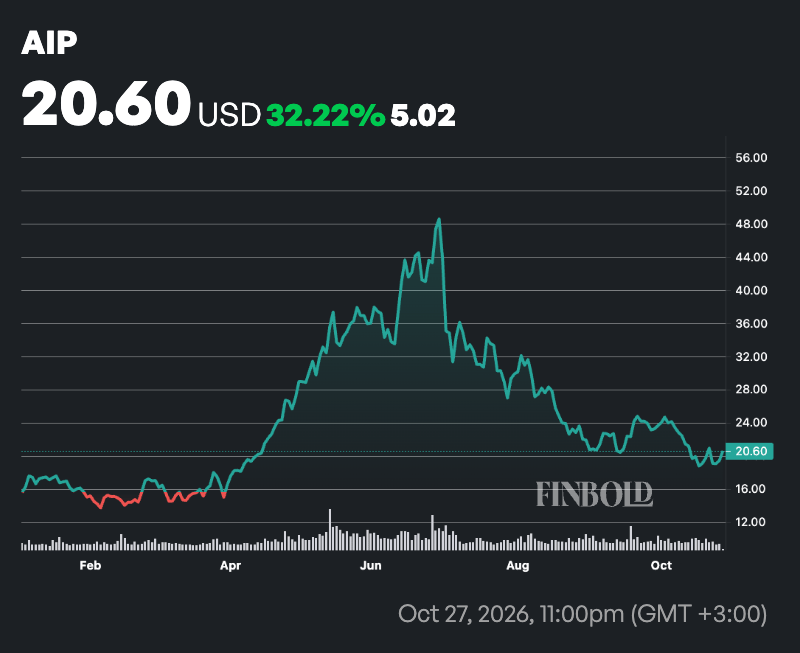
Arteris reported second-quarter 2026 revenue of $24.1 million, up 46% year over year. Annual contract value plus royalties rose 44% to $99.5 million, while remaining performance obligations increased 36% to $135 million.
Customer-confirmed design starts grew 21% over the trailing 12 months. Enterprise computing accounted for an average of 29% of annual contract value plus royalties over the preceding four quarters, with AI infrastructure deals contributing to some of its largest transactions.
Despite the growth, Arteris recorded a GAAP net loss of $14.1 million and a non-GAAP operating loss of $4.6 million. The company expects fiscal 2026 revenue of $95 million to $98 million and is scheduled to report third-quarter results on November 5.
GSI Technology (NASDAQ: GSIT)
Unlike Arteris, GSI Technology (NASDAQ: GSIT) develops semiconductor memory products and specialized processing technology.
Its Gemini-II associative processing unit (APU) targets AI inference and data-intensive workloads, giving the company a more direct route into AI computing.
GSIT shares have struggled in 2026, falling approximately 36% and trading at $4.27 at press time.
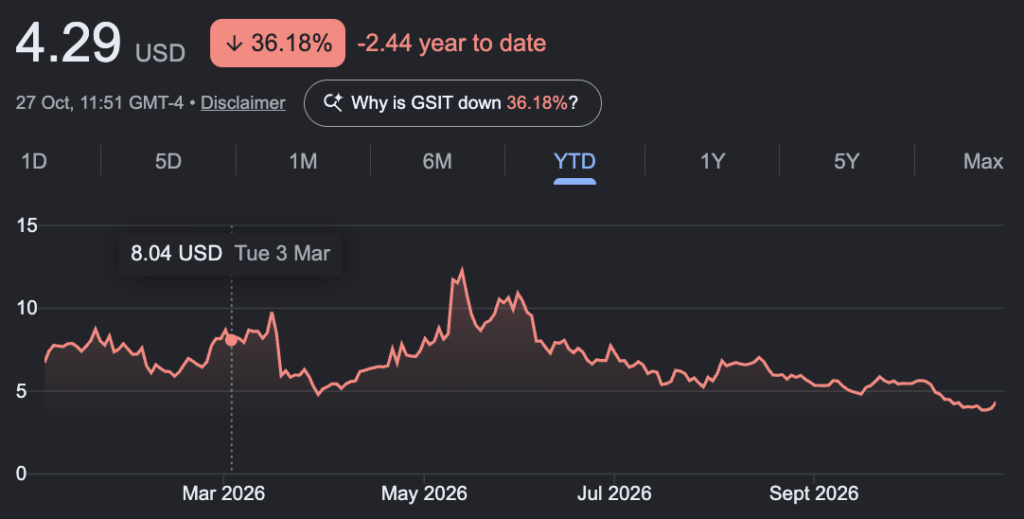
The decline contrasts with the company’s efforts to commercialize AI-processing technology, although future gains depend on turning development projects into meaningful sales.
In this line, GSI reported revenue of $6.31 million for the first quarter of fiscal 2027, ended June 30, up 0.5% year over year.
Gross margin was 53.4%, while operating and net losses reached $5.39 million and $4.79 million, respectively. Operating expenses rose to $8.75 million from $5.83 million a year earlier.
GSI ended the quarter with $77 million in cash and cash equivalents against $16.6 million in liabilities. However, it raised approximately $9.3 million through at-the-market stock sales, creating potential shareholder dilution.
On October 21, GSI said its Gemini-II-powered Smart Eye Guardian platform had passed initial acceptance testing and begun monitoring 20 surveillance cameras in Taiwan’s Hsinchu County, meeting the project’s 90% detection-accuracy requirement.
The company is also pursuing defense and edge-AI applications, including a roughly $2 million U.S. Army research contract and more than $5 million in non-dilutive funding.
Another catalyst is its Plato processor, designed to run large language models at the edge using less than 10 watts. As of July, the chip remained on track for a March 2027 tape-out, although commercial adoption is unproven.
GSI is scheduled to report its second-quarter fiscal 2027 results on November 5, providing an update on its financial performance and AI commercialization progress.