

Following the artificial intelligence (AI) boom, quantum computing stocks are touted as the next big opportunity due to the transformative potential of the technology.
Quantum computing remains an emerging industry, with companies racing to develop systems capable of solving problems beyond the practical reach of conventional computers.
Progress in hardware, error correction and commercial applications could attract investor interest over the next 12 months.
Against this backdrop, Finbold has identified two quantum computing stocks with speculative upside, with the potential of turning $10 into $100 in a year. Notably, neither stock is guaranteed to deliver that return
Rigetti Computing (NASDAQ: RGTI)
Rigetti (NASDAQ: RGTI) is developing superconducting quantum processors and integrated computing systems for applications that could benefit from advanced computational capabilities.
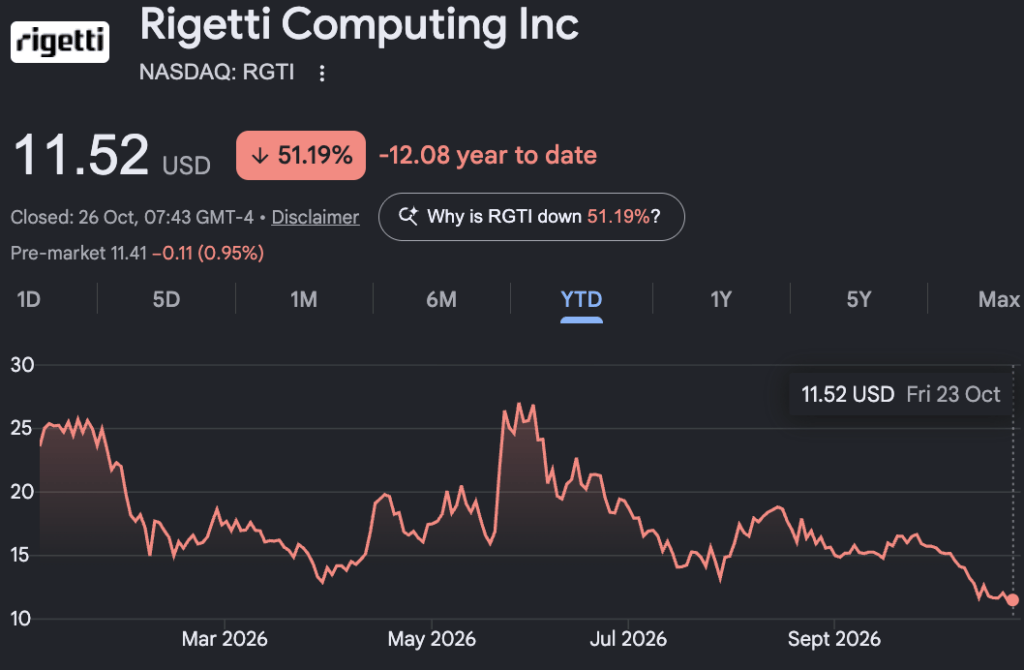
Despite the technology’s potential, RGTI stock has struggled over the past year. At press time, shares traded at $11.52, down 52% year to date.
Rigetti’s latest financial results show commercial activity, although revenue remains small relative to operating costs. In its second-quarter 2026 results, published on August 6, the company reported revenue of $5.1 million and an operating loss of $28.1 million.
It ended June with $541.3 million in cash, cash equivalents, and available-for-sale investments to fund research and development and commercial expansion.
The company is also pursuing practical high-performance computing applications. Its collaboration with Hewlett Packard Enterprise and the Pittsburgh Supercomputing Center aims to develop a hybrid quantum-classical supercomputing environment.
Rigetti is also pursuing a potential U.S. Department of Commerce funding arrangement worth up to $100 million over three years, subject to the terms of its announced letter of intent.
However, operating losses, research costs, and the challenge of improving processor performance remain significant risks.
D-Wave Quantum (NYSE: QBTS)
D-Wave (NYSE: QBTS) specializes in quantum annealing systems designed to solve optimization problems involving scheduling, logistics, and resource allocation. Their usefulness depends on the application and how they compare with conventional alternatives.
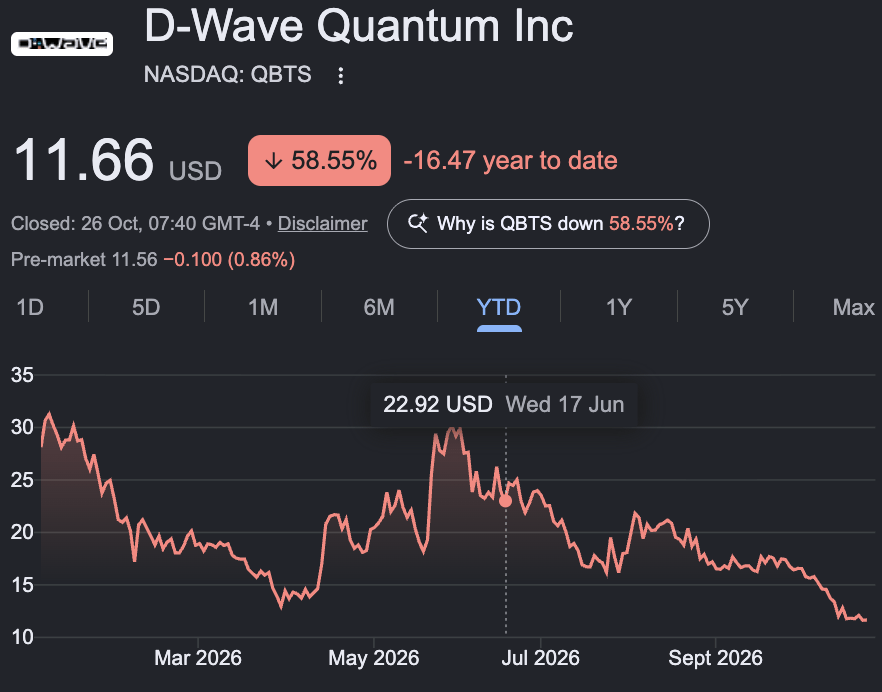
QBTS shares have also struggled, trading at $11.60 at press time, down 58% in 2026.
The company’s second-quarter 2026 results showed a sharp increase in customer bookings despite lower revenue.
D-Wave recorded $35.5 million in bookings in the first half of 2026, up from $2.9 million in the same period of 2025. Its remaining performance obligations reached $40.7 million at June 30, a 668% year-over-year increase.
The figures suggest that contracted demand is growing ahead of revenue recognition. More than half of D-Wave’s first-half revenue came from commercial customers, while commercial enterprises accounted for over 50% of its customers during the period.
Nevertheless, first-half revenue fell to $5.9 million from $18.1 million a year earlier, partly because of a $13.7 million system sale recognized in 2025, highlighting revenue volatility.
D-Wave’s upside depends on converting bookings into revenue, attracting more commercial customers and demonstrating cost-effective applications. New contracts and stronger financial results could improve investor sentiment.
However, inconsistent revenue, rising costs and slower-than-expected adoption remain key risks. Strong bookings alone do not guarantee a share-price increase, let alone a tenfold return.
Featured image via Shutterstock