
Following the explosive initial public offering (IPO), SpaceX (NASDAQ: SPCX) stock has the potential to become a $5 trillion company by 2031, according to OpenAI’s ChatGPT.
The forecast implies a 132% increase from SpaceX’s $2.152 trillion market capitalization as of press time, when SPCX shares traded at $163.42.
ChatGPT projects a broader timeline of 2029 to 2035, depending on revenue growth and profitability.
In ChatGPT’s bullish scenario, SpaceX could reach $5 trillion in 2028 or 2029 if Starlink Mobile expands quickly, AI investments generate stronger returns, and Starship advances toward reliable operations.
Its base case places the milestone between 2030 and 2032, while the bearish scenario suggests it could arrive after 2035 or never materialize.
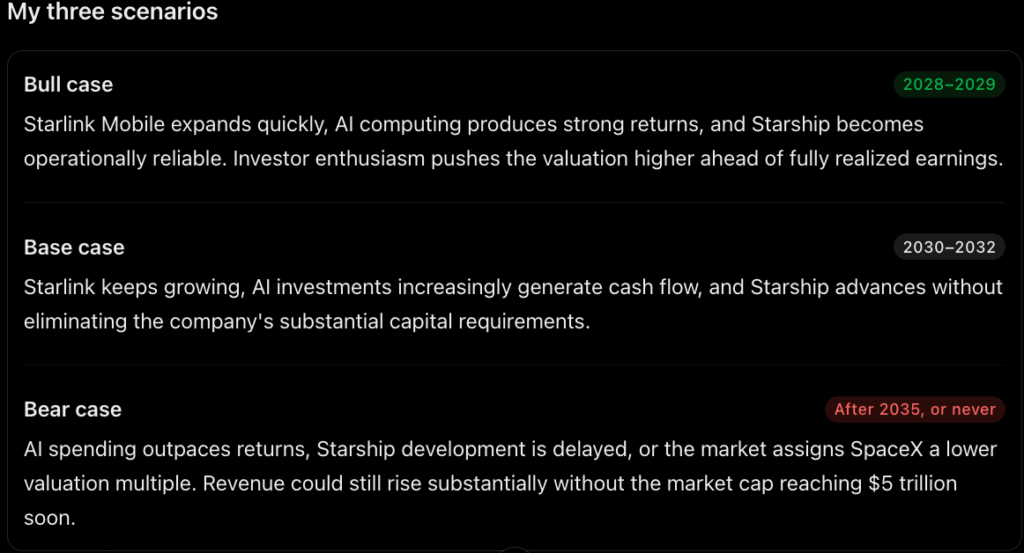
Overall, ChatGPT’s central estimate remains 2031, contingent on the company converting its revenue growth and heavy investment into sustainable cash flow.
Drivers of SpaceX growth
According to the AI model, Starlink will be central to this growth. Notably, SpaceX reported second-quarter 2026 revenue of $7.814 billion, up 92% year over year. Connectivity generated $4.291 billion in revenue and $1.656 billion in operating profit.
Starlink had 12 million subscribers at the end of June, double the year-earlier figure. However, average monthly revenue per user fell from $85 to $66, making sustained subscriber growth and profitability important to the company’s outlook.
ChatGPT also identified artificial intelligence (AI) as a potential growth driver. In this line, SpaceX’s AI segment generated $2.561 billion in second-quarter revenue, up 247% year over year, but recorded a $1.257 billion operating loss.
At the same time, SpaceX completed its $60 billion all-stock acquisition of AI coding startup Cursor in August and reported $14.1 billion in contracted cloud-services sales. However, the company’s AI expansion remains capital-intensive, with $15.828 billion in AI capital expenditure during the second quarter.
Starship development could provide another boost if the rocket achieves reliable reusability and reduces satellite deployment costs. Its September 28 flight reached orbit and deployed 26 next-generation Starlink satellites, although an engine problem shortened the mission.
SpaceX is also seeking to expand into mobile connectivity through its proposed $8 billion acquisition of Grain Management’s 800 MHz wireless spectrum portfolio.
The deal remains subject to regulatory approval. The company also reported more than $6 billion in multiyear U.S. government contracts for Starshield.
SpaceX stock risks
Despite these growth opportunities, ChatGPT highlighted high capital expenditure, technical setbacks, competition, and valuation risk as potential obstacles.
Notably, SpaceX reported a second-quarter net loss of $541 million, adjusted EBITDA of $3.538 billion, and approximately $100 billion in cash, cash equivalents, and marketable securities.
Featured image via Shutterstock