
Stifel Nicolaus has reaffirmed its ‘Buy’ rating on Nvidia (NASDAQ: NVDA) and maintained a price target of $282 ahead of the company’s fiscal second-quarter 2027 earnings report scheduled for August 26.
The target, issued by analyst Ruben Roy, implies potential upside of about 28% from Nvidia’s last closing price of $219.74.
The updated Nvidia stock forecast comes as investors closely watch the chipmaker’s earnings for signs of continued strength in artificial intelligence infrastructure spending.
Roy expects Nvidia to deliver stronger-than-anticipated results and raise guidance, supported by increasing capital expenditure commitments from major cloud service providers.
Recent earnings across the technology sector have pointed to sustained investment in AI-related infrastructure, a trend that continues to benefit Nvidia’s data center business.
According to Stifel, demand for Nvidia’s GB300 systems is expected to remain strong through the first half of 2027 as the company ramps production of its next-generation Vera Rubin platform.
The overlap between the two product cycles is expected to reduce the risk of a demand slowdown during the transition period.
The analyst noted that concerns around higher memory costs and growing competition in AI inference workloads are more likely to affect gross margins than overall demand. These risks are also viewed as being partially reflected in Nvidia’s current valuation.
Wall Street overwhelmingly bullish on Nvidia stock
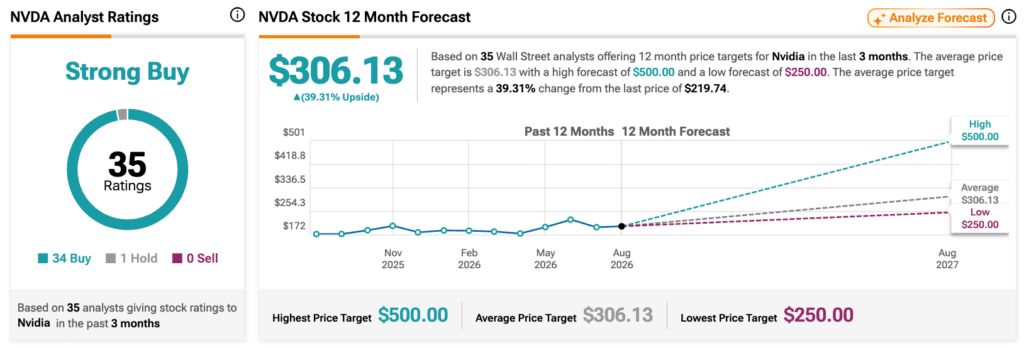
Meanwhile, Wall Street analysts remain overwhelmingly bullish on the stock. According to TipRanks, Nvidia carries a ‘Strong Buy’ consensus based on 35 analyst ratings, including 34 ‘Buys’, one ‘Hold’, and no ‘Sell’ recommendations.
The average Nvidia price target stands at $306.13, implying 39.3% upside from current levels. Analysts’ forecasts range from a low of $250 to a high of $500.
Ahead of earnings, investors are expected to focus on management commentary regarding the Vera Rubin rollout, future hyperscaler spending commitments, margin trends, and the overall outlook for AI infrastructure demand.
Consensus forecasts for the upcoming quarter point to substantial year-over-year growth in both revenue and earnings, extending Nvidia’s strong performance in recent years.
Although Nvidia stock has experienced some volatility ahead of earnings, including a decline of more than 2% in the latest trading session, shares remain higher on a year-to-date basis.
The continued expansion of artificial intelligence workloads and sustained spending by cloud providers remain key drivers for the company.
As a result, many analysts believe Nvidia is well positioned to maintain its leadership in the AI semiconductor market despite ongoing product transitions and cost pressures.
Featured image via Shutterstock