
SanDisk (NASDAQ: SNDK) laid out its Investor Day targets on August 13, presenting a new financial model that sent the stock price soaring 14% and reinforced analyst confidence in long-term Sandisk stock price targets.
Evercore ISI analyst Amit Daryanani reiterated an ‘Outperform’ rating and $2,800 price target on the company, highlighting the potential for higher margins, improved free cash flow, and capital returns.
Indeed, SanDisk management outlined long-term financial targets through fiscal 2030, including mid-to-high-teens revenue growth, approximately 80% gross margins, roughly 75% operating margins, and about 50% adjusted free cash flow margins.
On his part, Daryanani believes SanDisk could sustain gross margins around 80% through the peak of the current semiconductor cycle, supported by NAND prices that have more than tripled over the past year, before settling at roughly 65%-70% post-peak.
The analyst also estimates SanDisk could generate as much as $35 billion in annual free cash flow during the early stages of the cycle, potentially supporting substantial buybacks beginning in 2027.
A potentially crucial catalyst comes in the shape of the company’s High-Bandwidth Flash (HBF) technology. SanDisk expects to begin shipping HBF samples in 2027 and says the technology is designed to deliver HBM-class read bandwidth with approximately 16 times the capacity.
Mizuho doubles on its Sandisk stock price target on HBF optimism
Mizuho Securities analyst Vijay Rakesh likewise reiterated an ‘Outperform’ rating and a $1,900 Sandisk stock price prediction 2026, focusing primarily on the aforementioned HBF technology, which the company believes can deliver HBM-like bandwidth at a fraction of the cost.
Notably, Rakesh estimates a 16-stack HBF configuration could provide HBM-like bandwidth at roughly one-eighth the cost while offering 8-16x the capacity at a similar cost to HBM. SanDisk expects its first HBF dies and controllers in the C26E/C27E timeframe, with potential revenue beginning in C28E.
However, SanDisk emphasized that HBF is not necessarily intended to replace HBM. Instead, the technology could enable disaggregated memory architectures for AI inference, potentially improving system economics and efficiency, and the company is already working with major technology players, including Google (NASDAQ: GOOGL).
Moreover, Mizuho expects NAND pricing to remain supportive and sees demand as stronger than current consensus assumptions. While consensus estimates call for 2027 ASPs to decline 15-20% year over year, Mizuho expects ASPs to remain roughly flat to higher, citing strong demand from agentic and edge AI, HBF, and undersupplied consumer markets.
Wall Street Sandisk stock consensus
Citi analyst Asiya Merchant also reiterated a ‘Buy’ rating on SanDisk, as did Barclays’ Thomas O’Malley, with $2,100 and 2,300 price targets, respectively.
With these numbers, the average SNDK share price target for the next 12 months sits at $2,181, which suggests a nearly 43% upside potential from the current levels, based on the latest TipRanks data.
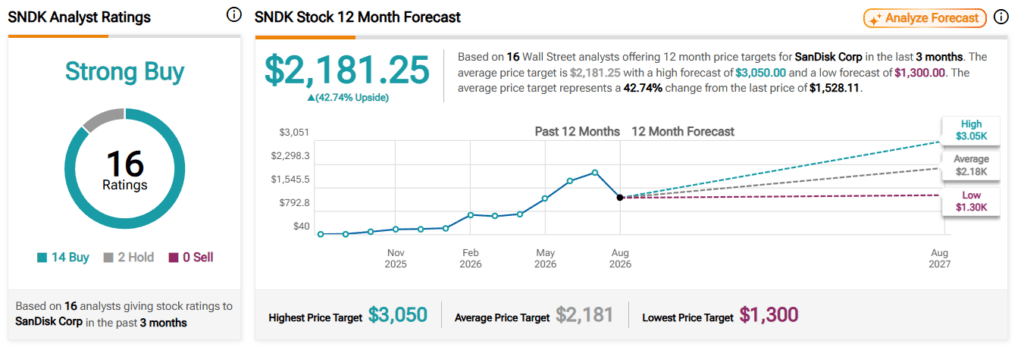
As per the same data, Sandisk is currently rated a ‘Strong Buy,’ with 14 buying and two holding recommendations over the past three months.
Featured image via Shutterstock