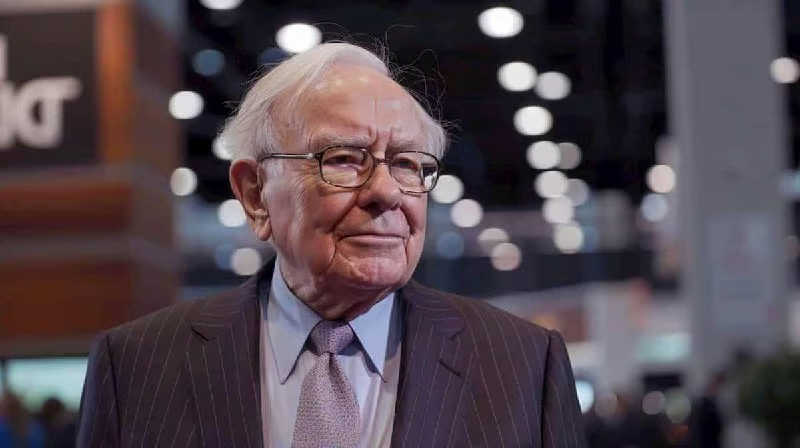

Starting with his 1965 acquisition – completed at approximately $19 per share – Warren Buffett transformed the struggling textile business Berkshire Hathaway (NYSE: BRK:A, BRK.B) into an investing powerhouse, securing his wealth and his legacy.
Nowhere is the success of the ‘Oracle of Omaha’ seen more clearly than in the fact that the company’s class A shares are, at press time on May 4, trading at a staggering $717,886. Thus, an investor who decided to purchase $100 worth of the equity when Buffett was completing his acquisition would, in 2026, have nearly $3.8 million.
Furthermore, Warren Buffett’s importance to his company might also be highlighted by the impact of his absence as CEO – and, indeed, by his retirement announcement in May 2025.
Here’s how Berkshire stock performed since Buffett announced his retirement
Despite periods of significant turmoil and uncertainty, the wider stock market – as exemplified by the benchmark S&P 500 – rallied 27.92% from 5,650 to 7,228 in the last 12 months.
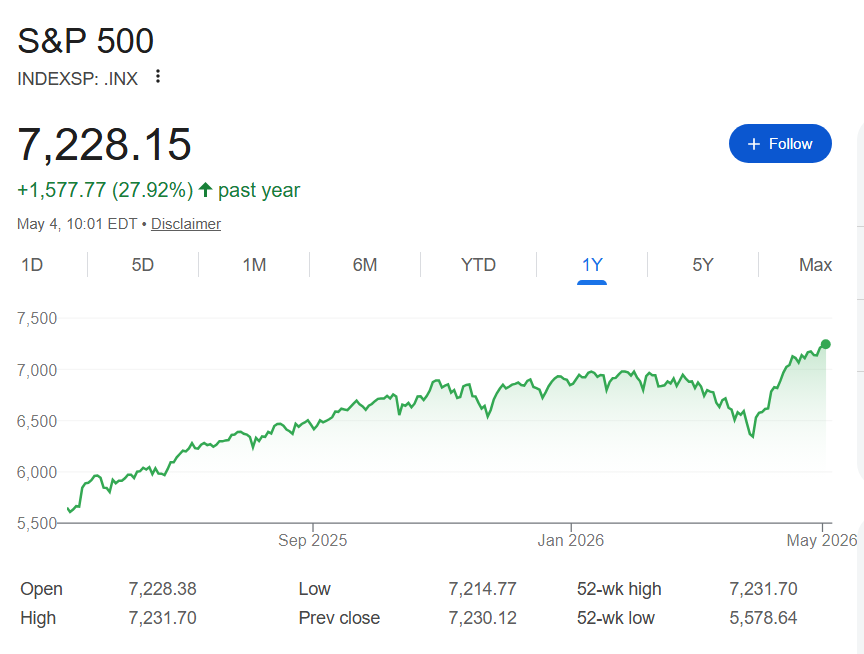
Within the same timeframe, both BRK.A and the more accessible and popular BRK.B shares declined. The former 6.76% from $769,963 to $717,886, and the latter 6.59% from $512.15 to $478.41.

Overall, Berkshire Hathaway underperformed by roughly 37% compared to the market’s leading index: $1,000 worth of the stock purchased in May 2025 would, at press time, be worth $934, while a similar investment in the benchmark index would have grown to $1,279.

For comparison, since 2000, the S&P500 is up 410%, and Berkshire Hathaway stock rallied well over 1,000%, with the last 12 months signaling that the ‘Warren Buffett premium’ is fading quickly.
Did the Warren Buffett premium begin fading already under The Oracle of Omaha?
Elsewhere, it is possible that, along with The Oracle of Omaha’s January 1, 2026, retirement, his strategy in the final years at the helm could have played a role in the underperformance.
Buffett has notably refrained from making major investments in recent years, occasionally claiming that he is not seeing truly enticing long-term bets. The notion that the overall approach contributed to the recent underperformance can be seen by comparing BRK.B shares to the S&P 500 in the last five years.
Indeed, while Berkshire stock is hardly in the red, it rallied 64.57% within the timeframe, while the benchmark index is up 70.77%.
Featured image via Shutterstock