

Bitcoin’s (BTC) apparent demand has fallen to the lowest level in more than a year, showing that retail sentiment is cooling drastically.
More precisely, the metric is approaching -160,000 BTC, which is a reading not seen since late April 2025, citing CryptoQuant data as of May 25.
For comparison, the figure was approaching a yearly record high of 229,000 on May 27, 2025, meaning the current levels represent a roughly 30% decrease in more or less twelve months.
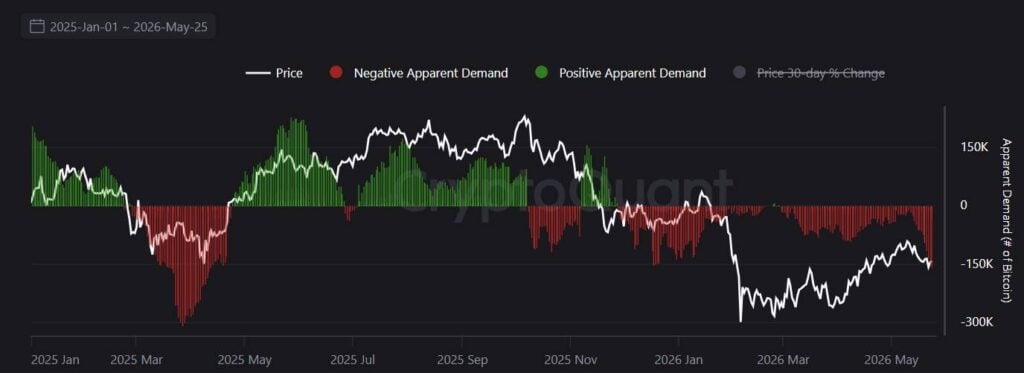
Notably, the apparent demand has been in the negative for nearly the entirety of 2026 so far, with only a few brief positive periods in late February.
What does negative Bitcoin apparent demand mean?
Apparent demand is an on-chain metric used to measure whether Bitcoin buying pressure is strong enough to absorb newly available supply.
In short, when the indicator falls deep into negative territory, it tends to signal that incoming demand is failing to keep pace with the amount of BTC entering circulation.
Understandably, the drop in apparent demand reflects a broader shift in market behavior. After all, spot purchases represent direct capital inflow into Bitcoin and usually translate into more sustainable growth compared to, for instance, leveraged futures.
Overall, then, the deepening negative reading shows that long-term holders are making more moves, which is adding supply-side pressure that current spot demand is struggling to absorb.

What’s next for Bitcoin?
At press time, BTC was trading at $77,260, up 0.69% over the previous 24 hours, thanks to news of a potential U.S.–Iran agreement, which sparked some relief across risk assets.
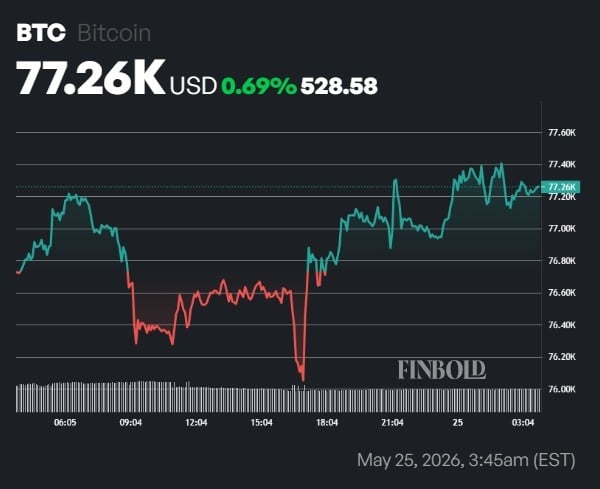
The latest uptick was also amplified by a large short squeeze in derivatives markets, with hundreds of millions in liquidations the day prior, alongside a rotation of capital out of altcoins.
Given the setup discussed above, traders are most likely to keep a close eye on whether spot demand can stabilize further.
However, spot Bitcoin ETF outflows remain a key headwind, continuing to offset bullish momentum from short-term catalysts as BlackRock alone offloads more than $1 billion worth of ‘digital gold.’
Looking ahead, the upcoming macro data, especially U.S. inflation (Core PCE) scheduled for May 28, remains the next key benchmark, as it could determine whether the rally extends or reverses.
Featured image via Shutterstock