
Bitcoin (BTC) funding rates – a fee set to balance perpetual contract price to the underlying asset price – have remained predominantly negative, despite its recent rebound above $81,000.
The 30-day Moving Average (MA) for Bitcoin funding rate has continued to drop, reaching a historic low region on May 6, according to analytics firm CryptoQuant. The last time such a decline in BTC funding rates was recorded was during the FTX-induced crypto capitulation in November 2022.
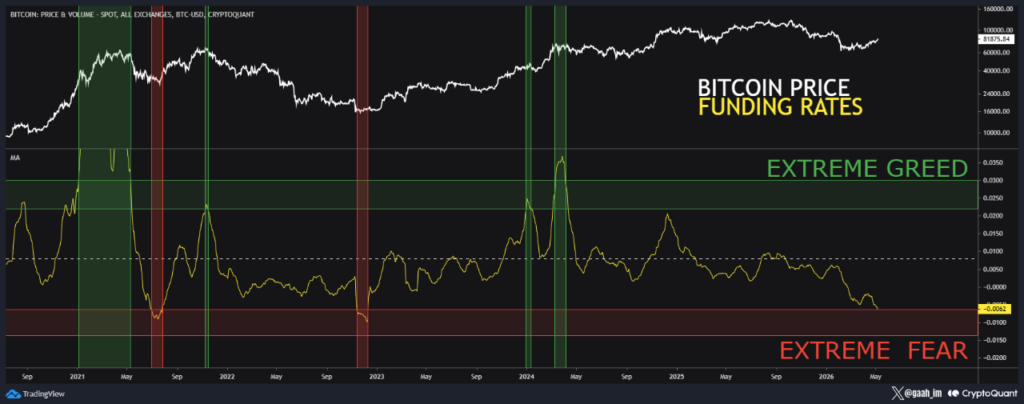
As Bitcoin price surged to a three-month peak earlier this week, derivatives traders have been willing to pay more to maintain their short exposure. Moreover, BTC’s Open Interest (OI) – a measure of all open derivatives positions at a given time- surged above $64 billion, its highest level in 109 days, on May 5, as Finbold reported.
“Historically, such conditions often emerge during phases of skepticism, where rallies are met with fading rather than aggressive long positioning. The persistence of negative funding alongside rising price suggests the market may be climbing a wall of worry,” Glassnode noted.
What’s next for Bitcoin price amid extreme negative funding rate?
The extreme negative Bitcoin funding rate has partially fueled the recent rebound through a sustained short squeeze – a bull rally that occurs when rising prices force short sellers to cut losses and bolster buyers. Over the past 24 hours, of the $188 million liquidated in the BTC derivatives market across all crypto exchanges, nearly $160 million involved short traders, as per updates from CoinGlass.

The recent bullish sentiment for BTC has also been exacerbated by renewed institutional spot demand. For instance, the United States spot BTC exchange-traded funds (ETFs) have registered four consecutive days of inflows totaling over $1.6 billion, as Finbold reported.
As such, if BTC price continues to rise through renewed spot demand, more pressure on existing derivative sellers could catalyze further upside. However, if spot demand fails to counter extreme selling pressure in derivatives, the flagship coin could reverse in the near term, potentially forming a new lower low in its macro bear market.