
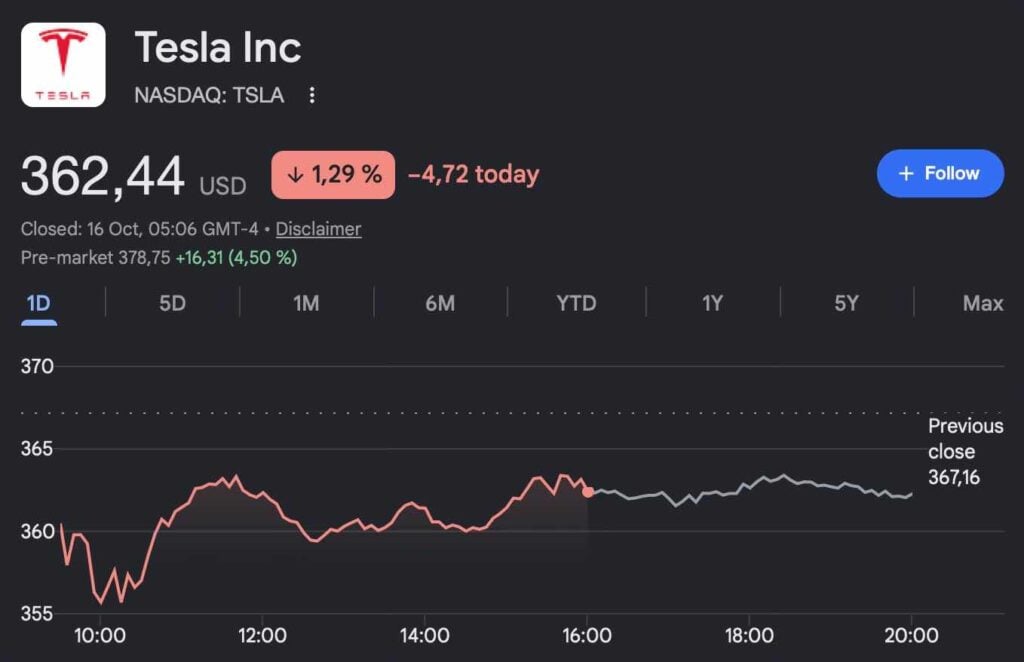
Tesla (NASDAQ: TSLA) stock surged 4.5% in premarket trading on Friday, October 16, after CEO Elon Musk unveiled the new “Tesla flying car” at a SpaceX (NASDAQ: SPCX) facility in Waco, Texas.
The even naturally reignited investor enthusiasm for the carmaker’s products, while growing speculation about a potential merger with SpaceX added to the momentum and put some recent upward price revisions in the spotlight.
The new Roadster model comes with a number of ambitious features, including compressed-air thrusters developed in collaboration with SpaceX, which allowed the vehicle to briefly lift off the ground and accelerate from zero to 60 mph in less than one second.
Beyond the main product reveal, the market was naturally quick to speculate regarding the possibility of a deeper corporate relationship between Tesla and SpaceX. The chatter became louder once everyone remembered that Barclays analyst Dan Levy argued earlier this week that a formal merger announcement could arrive before Tesla’s annual shareholder meeting expected to take place on December 6, 2026.
According to Levy, the potential combination is now approaching a consensus scenario among investors, with the primary strategic value centered on integrating artificial intelligence (AI) technologies across the two businesses.
Indeed, a closer relationship could strengthen Tesla’s position in AI, autonomous driving, robotics, and other emerging technology markets, although a merger remains speculative and has not been officially announced.
JPMorgan sets Tesla stock price target following flying car reveal
Adding another bullish catalyst, JPMorgan reiterated a “Neutral” rating and $415 TSLA share price target in the early hours on October 16.
A similar call came on Monday, October 12, when Jefferies raised its Tesla price target from $350 to $400 on Monday, October 12, while also maintaining a “Neutral” rating on the company.
The notes cited accelerating growth in Tesla’s non-automotive businesses, which suggests that Tesla’s longer-term valuation may increasingly depend on opportunities beyond vehicle sales and puts further emphasis on the SpaceX merger strategy.
Institutional activity provided another potential source of support. Namely, asset manager Assenagon reportedly acquired more than 870,000 Tesla shares on October 16, signaling renewed institutional interest ahead of the company’s third-quarter earnings report, scheduled for October 21.
What’s next for Tesla stock?
Today’s premarket gain marks a reversal of its recent four-session losing streak, bringing several potential catalysts back into focus. The Roadster presentation reinforced the company’s technological ambitions, investors fueled speculation about a possible Tesla-SpaceX combination, and Wall Street highlighted the potential contribution of non-automotive businesses.
Still, the bullish narrative faces important tests. After all, the Roadster’s production target remains years away, scheduled for 2028, and a Tesla-SpaceX merger has not been confirmed. For now, the next major near-term catalyst is Tesla’s third-quarter earnings report on October 21.
Investors will thus be watching for evidence that the company can translate its technology ambitions and expanding non-automotive opportunities into sustainable financial growth. Whether that optimism can be sustained will depend on the company’s financial results and its ability to turn ambitious technological demonstrations into commercially meaningful businesses.
Featured image via Shutterstock