

Cathie Wood, CEO of Ark Invest, believes that the era of heart-stopping Bitcoin (BTC) price crashes is officially over as institutional investors increasingly adopt it as a distinct asset class.
In an April 1 CNBC Squawk Box interview, Cathie stated that a potential 50% drawdown for Bitcoin in 2026 would be considered a real victory in its community. Furthermore, BTC price has historically recorded drawdowns of 85% or more from its peaks during prior major bear markets.
“The 85-95% collapses associated with a very new technology — that’s done. This is a proven technology, it’s a proven monetary system, and it’s a new asset class,” she stated.
As Bitcoin price traded at about $67,000 on April 3, Cathie highlighted its maturation as a payment technology, noting it has been bolstered by ongoing institutionalization. Building on this point, she described Bitcoin as both a new asset class and a store-of-value network whose volatility profile is structurally declining as large financial institutions accumulate it for long-term gains.
Will Bitcoin price repeat historical collapses in 2026?
From a technical analysis standpoint, Bitcoin price could be following its four-year cycle marked by the halving, an event that reduces miners’ rewards, thereby cutting its annual inflation. Since hitting its all-time high (ATH) of about $126,198 in early October 2025, BTC price could be preparing to retest the ‘Heavy Undervalued’ band on the on-chain value map model, based on data from BitcoinStrategyPlatform.
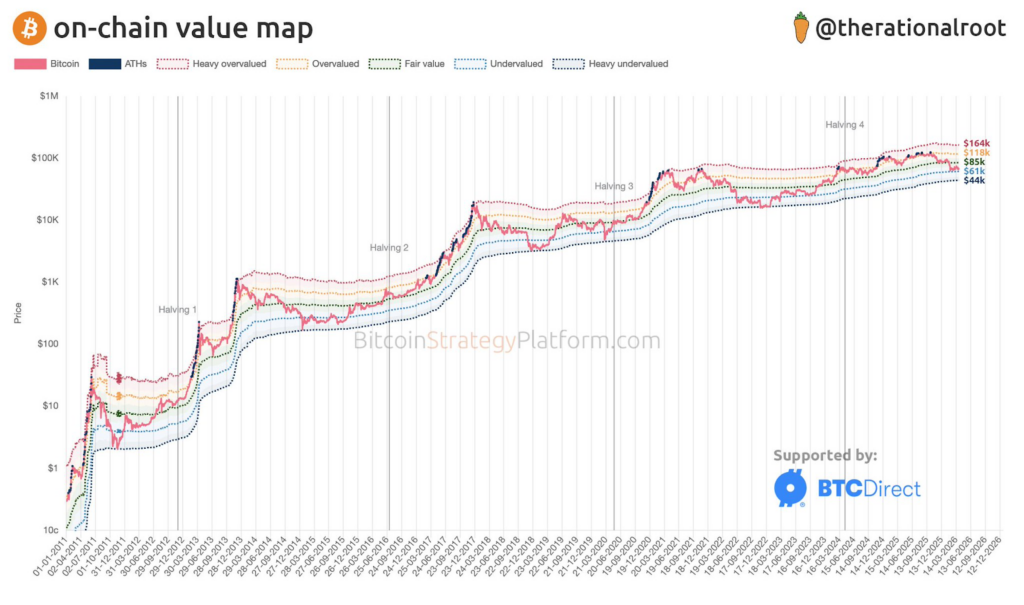
As such, if Bitcoin price follows historical trends, another capitulation could be brewing before a reversal towards a new ATH. However, if institutional investors, led by spot BTC exchange-traded funds (ETFs), renew demand for the flagship coin, a possible bear market bottom could have already formed.
After wrapping up its worst first quarter in 8 years with a 22.2% decline, Cathie and other financial experts are predicting a potential BTC price rebound in the second quarter, fueled by a supportive economic outlook in the United States.