
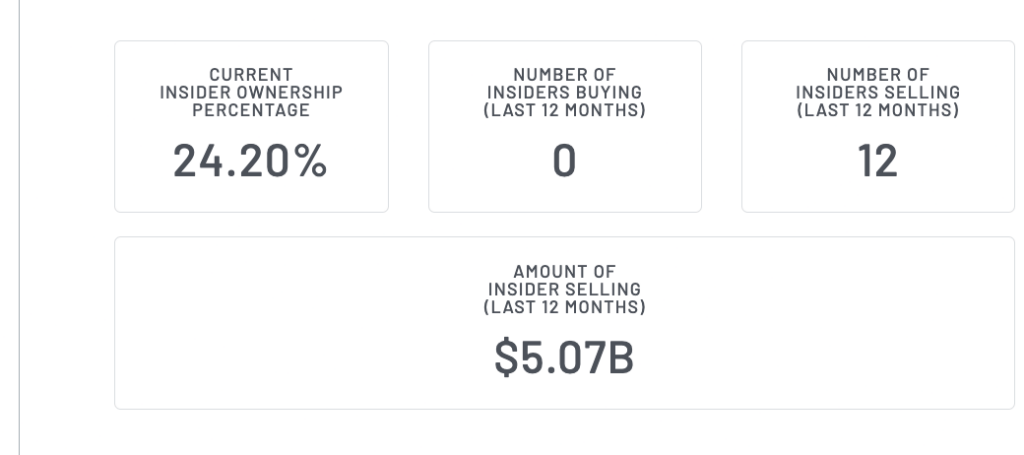
CoreWeave (NASDAQ: CRWV) stock has recorded massive insider selling activity, with 12 insiders selling shares worth over $5 billion in 12 months as the equity faces mounting pressure.
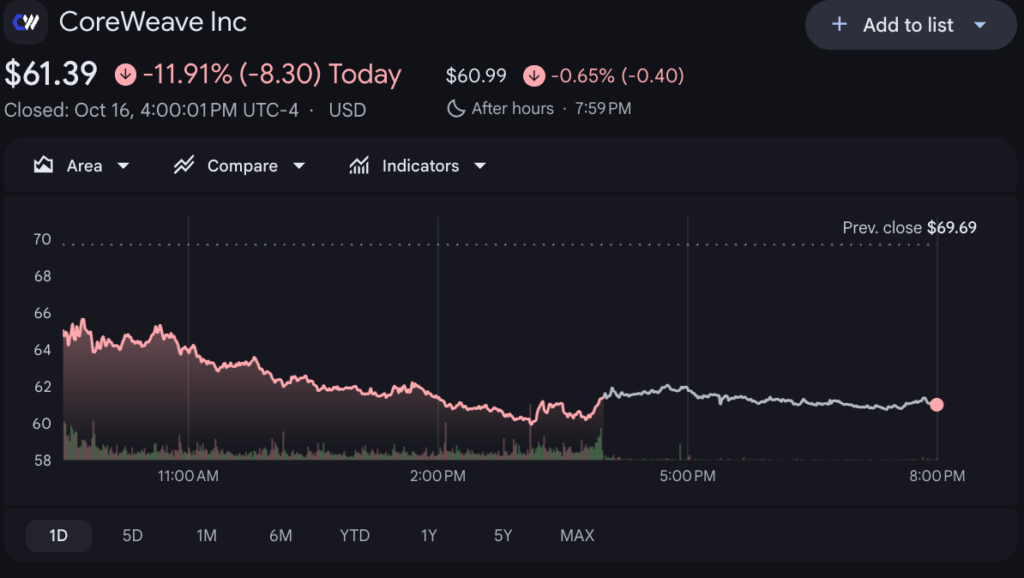
Indeed, CRWV was among the hardest-hit stocks during Friday’s sell-off, plunging almost 12% to close at $61.39 amid concerns about the company’s debt and the profitability of its AI infrastructure expansion.
The decline coincided with a broader technology sell-off driven by inflation concerns, rising oil prices, and interest-rate uncertainty. AI infrastructure stocks also faced pressure as investors questioned data-center spending returns and potential project delays.
CoreWeave was particularly vulnerable because its expansion relies on heavy borrowing, while falling bond prices and rising credit-risk premiums heightened financing concerns.
However, strong customer commitments and Nvidia (NASDAQ: NVDA) CEO Jensen Huang’s confidence offer some support.
Investors will be watching whether CoreWeave can deliver projects on schedule and convert its backlog into sustainable cash flow.
CoreWeave insider selling
Now, data from insider transaction records show that CoreWeave’s chief revenue officer, Jonathan Jones, and chief financial officer, Nitin Agrawal, sold shares on October 12 and 13, just days before the latest sell-off. The company’s reported insider ownership stood at 24.20%.
Jones sold 21,569 shares on October 13 for approximately $1.67 million, following a sale of 15,811 shares worth $1.27 million on October 12.
Agrawal also sold 22,579 shares on October 12 for approximately $1.81 million. A separate transaction recorded on October 6 involved three shares valued at roughly $266.
Earlier, on September 30, CoreWeave CEO Michael Intrator sold 78,552 shares for approximately $6.89 million. Other transactions that day included Brian Venturo’s sale of 65,616 shares worth $5.75 million and Brannin McBee’s sale of 56,531 shares valued at approximately $4.96 million.
The insider trading data showed 12 insiders selling shares over the preceding 12 months, compared with no reported insider buyers, and total sales of $5.07 billion.
However, insider selling does not necessarily signal that executives expect a stock to decline. Sales can reflect scheduled trading plans, tax obligations or portfolio diversification.
Nevertheless, the timing and scale of the transactions warrant attention as CoreWeave faces growing scrutiny over its financing requirements.
CoreWeave stock fundamentals
Investors are also reassessing the risks of CoreWeave’s debt-funded expansion, which requires substantial capital for GPUs, data centers and computing capacity.
Credit-market stress has intensified concerns, with yields on its October 2031 bonds briefly exceeding 16% and the cost of insuring its debt against default rising above 1,000 basis points.
Higher borrowing costs could pressure profitability and make expansion more expensive, while hardware depreciation and deployment delays could hinder cash flow.
Adding to the concerns, Gartner warned that at least 80% of neocloud providers could cease to exist as independent businesses by 2030, highlighting the challenges facing capital-intensive AI infrastructure firms. However, the forecast does not mean CoreWeave itself is expected to fail.
Featured image via Shutterstock