
On January 1, the White House official X account welcomed Americans into the “Golden Age.” Simultaneously, many opponents of President Donald Trump’s second administration would probably rather call it the second Gilded Age.
Amidst such grandiose proclamations and political bickering, questions about whether 2026 could bring a financial crisis and regular people might feel remain – especially since the less political Wall Street forecasts are often suited only for the 1% or, at best, the 10%.
Indeed, December studies show that many everyday Americans feel neither the Golden nor the Gilded age in full, but that the bag is, in fact, thoroughly mixed.
A quarter of Americans foresee financial trouble in 2026
Early in December 2025, a McKinsey study painted the picture of ‘pragmatic’ consumers, as a substantial proportion of respondents indicated they were under substantial financial pressure.
Indeed, the breakdown published on December 5 showed, almost across the board, that more Americans were feeling gloomy about the economic prospects than either at the start of 2025 or in the year’s third quarter (Q3).
For example, earlier survey waves showed that 18% of respondents felt pessimistic about U.S. economic conditions, a figure that rose to 25% by November 2025. Simultaneously, the proportion of optimists decreased from 46% to 40%.

The study also showed that the two biggest causes for anxiety for everyday Americans are rising prices and the ability to make ends meet. Between Q3 and Q4, 2025, the prevalence of the former rose from 44% to 45%, and of the latter from 22% to 24%.
Some of the other statistics include the proportion of people who took extraordinary measures to make ends meet. These include dipping into savings or saving less money, going into more debt, or paying less than the minimum amount due, and even applying for government assistance.
While the percentage for each of the separate categories hasn’t risen above 30%, it is noteworthy that only 23% of the respondents indicated they have taken none of the extraordinary measures by Q4, 2025.

Elsewhere, Bankrate conducted a similar study, publishing its results by mid-December.
American consumer sentiment weakens ahead of 2026
If McKinsey tracked the current conditions and anxieties of regular people, Bankrate was focused on their expectations for the new year and found that many anticipate at least some form of a financial crisis in 2026.
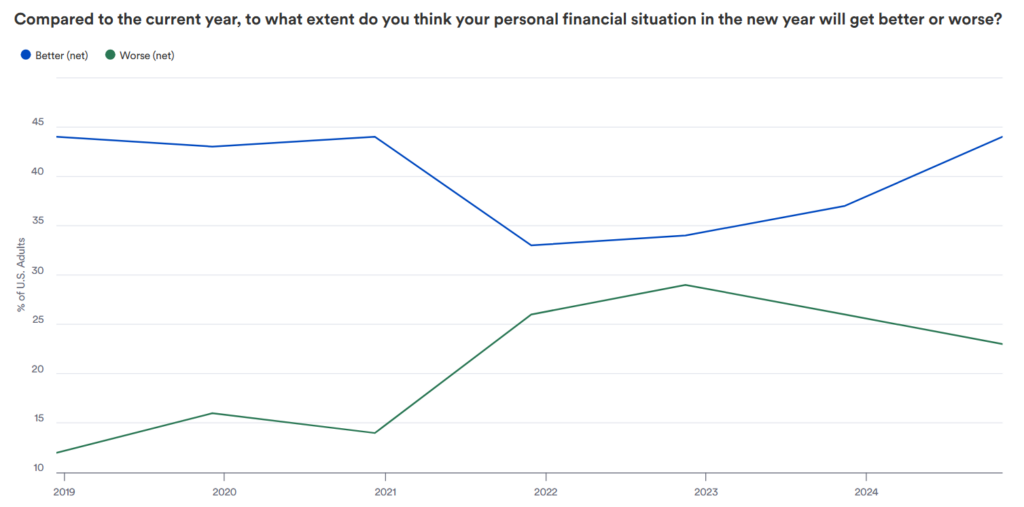
Specifically, as many as 32% of respondents believe Americans’ financial health will worsen in 2026 – a notable increase from the 23% who expected deterioration in 2025.
Perhaps surprisingly, Baby Boomers are the most pessimistic about the new year, since as many as 76% believe their situation will either stay the same or grow worse. On the flip side, Gen Z is the most optimistic, with 46% expecting an improvement.
Lastly, possibly the most alarming fact emerging from the study is that Americans are the most pessimistic they have been in any year since 2019. The worst year in the period before 2025 was 2022, when 29% believed they were on a downward path.
Still and as ever, despite the grim sentiment, actual holiday consumption shows that it is too early to toll the bells for the U.S. economy. Indeed, through the ‘pragmatism,’ retail spending was unexpectedly strong in December, showing the economic outlook for 2026 might not be as bad as many fear.
Featured image via Shutterstock