
Recession talk has seriously picked up in November, with the midterm elections, raising concerns about the American economy, and artificial intelligence (AI) expenditure leading some leading economists to predict when the next US recession could arrive.
According to Ned Davis Research (NDR), for example, the S&P 500’s valuation was experiencing an unusually sharp decline leading up to November, a development that historically tended to coincide with either an ongoing recession.
More specifically, the firm’s chief US strategist, Ed Clissold, noted that the index’s forward price-to-earnings (P/E) ratio fell by 4.4 points in the 12 months through October. That is, the measure now stands at approximately 18.8x, down from 23.2x last year.
Advertisement
A rare recession signal flashes
Such a decline is uncommon, taking place only six times since 1983. In five of those instances, the US economy was either experiencing a recession or the stock market was going through a so-called echo bear market, i.e., a sharp downturn that happens a few years after the market has recovered from a major correction.
Naturally, the historical pattern raises questions about whether the latest decline could be an early indication of another US economic downturn. Clissold argued that the current situation is particularly unusual because investors have already started pricing in the possibility that the AI boom could lose momentum.
In a similar context, Adam Slater, an economist at Oxford Economics, estimated that AI-related investment accounted for roughly a third of the US’s economic growth in 2025 and 2026, according to a Reuters report. However, he warned that underlying growth across advanced economies remains weak, making them particularly vulnerable to a slowdown in the AI boom.
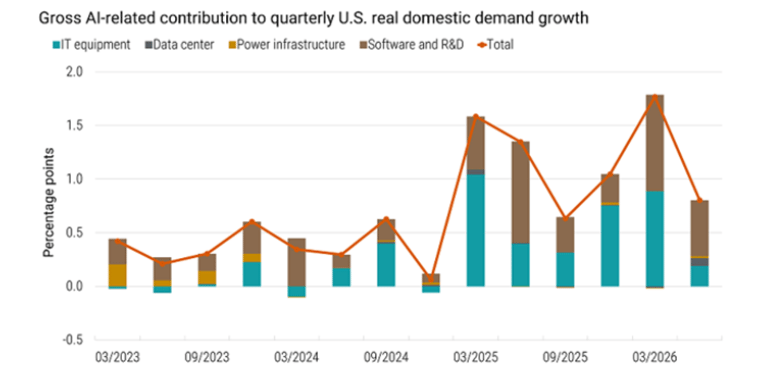
“The weakness of underlying growth across the advanced economies means that in the event of a serious slowdown in the AI boom – a genuine danger as we have recently argued – the risk of advanced economies going into recession would be substantial,” Slater said.
Peter Schiff warns of a much deeper economic crisis
Meanwhile, economist and longtime gold advocate Peter Schiff has offered an even more pessimistic assessment. Namely, Schiff argued that the American economy is heading toward a recession that could trigger a collapse not just in stocks but also corporate closures and millions of layoffs.
“If traders understood what’s happening, gold would have soared today. The U.S. economy is headed for a recession. Stock and real estate prices will crash, wiping out the net worth of millions. Companies will close, laying off millions. The reverse wealth effect and job losses will cause consumer spending and GDP to collapse.
Advertisement
In this scenario, Schiff argued, the Federal Reserve would be forced to abandon its planned December rate hike and potentially turn toward aggressive monetary stimulus. Schiff suggested that the government could introduce a massive fiscal stimulus package, financed by an extensive quantitative easing program.
He further warned that such a response could push annual budget deficits toward $5 trillion, weaken the US dollar, and accelerate inflation, eventually creating a sovereign debt and currency crisis. Expectedly, Schiff believes gold would emerge as the primary safe-haven asset in such an environment.
Featured image via Shutterstock