
While Elon Musk’s two mega-cap public companies have not been doing particularly well in general in the 2026 stock market, the previous week of trading proved especially damaging, and, combined, SpaceX (NASDAQ: SPCX) and Tesla (NASDAQ: TSLA) wiped over $360 billion from their valuations.
Indeed, the rocket, social media, and artificial intelligence (AI) company started out strong following its initial public offering (IPO) in early June but then entered a downtrend that took it as low as $110.85 before recovering slightly to $118.24.
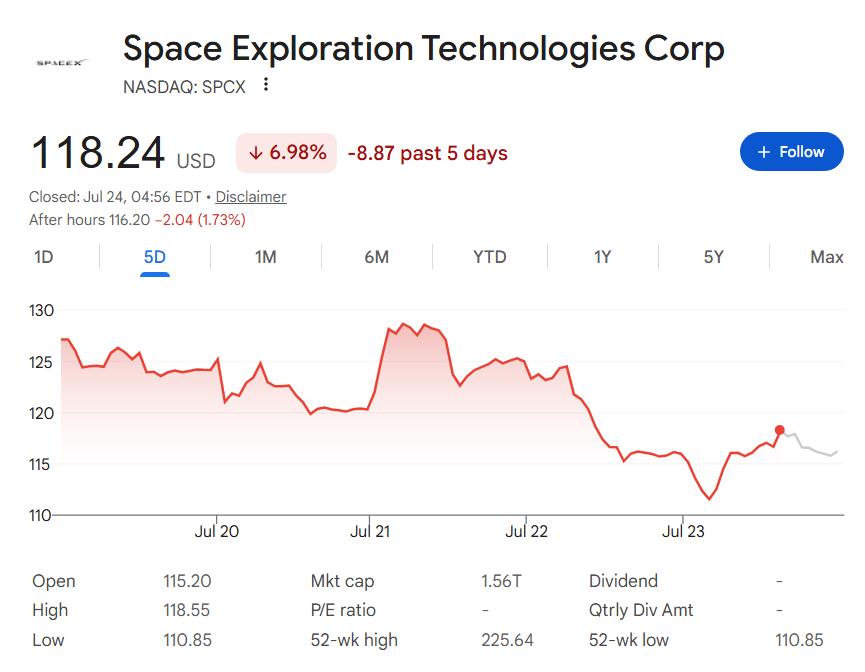
Within the last five sessions, SPCX shares fell 6.98%, and the company’s market capitalization crashed $116.83 billion from $1.67 trillion to $1.56 trillion.
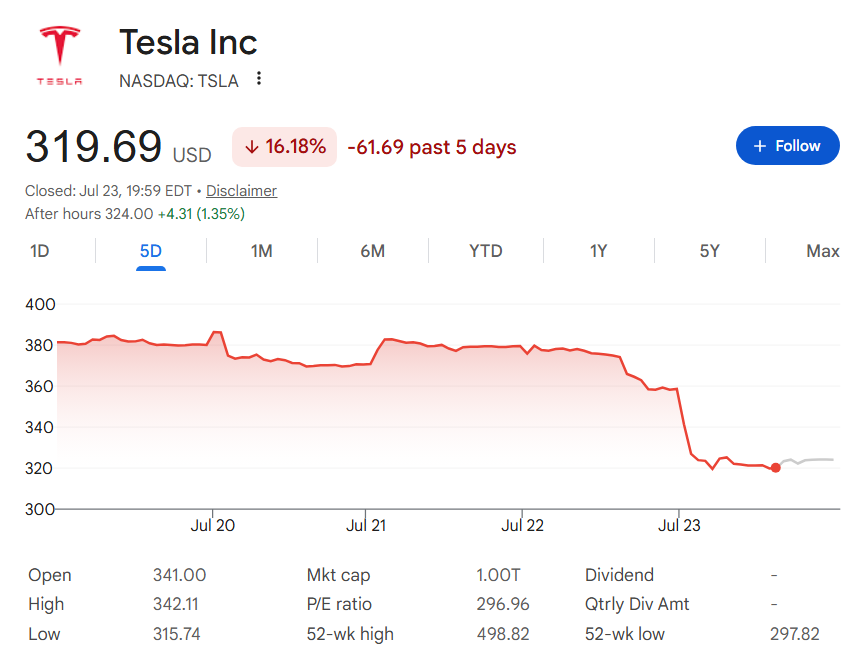
The situation has arguably been even worse for the electric vehicle (EV) maker Tesla as its equity plummeted 16.18% within the same timeframe, meaning TSLA’s valuation plunged $243.61 billion from $1.5 trillion to $1.26 trillion.
Why Tesla stock wiped $240 billion in a week
To begin with, Elon Musk’s car company has been struggling since the year started, between dwindling vehicle deliveries and a shifting timeline for the autonomous ‘Cybercab’ and the humanoid ‘Optimus’ robot.
By Wednesday, July 22, the situation took another adverse turn as the firm’s quarterly earnings report disappointed investors, initiating a 14.52% daily crash to Tesla stock’s latest closing price of $319.69.
Specifically, though revenue came in higher than expected – at $28.24 billion instead of the expected $25.71 billion – and the firm’s core business grew relative to the same period in the previous year, compressed margins and an earnings per share (EPS) miss ensured the selloff.
EPS in particular demonstrates why TSLA shares plummeted, given that analysts were expecting $0.51 and the actual number came in at $0.33.
Why SpaceX stock wiped $116 billion in a week
Elsewhere, SpaceX appears to be suffering from an overly ambitious initial valuation. Despite achieving less than $5 billion in revenue in the first quarter (Q1) of 2026 and suffering nearly a $2 billion loss, the company executed its IPO at a $1.77 trillion valuation and a $135 share price.
Broadcom (NASDAQ: AVGO) – a technology company with a comparable market capitalization – recorded roughly four times greater sales than Elon Musk’s space and AI firm within the same timeframe.
Saudi Aramco, an oil giant of a similar size, was profitable, unlike SpaceX, along with achieving significantly higher revenue.
Indeed, as Finbold reported earlier in the week, SPCX’s recent performance appears to back a case presented by Morningstar shortly before the IPO that the equity is headed under $100 and toward an estimated fair value close to $70.
Notably, however, SpaceX stock recorded a green day during the latest session and, despite the deep retracement, retains the confidence of Wall Street.
Featured image via Shutterstock