
Alphabet (NASDAQ: GOOGL) is closing in on semiconductor giant Nvidia (NASDAQ: NVDA) in the race to become the world’s most valuable public company, with the valuation gap narrowing to under $200 billion.
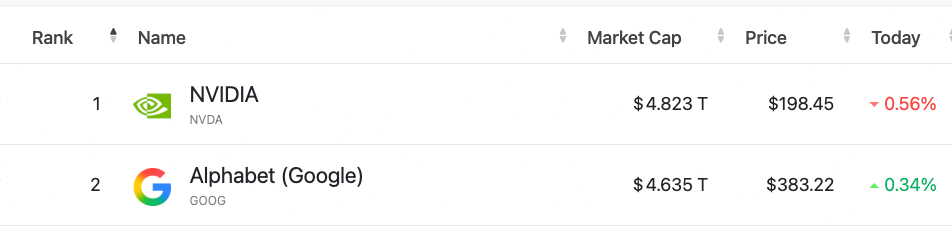
As of press time, Alphabet’s market capitalization stood at $4.635 trillion, while Nvidia was valued at $4.823 trillion, leaving a difference of about $188 billion between the two companies.
Alphabet’s rally has coincided with strong bullish momentum in the company’s stock, which ended the last session at $383, up more than 20% year-to-date.
The latest surge in Alphabet’s valuation followed stronger-than-expected first-quarter 2026 earnings.
The technology company reported revenue of $109.9 billion, up 22% year-over-year, while Google Cloud revenue jumped 63% to more than $20 billion. The results reinforced confidence in Alphabet’s AI strategy and sent shares up nearly 10% in a single trading session.
Alphabet’s momentum has been driven by the integration of AI across Google Search, Gemini models, and its broader ecosystem, while Waymo’s rapid expansion is adding another growth engine beyond advertising and cloud computing.
Nvidia’s competition
Nvidia, meanwhile, has retained its lead through its dominance in AI GPUs, benefiting from strong demand for chips from major technology companies and cloud providers amid the global AI infrastructure boom.
However, Alphabet’s strategy differs from Nvidia’s hardware-focused approach. In addition to being one of the biggest buyers of AI computing power, Alphabet also develops its own custom TPUs, giving it exposure across the entire AI stack, from infrastructure and models to applications and distribution.
Investors increasingly view this diversified approach as a long-term advantage as AI adoption expands beyond model training into enterprise deployment and inference.
Optimism has also been fueled by Alphabet’s cloud backlog, estimated at $460 billion, alongside improving cloud margins and continued strength in digital advertising, prompting analysts to raise price targets after the company’s latest earnings report.