
Financial exchanges spent centuries moving toward lower trading costs, and the shift accelerated with the digitization of the market and the introduction and maturation of cryptocurrencies. As a result, competition among crypto exchanges is now largely focused on making fee structures more appealing to users, with plenty of trading venues offering zero fees or going even further with negative maker fees.
Why are crypto trading fees going to zero?
Zero-fee trading has become mainstream, largely due to advancements in technology. As the cost of processing, clearing, and transmitting transactions declined, brokers increasingly looked beyond commission to increase their revenue.
As a result, payments for order flow, market-making activities, and interest earned on uninvested cash became important sources of income, especially for centralized exchanges (CEX). Robinhood, for example, held about $32.1 billion in cash-sweep balances in fiscal 2025, while its total platform assets reached roughly $324 billion. Still, a maker/taker fee model remains the core pricing principle for CEXs.
While large traditional brokers can generate substantial revenue in customer deposits, the prospects for other venues, such as crypto-native perpetual exchanges, remain far smaller. Hyperliquid and Lighter, for instance, two decentralized exchanges (DEXs), have both explored earning a share of interest generated from USDC deposited on their platforms, but the scale of traditional brokerages remains unmatched.
From zero-fee trading to negative maker fees
Similarly, MEXC has made zero-fee trading a central part of that strategy, offering zero maker and taker fees across spot markets and on selected futures products. Even though specific terms vary by product and promotional campaign, the exchange claims its zero-fee initiatives saved 3.44 million users approximately 1.1 billion USDT in 2025.
Artificial intelligence (AI) has also emerged as a major theme, as the new technology could make advanced analytical capabilities available to individual traders at a fraction of the traditional cost. Unsurprisingly, then, a recent MEXC campaign seeking customer feedback saw AI as the most frequently discussed topic.
As trading became cheaper and increasingly automated, crypto exchanges had to find new ways to create value and remain competitive. The next evolution was therefore less about charging users for individual transactions and more about building full-stack financial platforms capable of monetizing liquidity, deposits, market data, and other services.
This is where negative maker fees made their breakthrough, allowing platforms to pay a cash rebate to liquidity providers rather than charging them a fee once their limit order has been filled.
How do maker fees compare across CEXs and DEXs today?
While comparably smaller, DEXs are increasingly matching or undercutting CEX maker fees, even though both venue types increasingly rely on features such as zero-fee tiers and rebates to attract liquidity.
On traditional CEXs, rebates and negative maker fees generally become available at higher volume tiers. Order-book DEXs, however, are pushing the model further.
Hyperliquid, for example, currently has a base maker fee of 0.015%, with rebates tied to market share. That is, makers can receive from 0.001% to 0.003% depending on their share of weighted maker volume (>0.5% to >3%).
Likewise, exchanges like Hyperliquid and dYdX only turn the fee negative once a trader clears an extreme bar. Specifically, dYdX requires $100 million in 30-day volume, and Hyperliquid requires more than 0.5% of the entire exchange’s maker flow, meaning whales and market makers get the most out of it, not retail traders.
Aster and Lighter don’t offer a true rebate at all – only a floor at zero. On the other hand, Grvt offers a rebate to users of every tier, even those holding the smallest accounts.
| Platform | Base market fee | Maker rebate | Rebate conditions | Base taker fee |
| Hyperliquid | 0.015% (Tier 0) | Separately from the volume-fee tiers | >0.5% share of total exchange maker volume for −0.001%; up to −0.003% at >3.0% share | 0.045% (Tier 0), down to 0% at >$500 mil./14-day |
| dYdX | 1.0 bps (Tiers 1-2) | Only the top two tiers | ≥$100 mil./30-day volume for −0.007%; ≥$200 mil./30-day for −0.011% | 5.0 bps down to 2.5 bps |
| Aster | 0% (all contract types) | No | Maker fee floors at zero; never negative | 0.04% (USDT-perp), 0.005% (USD1-perp), 0.009% (stock perp) |
| Lighter | 0% (standard accounts) | No | Standard accounts pay/earn nothing; Premium accounts pay a small positive maker fee (0.0028%-0.0040%) instead of a rebate | 0% (Standard and Premium) |
| Grvt | Rebate from tier 1 | At every tier | −0.0001% at the lowest tier, scaling to −0.003% at Level 9 | 0.045% up to 0.024% across tiers |
Why do exchanges pay traders to make markets?
At first glance, it may seem that paying traders to trade on the platform is counterintuitive. However, for exchanges, maker rebates and similar incentives are actually a way to buy liquidity.
In short, deep order books with tight spreads make it easier and cheaper for other traders to execute orders, which attracts more takers who are willing to pay trading fees. In this sense, the cost of subsidizing market makers can be seen as an investment in liquidity and therefore revenue.
The model is particularly relevant to DEXs, as they compete directly with centralized platforms on execution quality but do not necessarily have the same established liquidity networks. To remedy this, such platforms offer negative maker fees to encourage professional market makers to supply liquidity and avoid having to take on the cost and risk of operating their own market-making desk.
This situation also reflects a broader shift in exchange economics. Namely, as trading fees continue to fall, perpetual trading is becoming increasingly commoditized. It is not enough to simply charge lower fees, so exchanges must push for deeper liquidity, tighter spreads, faster execution, and a better user experience overall.
In such an environment, paying makers is ultimately not a sign that an exchange is giving up revenue. Instead, it is an importan way of building the market infrastructure needed to generate further revenue.
What does a negative maker fee model actually look like?
A negative maker fee model can thus be explained as a fee model that turns the traditional exchange fee structure upside down: instead of charging traders to execute their trade, the exchange pays them to place an order.
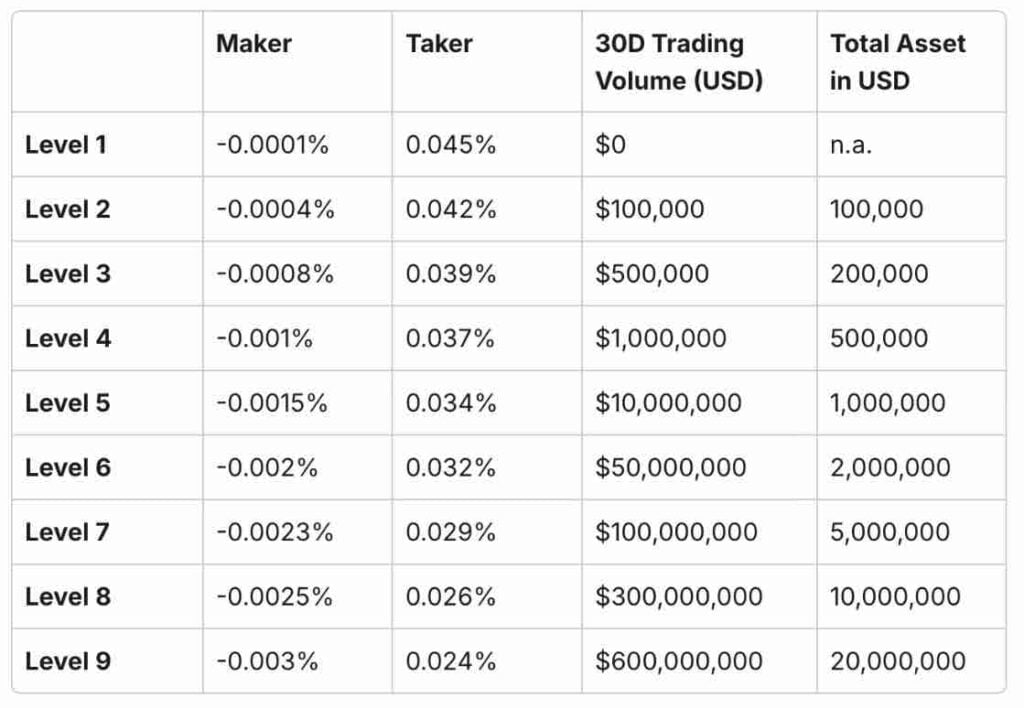
This can be illustrated with the pricing system on Grvt, which has a tiered maker-taker fee model based on 30-day trading volume. Unlike models where rebates are reserved for high-volume or professional market makers, the exchange applies negative maker fees across all markets from its entry tier. As a result, users receive a rebate on eligible maker trades from the outset, with the rebate increasing as trading activity grows.
Taker fees on Grvt start at 0.045% at the base tier and decline as a user’s 30-day trading volume increases. This creates a structure in which the exchange effectively subsidizes liquidity providers while charging users who immediately take liquidity from the order book.
Notably, traders providing liquidity can receive a small rebate, ranging from -0.0001% at Level 1 to -0.003% at Level 9. Taker fees decrease as traders move up the tiers, from 0.045% to 0.024%, making higher-volume trading progressively cheaper.
The tiers are determined by 30-day trading volume and total assets, with requirements increasing from $100,000 in volume/$100,000 in assets at Level 2 to $600 million in volume/$20 million in assets at Level 9.
Does a low fee actually mean a cheaper trade?
However, it must be noted that the rationale behind such a structure goes beyond simply offering the lowest headline trading fee. Rather, paying makers can encourage traders and professional liquidity providers to place more orders on the book. In turn, this helps build deeper liquidity and tighter spreads.
What’s more, a lower fee alone doesn’t necessarily determine the total trading cost. Indeed, the total cost of a trade can involve:
- Maker fees;
- Spreads;
- Slippage;
- Other costs, such as funding.
To take Grvt as an example one more time, if you’re a taker at Level 1 on the platform, you pay 0.045% in trading fees. On a $100,000 trade, that’s $45. At Level 9, the 0.024% fee would be $24 for the same trade, meaning you save $21. Nonetheless, if you’re on a platform where lower-fee tiers have worse liquidity or more slippage, you could end up paying more overall.
So, while an overall reduction in execution cost is the main appeal for the average trader, it is important to understand the fee structure holistically and stress that the longer-term implication behind low fees is that maker rebates, deeper liquidity, tighter spreads, and more productive capital can reinforce one another, potentially creating a better trading experience rather than merely a lower fee schedule.
This, of course, corresponds to the above-mentioned shift in exchange economics, where competition is moving beyond transaction fees toward liquidity, execution quality, and capital efficiency.
Summary
In conclusion, crypto trading fees have steadily declined as technology has reduced the cost of processing transactions and competition among trading venues has intensified. What began with lower commissions eventually turned to zero-fee trading and now negative maker fees, where platforms pay liquidity providers rebates for placing orders rather than charging them.
The shift has also led to platforms increasingly seeking to monetize liquidity, deposits, market data, and other financial services. In this context, negative maker fees are a sort of investment in market liquidity. In short, paying makers can attract more liquidity providers, which attracts takers and trading activity.
Importantly, though, low or negative trading fees do not necessarily imply the lowest overall trading cost, as traders need to consider bid-ask spreads, slippage, liquidity, funding costs, and execution quality. Therefore, negative maker fees are less about simply giving traders money and more about creating a stronger liquidity ecosystem that can benefit both trading venues and their users.
Disclaimer: The content on this site should not be considered investment advice. Investing is speculative. When investing, your capital is at risk.
FAQs
What are negative maker fees?
Negative maker fees are a form of financial incentives offered by some crypto exchanges. In short, the exchange pays the trader a small rebate instead of charging them a fee if their order adds liquidity to the order book.
Are negative maker fees the same as rebates?
Yes, negative maker fees and rebates offer similar benefits in that they both mean the exchange pays traders a small percentage of the trade value for providing liquidity instead of charging them a fee.
Do CEXs have negative maker fees?
Yes, a centralized crypto exchange can have negative maker fees.