

Pharos is a modular Layer 1 blockchain designed for real-world assets. This guide explores how the network works and its core technology.
What is Pharos?
Pharos is a modular Layer 1 blockchain designed to support real-world assets (RWAs) at scale. The project aims to combine the speed and usability of traditional financial systems with the transparency and security of decentralized infrastructure.
Unlike many blockchains that focus primarily on transaction execution, Pharos takes a broader approach. It targets the entire lifecycle of a block, including consensus, execution, storage, and data availability, and processes these components in parallel. This design is intended to remove bottlenecks that typically limit performance.
The network is designed for high throughput, aiming to sustain around 30,000 transactions per second on mainnet while maintaining low latency and responsiveness.
Following the launch of its AtlanticOcean testnet in October 2025, Pharos is preparing for its mainnet launch and token generation event (TGE), expected in Q2 2026.
Pharos was founded in 2024 by Alex Zhang and Wish Wu, both of whom previously worked on blockchain infrastructure at Ant Group. Zhang led AntChain as CTO and later served as CEO of ZAN, while Wu held the role of Chief Security Officer.
Core technology
Pharos is built around the idea that scaling blockchain systems requires optimizing more than just execution speed. In many existing networks, improving execution alone shifts bottlenecks to other areas like storage or consensus.
To address this, Pharos uses a modular architecture that separates execution, consensus, and other core functions such as storage and data availability, allowing each layer to scale more efficiently. The network processes these components concurrently rather than sequentially, which helps improve throughput and reduce latency.
Consensus layer
Pharos uses an asynchronous Byzantine Fault Tolerant (BFT) consensus model designed to avoid the limitations of leader-based systems. Instead of relying on a single validator to propose blocks, the network allows validators to operate more independently and adapt to real-time conditions.
Transactions are distributed across validators using a deterministic assignment process. Each validator handles a specific subset of transactions, reducing duplication and improving efficiency. Validators then create proposals in parallel, which are combined through a voting process into a finalized block.
This structure allows the network to scale more effectively as more validators join, while maintaining security and consistency even under unpredictable network conditions.
Execution layer
The execution layer is powered by the Deterministic Virtual Machine (DTVM), which supports both EVM and WASM environments within a single runtime. This allows developers to use different programming languages, such as Solidity or Rust, while maintaining compatibility across the system.
To ensure consistent execution across different hardware, Pharos introduces a deterministic intermediate representation (dMIR). This standardizes how code runs across all nodes, removing inconsistencies that could arise from differences in architecture or runtime environments.
The system also includes an optimized compilation process that works at the function level rather than the entire contract. This reduces delays and allows contracts to execute efficiently without long startup times.
Parallel processing and pipelining
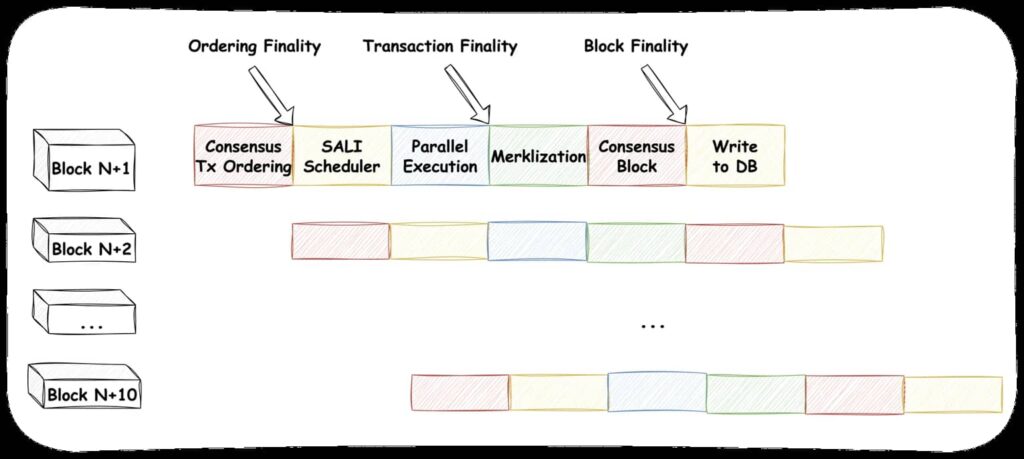
A key feature of Pharos is how it handles the block lifecycle. Instead of processing blocks step by step, the network runs multiple stages, including execution, data processing, and finalization, at the same time.
This pipelined approach improves efficiency and reduces latency by allowing execution, state updates, and finalization to occur concurrently, enabling faster feedback for applications before full block finality is reached.
This is particularly useful for time-sensitive use cases such as trading or gaming, where faster feedback improves user experience.
Storage Layer
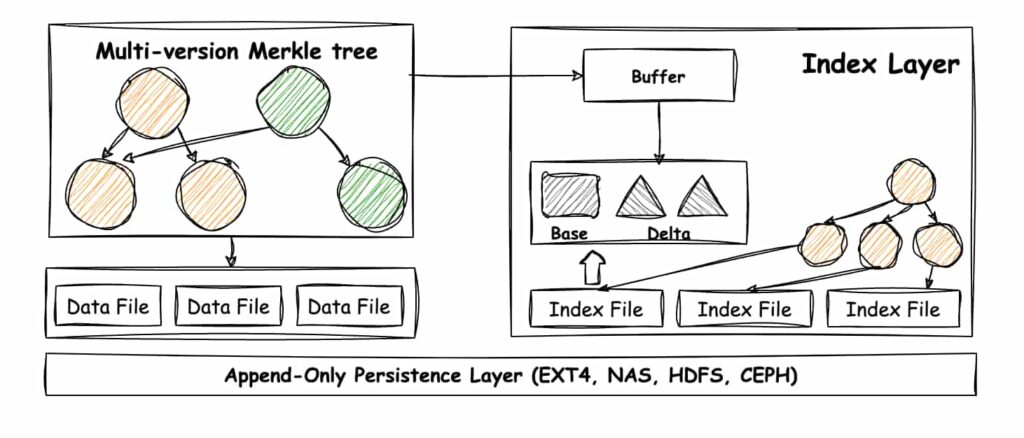
Storage is often a hidden limitation in blockchain performance. Pharos addresses this with a custom-built storage engine known as Pharos Store, which integrates verification structures directly into the storage layer.
In traditional systems, retrieving data can require multiple disk reads due to the way Merkle trees are layered on top of databases. Pharos Store embeds these structures directly into the storage engine, reducing the number of required reads from roughly eight to ten down to one to three.
The system also uses version-based indexing and efficient logging to reduce disk usage and improve storage efficiency. This design helps ensure that storage performance keeps pace with execution, rather than becoming a bottleneck as the network scales.
Networking Layer
Pharos’ networking layer is designed to support high-throughput data propagation across a distributed set of validators and nodes. The system is optimized to handle large volumes of transaction and consensus data efficiently, ensuring that communication does not become a bottleneck as the network scales.
Its architecture is built to operate under wide-area network conditions, maintaining performance and reliability even as validator participation and global distribution increase.
Special Processing Networks (SPNs)
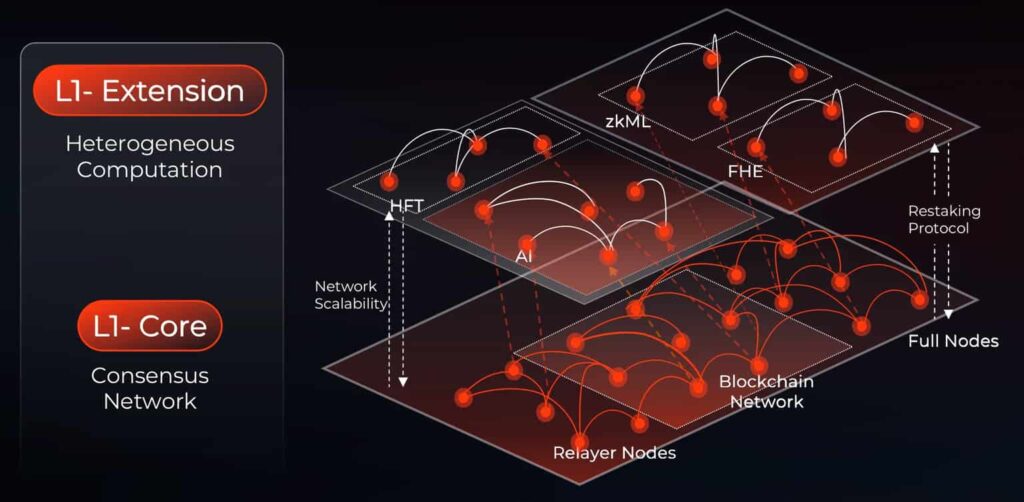
Pharos introduces Special Processing Networks (SPNs), which are customizable execution environments designed for specific use cases.
These networks allow developers to run specialized workloads — such as AI processing, cryptographic computation, or high-frequency trading — in dedicated execution environments connected to the main network.
SPNs inherit security from the main network through native restaking, allowing them to leverage shared validator security rather than bootstrapping entirely independent validator sets.
Ecosystem and RealFi
Pharos is building an ecosystem centered around RealFi, a model focused on bringing institutional-grade financial assets on-chain. This includes tokenized real-world assets such as U.S. Treasuries and structured credit products, enabled through partnerships with platforms like Centrifuge.
To support this ecosystem, Pharos has formed partnerships across key infrastructure layers. Chainlink provides data and cross-chain messaging, LayerZero supports interoperability, and Anchorage Digital offers institutional-grade custody and token services.
The network has also launched a $10 million RealFi builder incubator to support early-stage projects developing within its ecosystem.
In conclusion
Pharos is built on the idea that true scalability requires a full-stack approach. By addressing consensus, execution, storage, and data availability together, the network aims to overcome the structural limitations that have historically constrained blockchain performance.
Its architecture introduces several technical innovations, including a unified execution environment and parallelized block processing. At the same time, its focus on real-world assets places it within a growing area of interest for both developers and institutions.
With its mainnet launch approaching, the next phase for Pharos will be defined by how effectively these design choices translate into real-world performance, adoption, and ecosystem growth.
This guide is based on research and information presented in Messari’s report on Pharos.
Featured image via Shutterstock.