

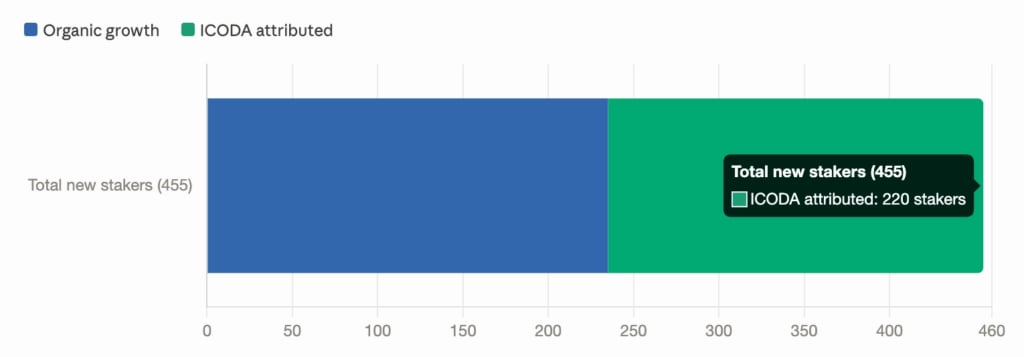
220 stakers. 48.3% of an ecosystem’s total growth. Verified on-chain, before and after. Not in a dashboard.
Most DeFi marketing reports show Twitter followers and Discord members. This one shows the blockchain explorer. That’s rarer than it should be. STRIF (Staked RIF) holders: 1,095 before the campaign, 1,550 after. Of the 455 new stakers RootstockCollective gained across Phases 1 and 2, 220 came from one attributable ICODA campaign. Every wallet was manually verified against on-chain history before being counted.
Here’s how that number was built.
Why Most DeFi Marketing Fails to Convert
DeFi campaigns typically optimize for the wrong thing. Follower counts, Discord members, and impressions are easy to report and easy to inflate, which is why they dominate post-campaign decks. None of them correlate reliably with on-chain action.
BTC-native DeFi users are the hardest audience in crypto to acquire. They’ve watched too many “yield on your Bitcoin” protocols collapse. They make allocation decisions inside communities they already trust, not from their Twitter feed. Mass-reach campaigns built for Ethereum audiences tend to repel them.
RootstockCollective didn’t need impressions. It needed stakers — actual wallets executing staking transactions, with Bitcoin-layer history, willing to commit capital. That’s a different brief from “grow the community.” No standard web3 marketing agency playbook covers on-chain attribution at this level.
The Strategy: Two Engines Running in Parallel
ICODA’s DeFi marketing strategy for RootstockCollective ran two operations simultaneously: a community acquisition funnel and a search and AI dominance campaign. Neither was built for scale. Both were built for attribution.
Engine 1: The “Audience Dragging” Discord Funnel
The Discord funnel selected 15 partner ecosystems based on on-chain activity, not follower count. Each partner had a co-incentive structure: a real reason to refer its members, not a broadcast agreement. Attribution ran at the link level: every partner had a unique referral link, so budget could be reallocated mid-campaign based on actual wallet conversion, not projected reach.
Every attributed wallet went through manual on-chain cross-check before being counted. No exceptions. This is what made the 220 number defensible.
Manual Sybil verification is expensive. It’s also the only thing that separates a result that means something from inflated numbers that don’t. In Bitcoin DeFi, a single multi-wallet farm can:
- Inflate staker count while contributing zero TVL
- Poison attribution data — an optimized funnel requires clean signal
- Erase the conversion value of 50 genuine participants in a single sweep
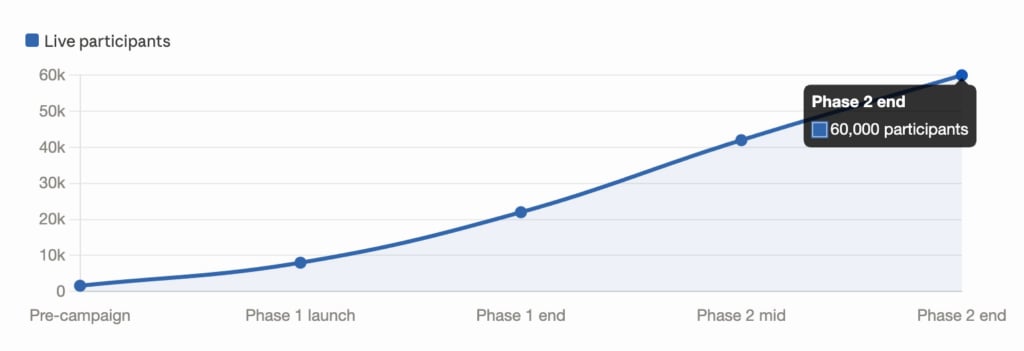
60,000+ live campaign participants entered the funnel across Phases 1 and 2, a 3,650% increase from baseline. 220 staked on-chain. That’s the correct filter for a high-intent BTC-native audience.
Engine 2: Search and AI Dominance
The second engine had one goal: own every surface a user encounters when searching Bitcoin DeFi — Google organic, Featured Snippets, AI Overviews, and ChatGPT.
Standard DeFi content doesn’t work here. BTC-native users aren’t reading for inspiration. They want specifics: how PowPeg works, what the real difference between rBTC and native BTC is, why merge-mining isn’t a custodial bridge. ICODA built content around those exact objections, timed to on-chain milestones, with factual hooks media could publish.
One content strategy, three visibility layers:
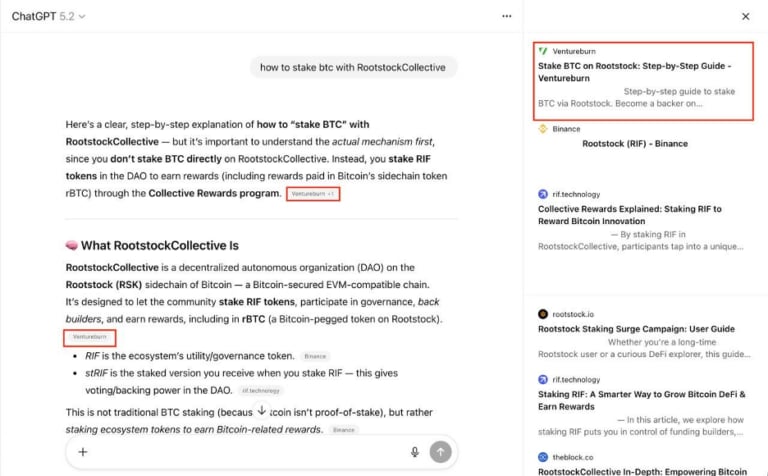
- A Ventureburn article for “how to stake BTC on Rootstock” appeared in both Google organic results and Google AI Overview simultaneously
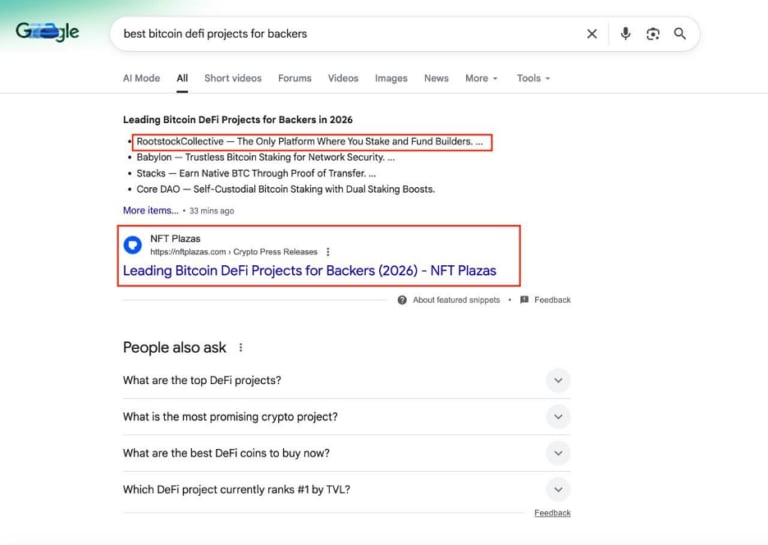
- RootstockCollective captured the Featured Snippet for “best bitcoin defi projects for backers,” listed as the #1 platform
- ChatGPT cites Ventureburn as its primary source when users ask how to stake BTC on RootstockCollective
- “Bitcoin DeFi Staking” reached #1 in Google rankings
These positions are live. The campaign budget ends. The search rankings don’t.
Campaign Results at a Glance
- ICODA-attributed stakers: 220 — 48.3% of total ecosystem growth
- Total new stakers (Phases 1 & 2): 455
- STRIF holders before campaign: 1,095
- STRIF holders after campaign: 1,550
- Live campaign participants: 60,000+ (↑3,650%)
- Partner Discord communities: 15
- Sybil verification: 100% manual, on-chain
- Google ranking — “Bitcoin DeFi Staking”: #1
- Featured Snippet captured: “Best Bitcoin DeFi Projects for Backers”
- AI citations: ChatGPT + Google AI Overview
→ See the full RootstockCollective case study
What a Real DeFi Marketing Strategy Looks Like
The best DeFi marketing strategy in 2026 measures at the wallet level and shows the before/after on the blockchain explorer, not a slide. The RootstockCollective campaign ran across a flat market — no bull-run tailwind, no token launch hype. The 455 new stakers came from deliberate targeting and clean attribution.
Attribution that survives scrutiny. Unique links per partner, manual Sybil verification, on-chain cross-check before any wallet gets counted. If you can’t trace each conversion to its source, you don’t have a DeFi marketing strategy — you have a traffic report.
Community quality over audience size. 15 Discord ecosystems selected for on-chain activity outperformed what any broadcast campaign would have delivered. In BTC-native DeFi, audience quality is the product. Mass reach runs counter to it.
Search as a permanent asset. The Featured Snippet, AI Overview placement, and ChatGPT citations didn’t stop working when the campaign closed. Every user who searches Bitcoin DeFi staking now gets routed to RootstockCollective content. The positions compound; the budget doesn’t.
The On-Chain Proof
The before/after is on the blockchain explorer, not a slide. Of those 455 new stakers, 220 trace directly to ICODA’s campaign, verified wallet by wallet, with zero Sybil contamination and three live search positions running in parallel.
In a market full of vanity metrics, neither number needs a disclaimer.
→ Book a DeFi strategy session with ICODA