
Investors seeking to optimize their entry ahead of Nvidia’s (NASDAQ: NVDA) next dividend payout may want to pay close attention to the stock’s historical recovery pattern following past payout dates.
Data shows that Nvidia shares have historically recovered from their post-dividend decline within an average of 2.5 trading days, indicating the stock typically rebounds quickly after the dividend adjustment.
Nvidia’s next estimated dividend payment is scheduled for July 3, with the company expected to maintain its quarterly payout at $0.01 per share, unchanged from the previous distribution on April 1, 2026.
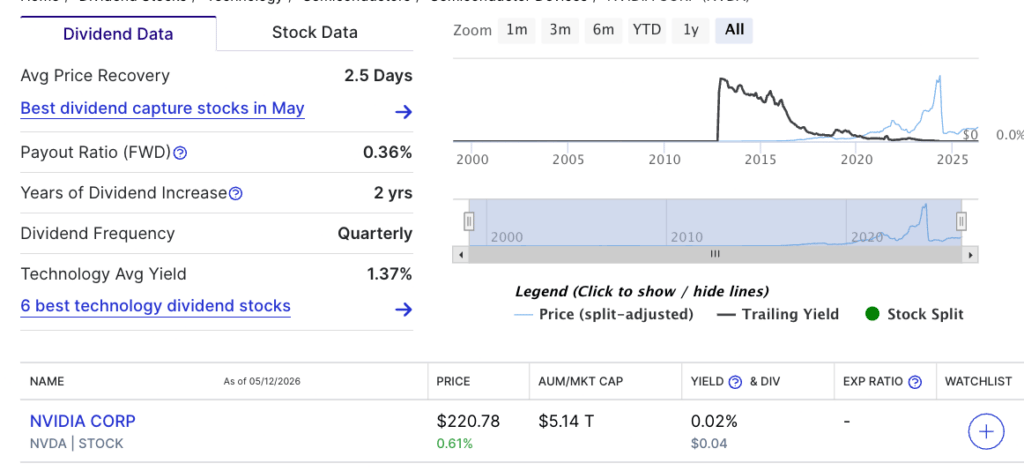
Based on the recovery trend, investors may find a better entry point by buying shortly after the ex-dividend adjustment, as Nvidia shares have historically rebounded quickly from the temporary dip.
The approach is particularly relevant given Nvidia’s minimal dividend yield of 0.02% and forward payout ratio of 0.36%, reinforcing the company’s position as a growth-focused stock rather than an income play.
Although Nvidia has raised its dividend for two consecutive years, the stock’s performance remains far more influenced by earnings, AI demand, and broader semiconductor sector momentum.
NVDA stock bullish run
Meanwhile, NVDA shares have continued their stellar run in 2026, closing at a record high of $220 on May 11, marking their third all-time closing high of the year.
The stock climbed as high as $223 intraday, pushing the company’s market capitalization above $5.3 trillion at its peak. By press time, NVDA shares were trading at $219.
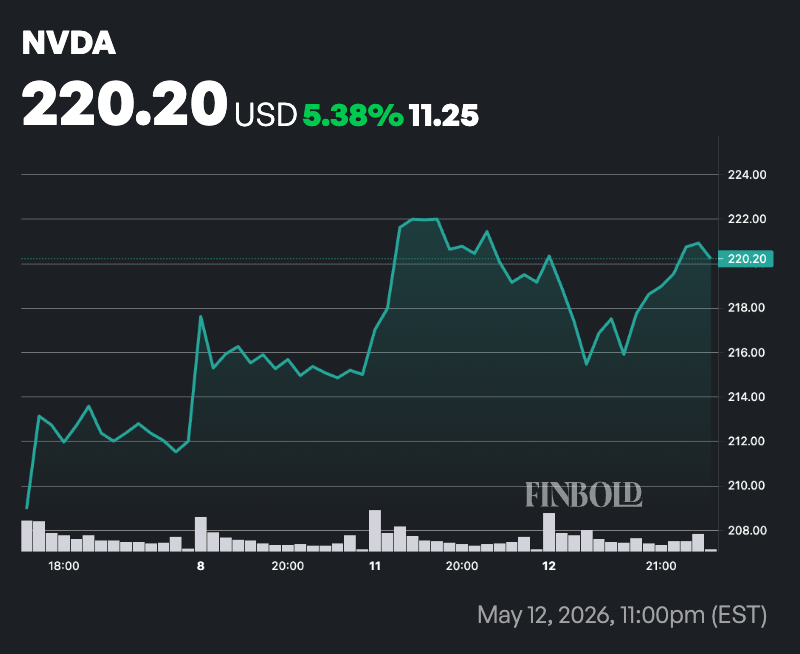
The latest surge extends a strong rebound, with shares up roughly 13% in just four trading days while posting their longest winning streak since late 2025.
Nvidia stock fundamentals
Investors remain enthusiastic about Nvidia’s dominant position in AI infrastructure. The company’s Blackwell architecture, described as its fastest production ramp ever, is delivering major gains in performance and efficiency for AI training and inference.
Demand from hyperscalers and enterprise “AI factories” continues to strengthen, with CEO Jensen Huang highlighting progress in agentic AI and expanding ecosystem partnerships.
Wall Street is now turning its attention to Nvidia’s Q1 FY2027 earnings, scheduled for release after the market close on May 20. Analysts expect revenue of around $78.5 billion, with Data Center sales near $73 billion alongside healthy gross margins in the mid-74% range.
Strong guidance on Blackwell shipments, gross margin trends, and the roadmap to the next-generation Vera Rubin platform could help shape sentiment for the second half of 2026.
However, risks remain, including potential margin pressure during architecture transitions, rising competition, geopolitical export restrictions, and any broader slowdown in AI capital spending.