
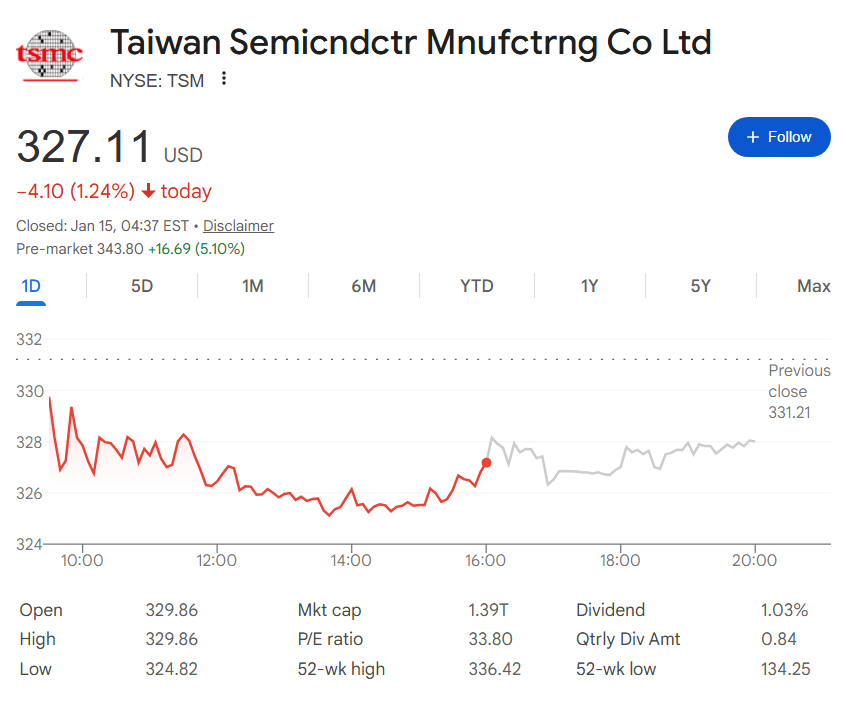
One of the most important companies in the world for the global digital infrastructure, Taiwan Semiconductor Manufacturing (NYSE: TSM) just surged 5.10% in overnight trading,
The pre-market move on January 15 sent TSM shares soaring from their latest closing price of $327.11 to their press time price of $343.80.
The driving force behind the TSM stock upswing has been the company’s latest earnings report, published shortly after midnight, New York time, on January 15.
Why TSM stock is surging
In the latest filing, TSMC announced it had beaten revenue forecasts, achieving 1.046 trillion new Taiwan dollars ($33.73 billion) instead of the expected NT$1.034 trillion ($32.76 billion). Similarly, the firm’s net income came in at NT$505.74 billion ($16.02 billion) instead of the anticipated NT$478.37 billion ($15.16 billion).
Perhaps the most impressive segment of the report was the December 2025 revenue growth, considering it featured a 20% increase compared to the same month one year before.
TSMC expects 2026 to be another year of strong growth, driven by the increasing demand for advanced artificial intelligence (AI) chips.
The 2026 TSM stock bull case
Considering Taiwan Semiconductor Manufacturing’s core business, the strong results can hardly be considered surprising.
TSMC’s foundries are responsible for the production of more than 50% of the world’s microchips, and the firm is the main manufacturer for semiconductor giants Nvidia (NASDAQ: NVDA) and Advanced Micro Devices (NASDAQ: AMD).
Indeed, under the circumstances, the growth of the two prominent chipmakers will, by necessity, translate into strong results for the Taiwanese behemoth.
Elsewhere, it is noteworthy that TSMC enjoys a relatively close relationship with the U.S. Government.
Not only are its products critical for the planned adoption of advanced AI across various national organizations, such as the Department of War, but the firm has also been expanding its production capacity on American soil.
The industrial drive can be seen as particularly important for the Federal Government, considering both the ubiquity of semiconductors in modern infrastructure and the politically precarious position of Taiwan.
Featured image via Shutterstock