Stablecoins are becoming a more practical layer for business payments, particularly in
cross-border commerce. Stripe reported that stablecoin payment volume doubled to around
$400 billion in 2025, with an estimated 60% representing B2B payments. Visa has also
highlighted cross-border B2B payments and B2C payouts as practical use cases for
stablecoin-based money movement.
For e-commerce and SaaS businesses, however, adding crypto is not simply a matter of
placing another payment option at checkout. Businesses still need to handle multiple
blockchains, different digital assets, payment confirmation, settlement preferences, and
integration with existing order or subscription systems.
CCPayment addresses this integration problem through two core workflows designed to
operate alongside an existing payment stack.
Multi-Chain Checkout + Stablecoin Settlement
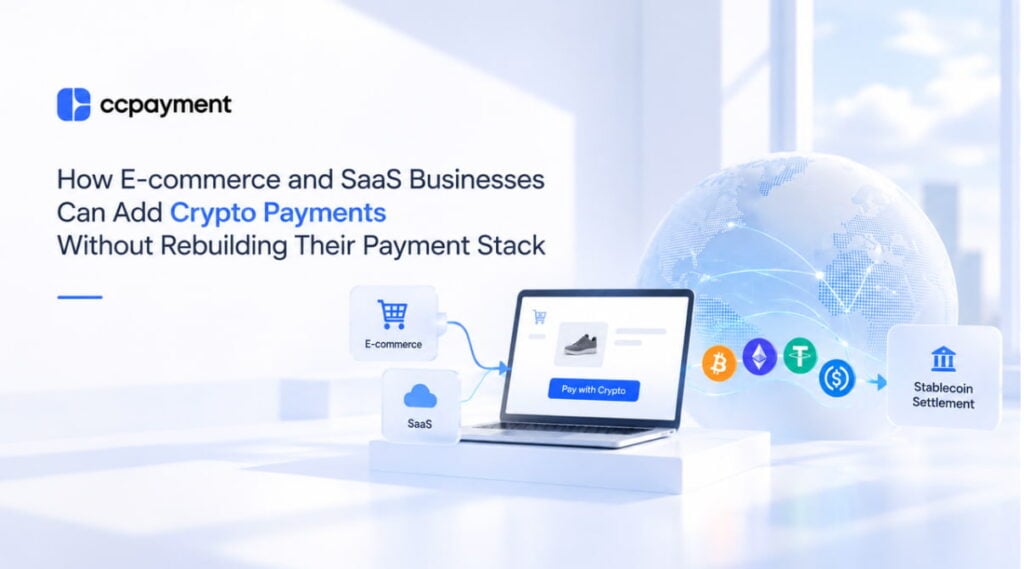
For e-commerce merchants, CCPayment provides a single payment infrastructure
supporting more than 900 cryptocurrencies across over 100 blockchains, with processing
rates starting at 0.2%.
Customers can pay with supported digital assets through checkout links, embedded widgets,
or API-based payment flows. Incoming crypto can be automatically converted into USDT or
USDC at the point of sale, allowing merchants to separate the customer’s payment choice
from their preferred settlement asset.
After an on-chain transaction is detected and confirmed, Webhook notifications return the
payment status to the merchant system, where it can be connected with order confirmation,
digital delivery, or fulfillment.
Businesses can also review CCPayment’s supported cryptocurrencies and blockchain
networks when determining which payment options to make available at checkout.
API Billing + Webhook Synchronization for SaaS
SaaS businesses face a different challenge: crypto payments need to remain synchronized
with billing cycles and product access.
CCPayment supports monthly and annual crypto billing, as well as multi-seat and
usage-based billing through APIs. When a renewal is due, the merchant system can trigger
a payment request via API and notify the customer to approve the transfer. Webhook
callbacks then synchronize payment status with the product’s access logic.
This structure allows crypto payment activity to connect with an existing SaaS billing
workflow through APIs and Webhooks rather than operating as a separate payment process.
Together, the two workflows give e-commerce and SaaS businesses a way to add crypto
payment acceptance while retaining their existing commerce and billing infrastructure.
Explore CCPayment’s E-commerce and SaaS payment workflows to see how crypto
checkout, stablecoin conversion, billing, and settlement can fit into an existing payment
stack.
Learn more: CCPayment Official Website
Email: [email protected]
X https://x.com/CCPaymentX
Telegram https://t.me/CCPaymentSupportBot
Linkedin https://www.linkedin.com/company/ccpayment/