

As International Business Machines Corp. (NYSE:IBM) stock crashed amid a shift in enterprise tech spending, as of July 15, Jim Cramer had previously recommended that investors buy the shares.
On July 13th, at the Mad Money show, Cramer said investors ought to buy some IBM stock immediately and add on potential market dips. Less than 24 hours later, IBM stock crashed over 25% as the company missed its quarterly revenue forecast.
Cramer’s disastrous timing on IBM stock outlook was potentially exaggerated by the inverse Cramer movement. Nonetheless, after the company reported that it forecast a revenue of $17.2 billion in the second quarter, below expectations of $17.86 billion, Cramer shifted his sentiment.
On Tuesday, Cramer said that IBM has landed on the wrong side of enterprise tech spending amid the AI boom. Moreover, enterprise tech spending has been shifting toward hardware investments rather than software allocations.
“That’s the new reality, and I have no idea when it will change, which is why I can’t recommend IBM, not even after today’s severe decline,” Cramer said.
Notably, IBM stock has underperformed core AI stocks, led by semiconductor stocks. Furthemore, IBM stock price has been outshined by Nvidia Corp. (NASDAQ: NVDA), Intel Corporation (NASDAQ: INTC), Marvell Technology, Inc. (NASDAQ: MRVL), Advanced Micro Devices, Inc. (NASDAQ: AMD), and Broadcom Inc. (NASDAQ: AVGO) over the past 5 days.
What’s IBM stock price forecast for 2026 and outlook?
Although International Business Machines, under CEO Arvind Krishna, continues to realign its business towards the AI boom, Wall Street analysts have set a ‘Moderate Buy’ rating and an average price target of $303.83 for the next 12 months, as Finbold reported.
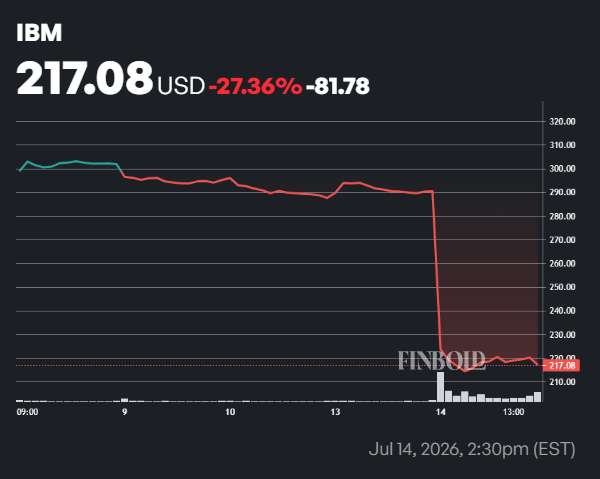
Following IBM’s worst day in decades on Tuesday, the shares closed at $217.08, down more than 27% over the past five days. However, IBM stock had rebounded slightly during Wednesday’s pre-market session, hovering around $219.32, resulting in a market capitalization of approximately $204.0 billion at press time.
Nevertheless, the company’s stock has retested a major multi-month support level amid modest bullish sentiment from Wall Street, thus potentially explaining the mixed signals from Cramer.