
OpenAI’s ChatGPT projects Intel (NASDAQ: INTC) stock could climb to $120 over the next 12 months as its latest acquisition strengthens its position in quantum computing.
On October 26, Intel announced an agreement to acquire Israeli quantum computing software company Classiq, expanding its ambitions beyond conventional processors and artificial intelligence (AI) chips.
The deal would combine Classiq’s quantum algorithm and circuit design software with Intel’s silicon spin-qubit technology and semiconductor manufacturing expertise, creating a more comprehensive quantum computing business spanning hardware and software.
Reports value the transaction at approximately $2.3 billion, although Intel has not officially disclosed the price. The deal is expected to close in the first half of 2027, subject to regulatory approvals and customary conditions.
However, quantum computing remains in the early stages of commercial development, meaning the deal is unlikely to materially boost earnings immediately. Its long-term value will depend on technological progress, customer adoption, and Intel’s ability to commercialize the technology.
INTC stock prediction
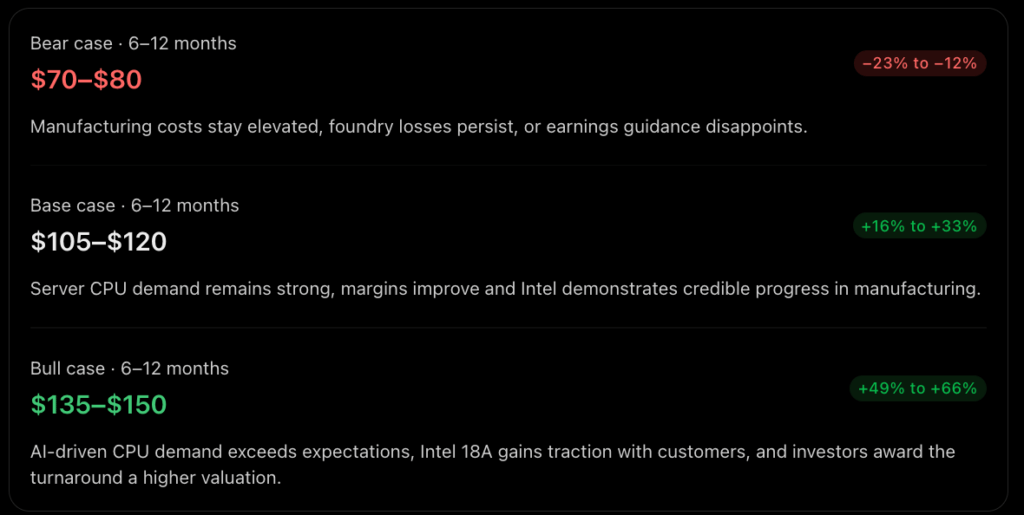
Based on ChatGPT’s analysis, Intel stock has a base-case target of $105 to $120 over the next six to 12 months, assuming continued server processor demand, improving margins, and progress in advanced manufacturing.
In a more bullish scenario, INTC could reach $135 to $150, representing upside of approximately 49% to 66% from the $90.47 reference price.
This would likely require stronger-than-expected processor demand, sustained earnings growth, and greater confidence in Intel’s manufacturing strategy.
Conversely, the stock could fall to $70 to $80 if manufacturing costs remain elevated, foundry losses persist or earnings disappoint.
Intel stock fundamentals
Beyond quantum computing, Intel’s financial performance offers a more immediate basis for a potential recovery.
Intel reported second-quarter 2026 revenue of $16.1 billion, up 25% year over year, while non-GAAP earnings per share reached $0.42, compared with a loss of $0.10 a year earlier. Non-GAAP gross margin rose to 41.8% from 29.7%, while Data Center and AI revenue jumped 59% to $6.3 billion.
The results suggest Intel could benefit from growing demand for server CPUs as AI infrastructure expands. Sustained demand, cost control, and progress in its 18A manufacturing process could further improve profitability.
However, substantial manufacturing costs and continued foundry losses remain risks. Quantum computing’s commercial potential is also uncertain, while acquisition integration and customer adoption will take time.
If investors have already priced in much of Intel’s recovery, disappointing results or weaker guidance could trigger a correction.
Intel’s third-quarter 2026 results, scheduled for October 29, are the next key catalyst. Strong revenue, margins, and guidance could support a move toward the $100–$103 resistance area identified in ChatGPT’s technical assessment, while weaker results could put further pressure on the stock.
Featured image via Shutterstock