

Palantir Technologies (NASDAQ: PLTR) reports its first-quarter 2026 earnings today, May 4, and with the shares down 18% since the start of the year, the market is somewhat on edge.
Wall Street expects revenue of around $1.54 billion, implying 74% year-over-year growth, well ahead of the 39.3% recorded in the same period last year.
Further, analysts are looking for earnings of $0.28 per share, more than double what we saw last year, supported by the company’s pledge to remain profitable throughout 2026.
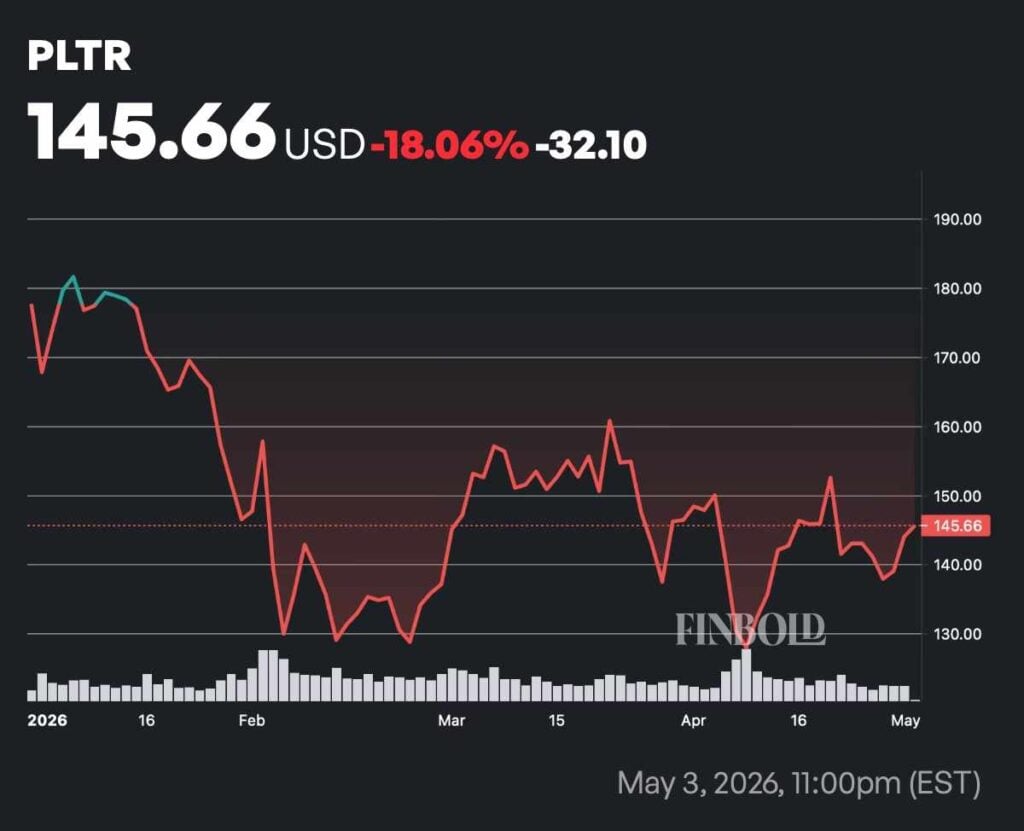
Palantir’s critical segments
Investor attention is primarily focused on Palantir’s Artificial Intelligence Platform (AIP), especially since the management expects it to fuel at least a 115% increase in U.S. commercial revenue this year.
With the segment also being the company’s chief growth engine, any signs of deceleration could weigh heavily on the stock.
Palantir’s government business, on the other hand, continues to provide much-needed support beyond commercial adoption.
As a result, updates on contracts with government agencies will be another key area of interest, given the segment’s stability and recurring revenue profile.
HSBC mixed on Palantir
Most recently, on May 1, HSBC analyst Stephen Bersey downgraded Palantir from ‘Buy’ to ‘Hold’ with a price target lowered from $205 to $151.
Bersey argued that the company’s innovative approach to artificial intelligence (AI) has prompted competitors like OpenAI to try to replicate it.
In other words, the analyst believes the proliferation of agentic frameworks and model context protocol servers has made Palantir’s entry point less relevant.

For example, Bersey noted that Anthropic has seen a surge in revenue, which he believes raises concerns that the growth could come at Palantir’s expense.
Palantir’s premium validation is justified, Oppenheimer claims
However, a day earlier, Param Singh of Oppenheimer initiated coverage of the technology giant, citing several business aspects he believes position Palantir as a ‘Buy.’
For example, he noted that Palantir is rapidly expanding within traditional commercial enterprise organizations. Simultaneously, the firm is benefiting from its U.S. military work, with President Donald Trump’s $1.5 trillion defense budget proposal adding further long-term support.
U.S. government revenue, Singh added, could also mean that valuation concerns that have been characteristic of the Palantir discourse in the past months could be somewhat overblown.
“We believe a meaningful premium is warranted for the company given its defensible moat for U.S. government revenue (anchored by long-duration IDIQ contracts and recurring task order flow), accelerating US commercial revenue, and expanding operating margins,” Singh opined.
Singh’s thesis assumes the company’s Ontology serves as a “platform differentiator” since it is highly difficult and expensive to switch to another model once a client has adopted a product specifically tailored for their use.
Moreover, Palantir’s commercial customer base has gone up from 375 in 2023 to 780 in 2025, with revenue per customer also going up from $5.6 million to $8.7 million. Now, with a total addressable market of roughly $2.1 trillion by 2030, Singh thinks there is a lot of room for further growth.
Palantir stock Wall Street consensus
Just ahead of earnings, analyst estimates carry a ‘Moderate Buy’ consensus, with 14 ‘Buys,’ five ‘Holds,’ and two ‘Sells.’ The average price target stands at $188.39, suggesting roughly 28% upside from current levels, according to TipRanks data Finbold retrieved at press time.
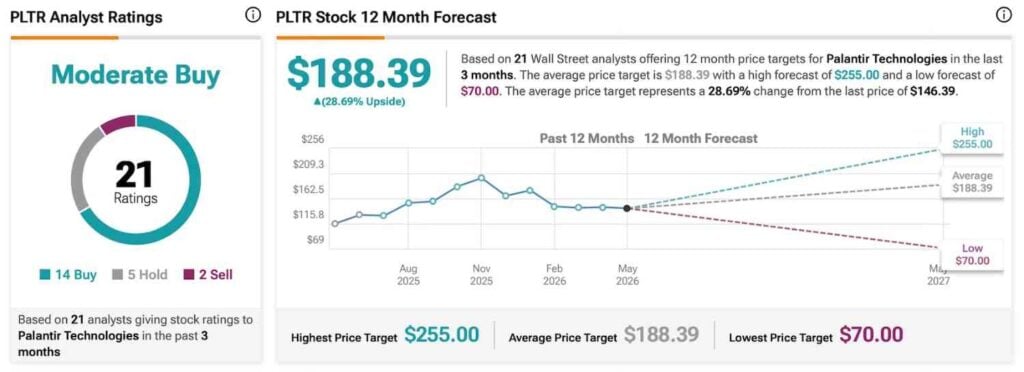
However, the wide range of projected price targets illustrates how uncertain the market is. Namely, the lowest projected PLTR share price for the next 12 months sits at just $70, while the opposite extreme sees the stock trading at $225.
Featured image via Shutterstock