

SpaceX (NASDAQ: SPCX) stock has undergone a sharp reversal just weeks after completing the largest IPO in history, raising questions about whether the pullback presents a buying opportunity or signals further downside.
After debuting at $135 per share in June 2026 and rallying to a post-IPO high of about $226, SpaceX stock has fallen to $124 as of press time.
The decline of roughly 45% from its peak has pushed shares below their IPO price and wiped nearly $1 trillion from the company’s market value, reducing its valuation from about $2.6 trillion to $1.6 trillion.
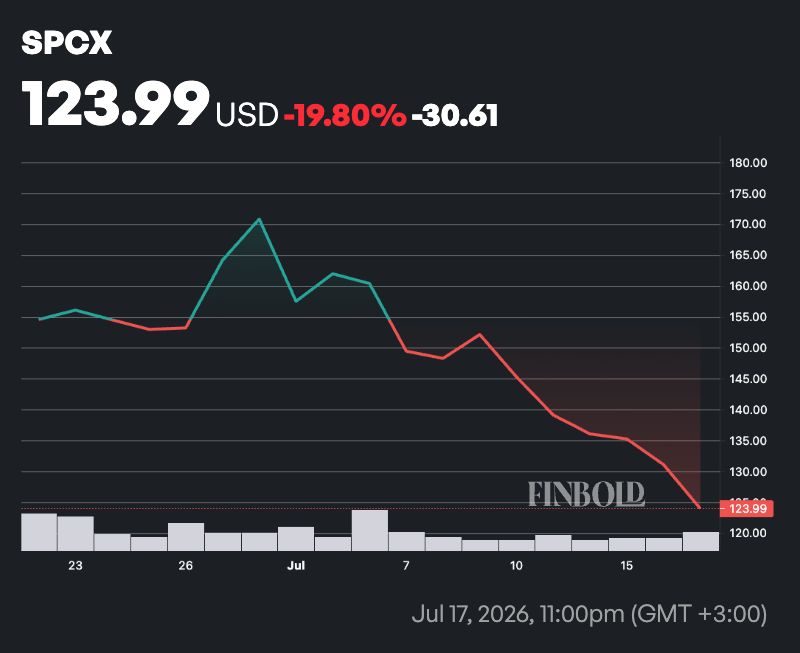
Why SpaceX stock plunged post-IPO
The sell-off reflects a common post-IPO pattern, with early enthusiasm giving way to profit-taking, insider selling, and valuation concerns.
Additional pressure has come from share unlocks, rising short interest, a recent Starship testing setback, and a broader pullback in speculative technology stocks. Even so, SpaceX remains among the world’s most valuable public companies.
The strongest case for buying SpaceX stock is Starlink, the company’s primary revenue and profit driver.
The satellite broadband service now serves more than 10 million users worldwide, generating recurring, high-margin revenue from consumer, enterprise, and government customers, including Starshield contracts.
Notably, SpaceX generated $18.7 billion in revenue in 2025, up 33% year-over-year, with revenue projected to reach between $22 billion and $30 billion in 2026 if subscriber growth and launch activity remain strong.
While Starlink powers current growth, the long-term investment case largely depends on the success of Starship.
The next-generation rocket could significantly reduce launch costs if development stays on track. A successful rollout would support faster satellite deployments, in-orbit refueling, lunar missions, and new opportunities such as orbital data centers.
However, Starship remains in testing and faces execution risks. Technical setbacks, regulatory challenges, or development delays could weigh on investor sentiment and future growth prospects.
As a result, upcoming Starship flight tests may be more important than short-term stock movements in shaping SpaceX’s long-term valuation.
Is SpaceX a buy?
Whether SpaceX stock is a buy at current levels largely depends on an investor’s time horizon.
The 45% decline has reduced some of the valuation excess seen after the IPO, but SpaceX still trades at a premium to many established technology and industrial companies. Even after the sell-off, its valuation remains heavily tied to future growth rather than current profitability.
Although revenue continues to expand, SpaceX reported a net loss of about $4.9 billion in 2025 as it invested heavily in infrastructure, research and development, artificial intelligence initiatives, and Starship development.
Investors bullish on satellite communications, reusable space transportation, and the broader space economy may view the pullback as a more attractive entry point.
More cautious investors may prefer to wait for evidence of sustained profitability, successful Starship milestones, and the completion of major share unlock events.
Key near-term catalysts include earnings results, Starlink subscriber growth, and Starship test flights. Strong execution could improve sentiment, while operational setbacks or insider selling may keep the stock volatile.