
A machine learning model by Finbold’s AI Agent forecasts that Intel (NASDAQ: INTC) stock could trade at an average price of $86.42 on September 30, 2026, implying a 0.51% decline from the current price of $86.87.
The forecast was generated using technical indicators, including the Relative Strength Index (RSI) and Moving Average Convergence Divergence (MACD), alongside historical price data.
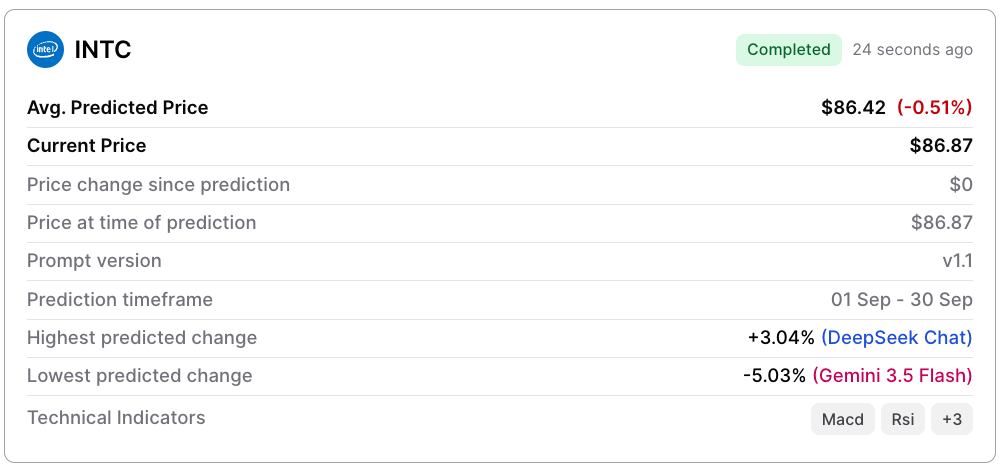
It suggests Intel may remain largely range-bound over the next four weeks despite continued investor interest in the company’s AI and semiconductor businesses.
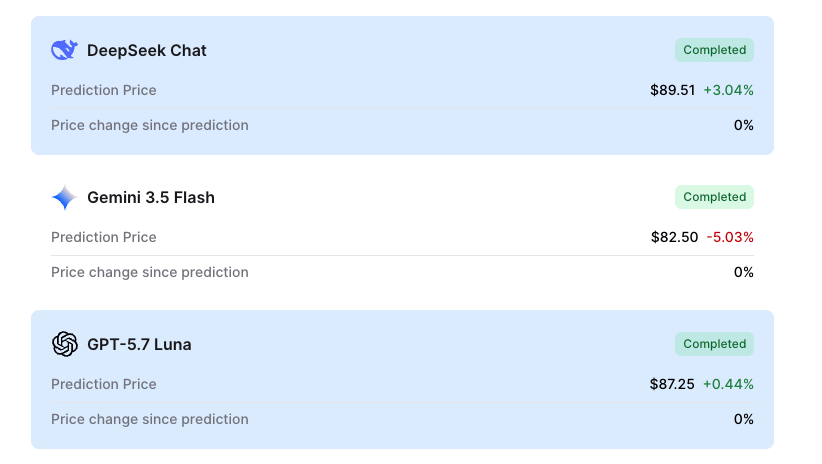
Among the individual models, DeepSeek Chat delivered the most bullish outlook, projecting INTC at $89.51, a potential 3.04% gain from current levels. Gemini 3.5 Flash was the most bearish, forecasting a decline to $82.50, while GPT-5.7 Luna predicted a more modest rise to $87.25.
Intel stock fundamentals
The cautious September outlook follows a remarkable run for Intel shares over the past year. The stock recently traded in the high-$80 range after gaining more than 260% over the previous 12 months, driven by optimism around AI demand and Intel’s manufacturing turnaround strategy.
However, the stock has remained volatile as investors balance long-term growth opportunities against execution risks and the impact of shareholder dilution from a major equity offering.
Intel’s latest quarterly results highlighted improving fundamentals. In the second quarter of 2026, the technology firm reported revenue of $16.1 billion, up about 25% year-over-year, while non-GAAP earnings reached $0.42 per share, beating analyst expectations.
Growth was led by Intel’s Data Center and AI segment, which benefited from rising demand for AI infrastructure and server processors. The company also reported improving margins and maintained third-quarter revenue guidance of $15.8 billion to $16.8 billion.
Despite the progress, Intel continues to invest heavily in its foundry expansion and advanced manufacturing roadmap, both of which require significant capital spending and remain central to the stock’s long-term investment case.
Intel’s turnaround has improved sentiment, but analysts remain divided on its long-term outlook. Bulls point to strong AI and server demand, expanding margins, government-backed semiconductor investments, and the potential for Intel’s foundry business to secure more external customers. Successful execution on advanced manufacturing nodes could further support growth.
Intel stock risks
However, the foundry unit continues to generate losses and requires substantial capital investment, while the company faces intense competition from AMD, Nvidia, and TSMC. Investors are also monitoring progress on advanced process technologies, manufacturing yields, and Intel’s efforts to regain process leadership.
Following the stock’s sharp rally, valuation concerns and recent share dilution have added to the uncertainty.
Featured image via Shutterstock