

Famed investor Michael Burry has warned that the stock market’s growing fixation on artificial intelligence is beginning to resemble the final stages of the late 1990s Dot-com bubble.
In a Substack post, Burry argued that financial markets are no longer reacting rationally to key economic indicators such as jobs data and consumer sentiment.
Instead, he said investor enthusiasm surrounding AI-related companies has become the dominant force driving equity prices higher.
The warning comes as major U.S. indexes continue reaching record highs despite signs of broader economic uncertainty. For instance, on Friday, the S&P 500 closed at a record high of 7,398 after investors focused on a stronger-than-expected April jobs report.
“Stocks are not up or down because of jobs or consumer sentiment. <…> They are going straight up because they have been going straight up. On a two letter thesis that everyone thinks they understand.<…> Feeling like the last months of the 1999-2000 bubble,” Burry said.
Burry, who gained prominence for predicting the 2008 U.S. housing crash chronicled in The Big Short, compared the current rally in AI-linked stocks to the surge in technology shares that preceded the collapse of the dot-com bubble in March 2000.
He specifically pointed to the performance of the Philadelphia Semiconductor Index, which has risen more than 10% this week and is now up roughly 65% in 2026.
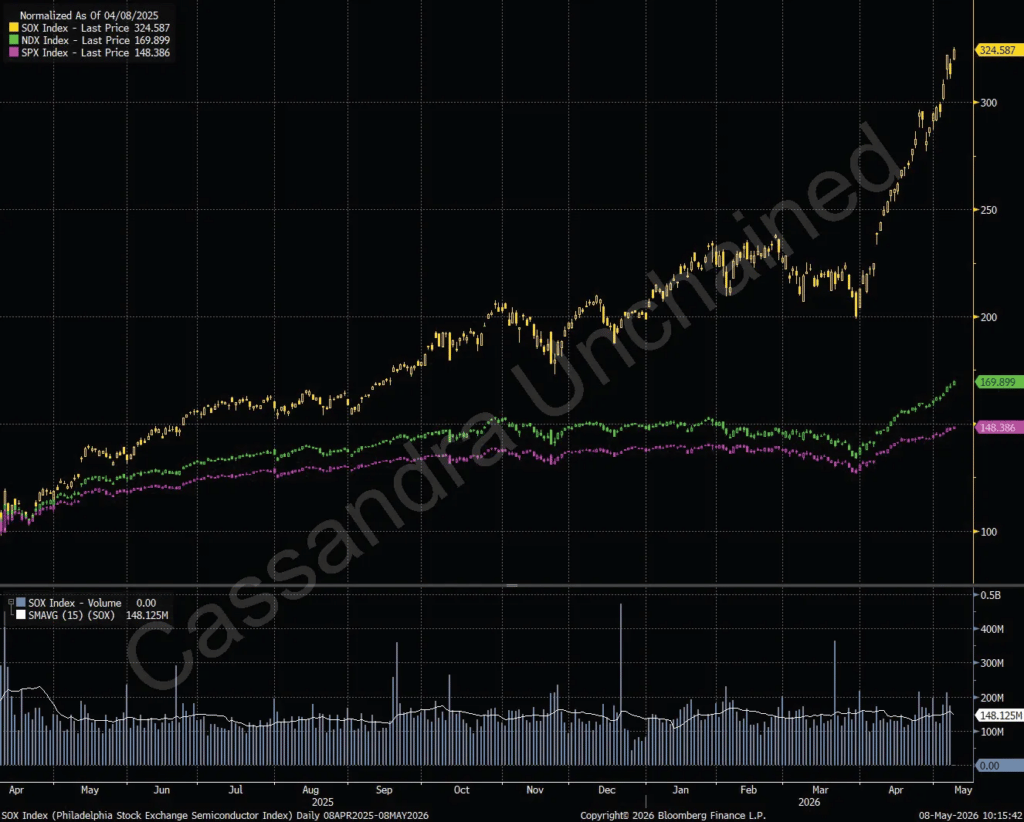
AI driving market rally
Semiconductor manufacturers and large technology firms tied to AI infrastructure have led the ongoing market rally as investors continue pouring money into companies benefiting from the rapid expansion of generative AI.
Burry suggested that stocks are increasingly rising simply because momentum continues to attract more buyers rather than because of improving economic conditions.
According to his assessment, the market’s focus on AI has become so dominant that other financial and economic developments are receiving little attention from investors.
Overall, the AI boom has fueled sharp gains across technology and semiconductor stocks over the past two years, with investors betting heavily on companies expected to benefit from advances in artificial intelligence.
However, growing comparisons to the Dot-com era are intensifying fears that excessive optimism and stretched valuations could expose markets to a significant pullback if sentiment weakens.