
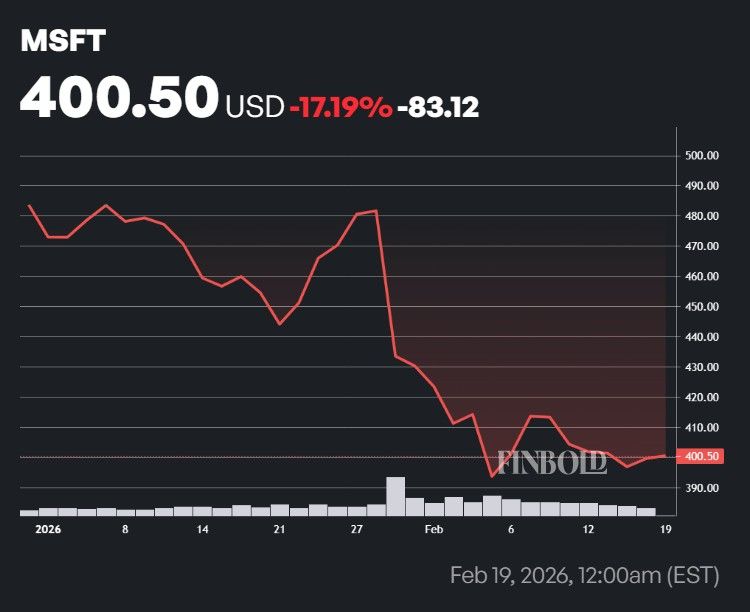
After falling 17.19% in 2026 to its February 19, press time price of $400.50, Microsoft (NASDAQ: MSFT) stock received a welcome show of confidence in the form of a board member executing a $2 million purchase.
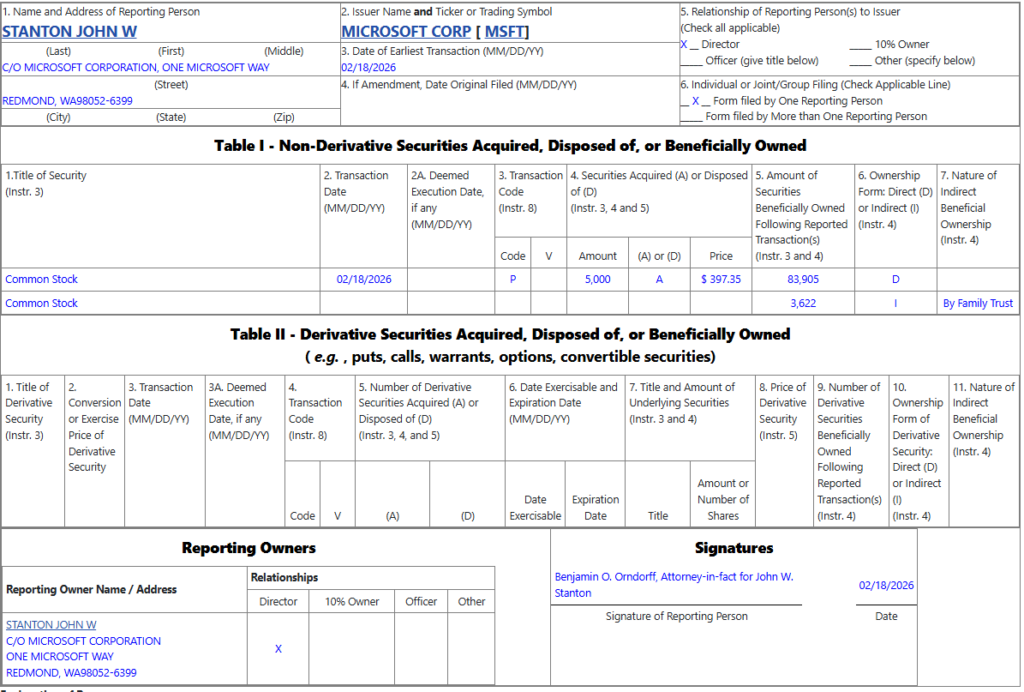
Specifically, Director John W. Stanton bought 5,000 MSFT shares at an average price of $397.35 on February 18 and reported his trade on the very same day.
The insider purchase is remarkable for being the biggest Microsoft has seen in about a decade, and one of the only two executed since 2022.
Microsoft Vice Chair bought and sold $1.5M shares in a week
Vice Chair and President Bradford Smith made the other recent insider buy on April 23, 2025. It amounted to $1.45 million and 3,842 shares. Notably, Smith reported selling the exact same amount of equity only one week later – on April 30, 2025 – for just under $1.7 million.
Additionally, the Vice Chair only reported the two opposite trades months later, on December 12.
The third most recent insider buy took place in late January 2022, when Director Emma Walmsley purchased $1 million worth of Microsoft stock.
Thus, Stanton’s February 2026 insider trade is notable for multiple reasons. It came after MSFT shares suffered a significant drop in less than two months, it was the first purchase to not be immediately reversed by a sale, and it is the biggest Microsoft has seen in a decade.

Does Stanton’s Microsoft stock insider buy hint at imminent MSFT rally?
While Director John Stanton’s insider trade is indeed a welcome show of confidence, it is notable that the blue-chip technology giant remains under significant pressure in 2026.
Specifically, investors have grown increasingly wary of Microsoft’s massive investments in artificial intelligence (AI) and exposure to OpenAI.
Indeed, the revelation that as much as 45% of the big tech firm’s backlog is tied to Sam Altman’s private company is, arguably, the single biggest reason behind MSFT stock’s recent post-earnings drop that wiped some $350 billion from the corporation’s market capitalization within a single session.
Such weakness and instability are relatively unlikely to subside despite Wall Street’s overwhelming bullishness and Stanton’s insider trade, considering OpenAI’s internal documents reportedly forecast a $14 billion loss in 2026.
Still, there remains strong potential for reversal. Microsoft’s overall business remains mostly healthy and very profitable – as seen with the other aspects of the most recent earnings – and, should the company address the growing number of complaints of Windows users, and should OpenAI’s forecast for $100 billion in revenue by 2029 come true, MSFT shares might soon enjoy tempestuous tailwinds.
Featured image via Shutterstock