

Cybersecurity firm Palo Alto Networks (NASDAQ: PANW) stock has witnessed a notable insider buy at a time when the equity continues to record losses amid the broader market downturn.
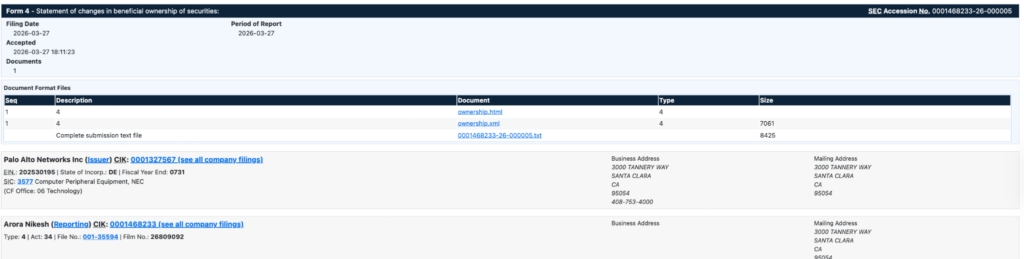
In this context, the stock, in which former House Speaker Nancy Pelosi has a stake, saw its Chief Executive Officer Nikesh Arora disclose a near-$10 million PANW share purchase.
According to a Form 4 filing with the SEC dated March 27, 2026, Arora acquired 68,085 shares at an average price of $146.87, bringing the total transaction value to approximately $9.99 million.
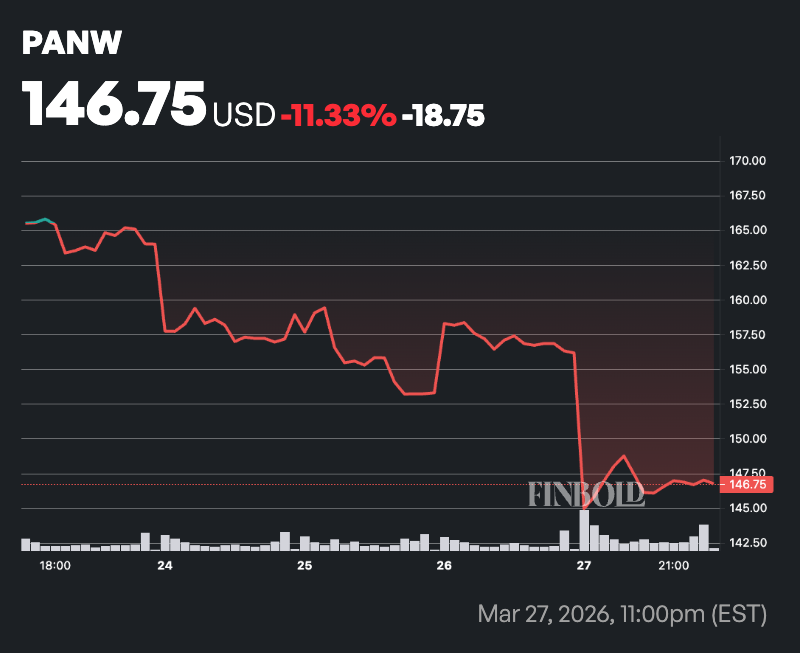
The move is notable given the company’s recent volatility, with shares closing at $147.02 on the same day, down about 6%.
Notably, insider buying of this scale is often interpreted as a signal of confidence in the company’s long-term outlook, particularly during periods of weakness.
In this line, Palo Alto Networks remains a dominant player in cybersecurity, with strong fundamentals underpinning its growth narrative.
The company reported trailing 12-month revenue of $9.89 billion and net income of $1.28 billion, alongside robust free cash flow generation.
Nancy Pelosi PAWN ownership
At the same time, the equity also draws added attention due to its association with Pelosi’s household portfolio. Filings indicate that she does not directly trade equities; her husband, Paul Pelosi, has previously built a position in Palo Alto Networks through options and subsequent share acquisitions.
For instance, in February 2024, Paul Pelosi purchased call options on PANW valued at up to approximately $1.25 million, signaling a bullish stance on the stock.
The position was later converted in December 2024 into roughly 14,000 shares following the exercise of those contracts, according to periodic transaction reports filed with Congress.
Meanwhile, despite near-term headwinds and a premium valuation, Palo Alto Networks is viewed as a long-term growth play tied to rising cybersecurity demand and enterprise adoption of integrated security platforms.
Notably, the executive’s timing of the transaction, coming amid a dip in the stock, suggests management sees current levels as an attractive entry point, potentially signaling confidence in a rebound as broader market conditions stabilize.
Featured image via Shutterstock