
Most non-custodial crypto wallets lack the inheritance and shared-access tools that wealthy holders and family offices need, according to a scored comparison prepared by wallet provider Bron. Of the ten wallets assessed, four offer no inheritance feature at all, and six are single-user products.
What the report assessed
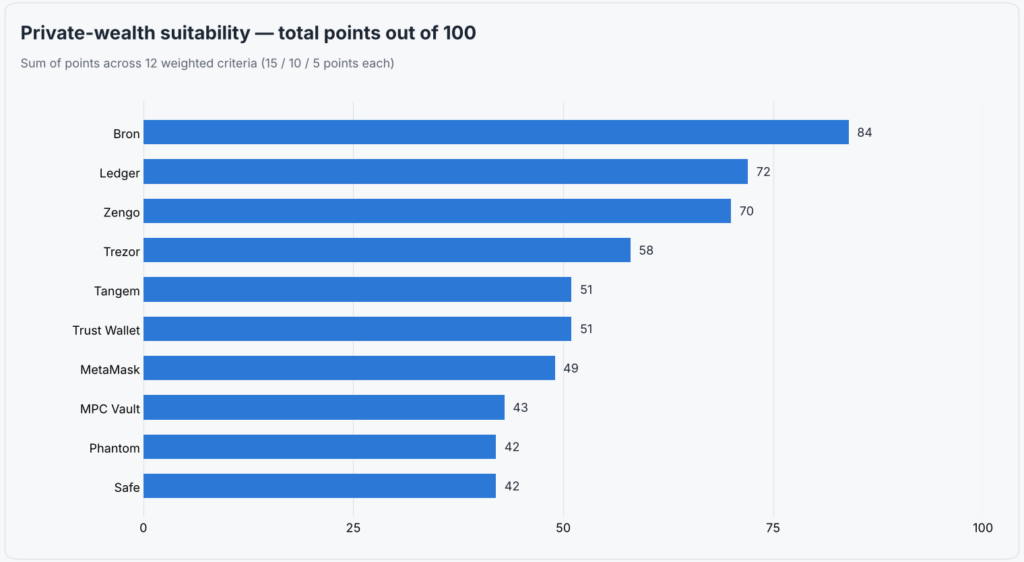
Bron’s report scores ten wallets on twelve criteria worth 100 points in total. It is aimed at affluent and high-net-worth individuals and family offices. Alongside Bron’s own wallet, it covers Ledger, MetaMask, MPC Vault, Phantom, Safe, Tangem, Trezor, Trust Wallet and Zengo.
Security carries the most weight at 15 points. Multi-user management and inheritance are worth 10 points each. The sections below cover those two first, then the overall scores and the full list of criteria.
Bron says its claims trace to vendors’ official documentation and help centers. It adds that it cross-checked them in live tests, in which each vendor’s support desk answered the same questions on recovery, inheritance, team access, and limits.
Inheritance: four wallets have no feature
Inheritance carries 10 of the 100 points. Trust Wallet, Phantom, MetaMask, and MPC Vault scored zero, with no beneficiary designation and no dormancy mechanism. According to the report, their support desks confirmed that an heir who does not hold the credential inherits nothing.
Ledger, Trezor, and Tangem scored two points each. Ledger points users to third-party services or Ledger Multisig, and Trezor to multisig partners. For Tangem, the report treats handing over a backup card and access code as handing over a live key, and scored it the same two points as Ledger.
Only three wallets scored above that. Bron’s Digital Inheritance feature scored 10: a designated beneficiary starts a claim, which runs a 12-month delay, shortened to six months if the beneficiary enters codes from two guardians. The owner, a guardian, or a beneficiary can cancel at any time. Zengo’s Legacy Transfer, a paid Pro feature, scored 9. It releases access to one recipient after an inactivity timer of 3 to 24 months. Safe scored 6, because a designated recoverer can replace the signers after a review delay, but only as a do-it-yourself setup on EVM chains.
Shared control: six single-user wallets
Multi-user management also carries 10 points. The report says Trust Wallet, MetaMask, Phantom, Tangem, Trezor and, in its consumer app, Ledger are single-user products. According to the report, their support desks confirmed that the only way to share control is to share the key itself.
Bron scored 10, ahead of MPC Vault and Zengo with 9 each, and Ledger and Safe with 7. Ledger’s score rests on separate products, Ledger Multisig and Ledger Enterprise. Bron says Zengo’s roles sit in a separate business app, which cost it a point.
Overall scores
Bron placed first with 84 points, followed by Ledger (72), Zengo (70), Trezor (58), Tangem and Trust Wallet (51 each), MetaMask (49), MPC Vault (43), and Phantom and Safe (42 each).
On security, the report’s largest weighting at 15 points, Bron and Safe scored full marks. Zengo scored 14. Trust Wallet, MetaMask and Phantom scored 6 each. Bron says that is because they authorize transactions with a password or biometric on the same device that holds the key, and a lost recovery phrase cannot be recovered.
What to look for in a non-custodial wallet
Bron’s report ranks its twelve criteria by points. Each works as a question to put to a wallet provider:
- Security (15 points): Does every transaction need a second authorization, and can funds be recovered if the vendor shuts down?
- Multi-user control (10): Are there separate roles, such as an approver and a view-only user?
- Inheritance (10): Is there a documented path for heirs that does not require handing over live credentials?
- Asset coverage (10): Does the wallet support the largest blockchains by market capitalization?
- Fiat rails (10): Can large amounts move in and out through bank transfers?
- Cross-chain swaps (10): Can funds move between chains inside the wallet?
- Trading (10): Are perpetual futures or tokenized assets available in the app?
- Fraud protection (5): Are there address allowlists, spending limits, delays and transaction simulation?
- AML screening (5): Are incoming funds checked for sanctions and illicit-funds risk?
- Staking and earn (5): Can assets earn yield without leaving self-custody?
- Support (5): Is human support available, with a published response time?
- Discretion (5): Can accounts be hidden, and can balances be made confidential on-chain?
Gaps the report flags
None of the ten wallets scored on AML screening of incoming funds, a criterion worth 5 points. Bron says no wallet in the group documents such screening. It adds that its own feature is coming but was not live as of October 2026.
Bron also lists its own deductions. It lost four points on trading, because it offers tokenized US stocks and exchange traded funds (ETFs) but no perpetual futures. It lost two on fiat for having no card. Ledger, MetaMask, Phantom and Trust Wallet each scored 9 of 10 on trading.
Featured image via Shutterstock