

A multimillion-dollar Bloom Energy (NYSE: BE) purchase linked to former House Speaker Nancy Pelosi’s household has received a major bullish catalyst after the company was selected for inclusion in the S&P 500.
Disclosures filed in August showed that accounts belonging to Pelosi’s spouse purchased 10,000 Bloom Energy shares and 100 call options with a $100 strike price expiring in June 2027 on July 24, 2026.
Four days later, on July 28, the account added another 5,000 shares and 100 additional call options with the same strike price and expiration date.
The transactions were executed when Bloom Energy traded near $185 and $167, respectively.
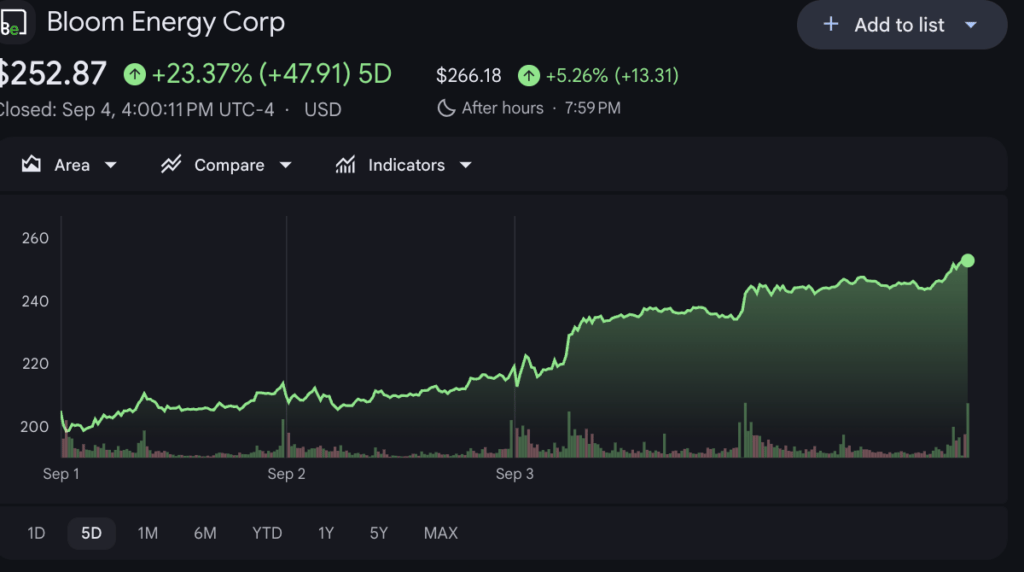
The investment has already moved in the right direction. On September 4, S&P Dow Jones Indices announced that Bloom Energy would join the S&P 500 before the market opens on September 21, replacing companies including Molson Coors Beverage (NYSE: TAP).
The announcement triggered a rally in Bloom Energy shares, which continued climbing in subsequent sessions as investors positioned for the index addition. Notably, BE closed the last session up more than 7% at $252.
Why S&P 500 inclusion is bullish
S&P 500 inclusion is widely viewed as a positive catalyst because index-tracking funds and exchange-traded funds must buy shares of newly added companies to mirror the benchmark.
This creates additional demand for the stock between the announcement date and the effective inclusion date. Membership in the index can also increase institutional ownership, improve liquidity, and boost visibility among investors.
While post-inclusion performance is often mixed, many stocks experience strong gains leading up to their addition as passive funds accumulate shares.
Bloom Energy manufactures solid-oxide fuel cell systems that generate electricity on-site without combustion. The company has emerged as a beneficiary of growing power demand from AI data centers and hyperscale computing facilities.
The firm has secured major agreements supporting multi-gigawatt deployments and recently reported record quarterly revenue exceeding $1 billion.
Bloom Energy also raised its full-year guidance after posting strong year-over-year growth, driven by orders from major technology customers seeking alternatives to constrained grid capacity.
The combination of strong earnings, rising AI-related power demand, and S&P 500 inclusion has strengthened the investment case for the stock.
Pelosi’s controversial stock trades
Meanwhile, Pelosi’s Congress trades continue to attract public attention due to concerns about potential conflicts of interest and the gap between transaction dates and public disclosures.
Receive Signals on US Congress Members' Stock Trades
Stay up-to-date on the trading activity of US Congress members. The signal triggers based on updates from the House disclosure reports, notifying you of their latest stock transactions.
Pelosi’s household trades have been closely monitored for years because of their size and concentration in technology and growth companies.
Critics have called for stricter restrictions on stock ownership by lawmakers and their immediate family members.
At the same time, Pelosi’s office has previously stated that the congresswoman does not own stocks herself and has no involvement in or prior knowledge of transactions executed by her spouse. No formal findings of wrongdoing have resulted from the trades.
Featured image via Shutterstock