

Nike (NYSE: NKE) unveiled its “Full Stride Ahead” growth strategy on Tuesday, November 17, which includes $12 billion to be distributed to shareholders via dividends.
The sum will be distributed through cumulative dividend payments between fiscal 2027 and fiscal 2031, with approximately $2.4 billion in 2027 alone.
“Including fiscal 2027, the Company plans to return approximately $12 billion of cumulative capital to shareholders through dividends through the end of fiscal 2031, reinforcing its commitment to delivering shareholder returns while investing to restore sustainable growth,” the firm wrote.
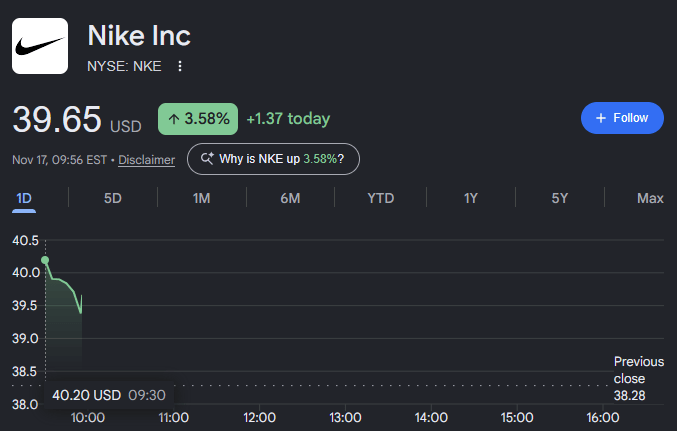
Nike shares are trading at $39.65, up 3.58% on the daily chart at press time.
New Nike guidance
At the same time, the sports apparel company reaffirmed its fiscal 2027 outlook, projecting a single-digit revenue decline and an adjusted operating margin of approximately 6%.
Meanwhile, adjusted earnings per share (EPS) are expected to range from $1.15 to $1.35, excluding approximately $0.15 per share in restructuring-related expenses.
Looking even further ahead, Nike aims to achieve operating margins of 12% to 14% and adjusted earnings per share of $3.00 to $3.50 by fiscal 2031.
According to the announcement, Performance Sports are expected to account for approximately $4 billion of the targeted incremental revenue growth, while Sportswear is projected to contribute another $1 billion,
Nike’s Full Stride Ahead strategy
The Full Stride Ahead strategy itself centers on five priority Performance Sports categories: Running, Training, Global Football, Basketball, and Outdoor. The Sportswear portfolio, which includes Nike Sportswear, Jordan, and Converse, represents another key growth area.
With 23 priority countries covered, management expects those businesses to generate more than 90% of Nike’s revenue growth through fiscal 2031.
Furthermore, the company expects revenue declines to slow down in fiscal 2028, followed by a return to market-level growth in fiscal 2029. After that, the company expects revenue growth to accelerate beyond overall market growth in fiscal 2030 and fiscal 2031.
Featured image via Shutterstock