

Palantir’s (NASDAQ: PLTR) situation since the start of 2026 has been somewhat contradictory, as it has been affected by the stagnation of the artificial intelligence (AI) sector, the software sell-off, and the military-industrial complex boom.
Amidst the uncertainty, insider activity might be the strongest indicator that the bearish forces are the most decisive, considering the technology giant’s top executives have been dumping an average of almost $6 million worth of PLTR shares daily since the year started.
Specifically, across 12 sales, Palantir senior personnel raised more than $436 million by selling equity for a daily average of $5.82 million.
The smallest of the 2026 trades was made by Director Lauren Friedman Stat, who, on February 2, sold 400 shares at an average price of $151.14, making $60,456.
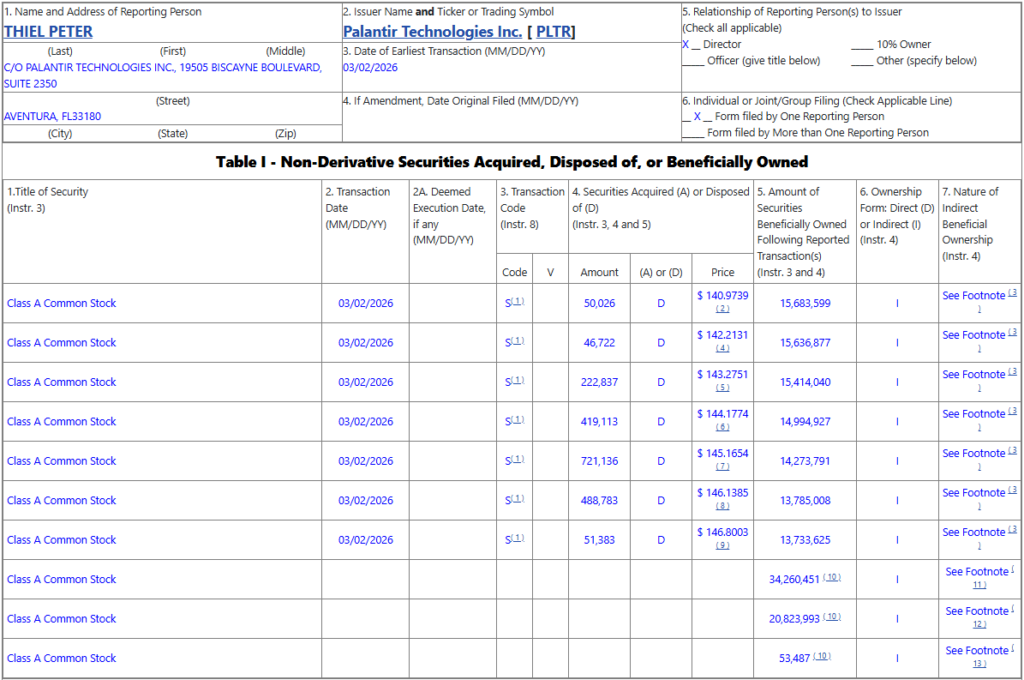
The biggest 2026 Palantir stock sale was the doing of Peter Thiel. On March 2, the billionaire dumped 2 million PLTR shares at $144.85, raising a total of $289.7 million and becoming responsible for 66.34% of the total value of insider sales this year.
Why massive Palantir stock insider sales are likely not bearish
Elsewhere, though the scale of insider selling appears, at face value, as a sign that insiders are anticipating a crash, there are multiple reasons to believe they were, in fact, part of regular trading activity.
Specifically, Palantir executives often engage in extensive stock trading, and as large as Peter Thiel’s March 2 trade was, it was smaller than the $310 million dump done in March 2025 by Director Andrew Cohen, or the late 2024 $370 million PLTR stock sale made by Shyam Sankar.
Furthermore, the War against Iran that was started by the U.S. and Israel on February 28, 2026, proved a substantial boon for the technology giant.
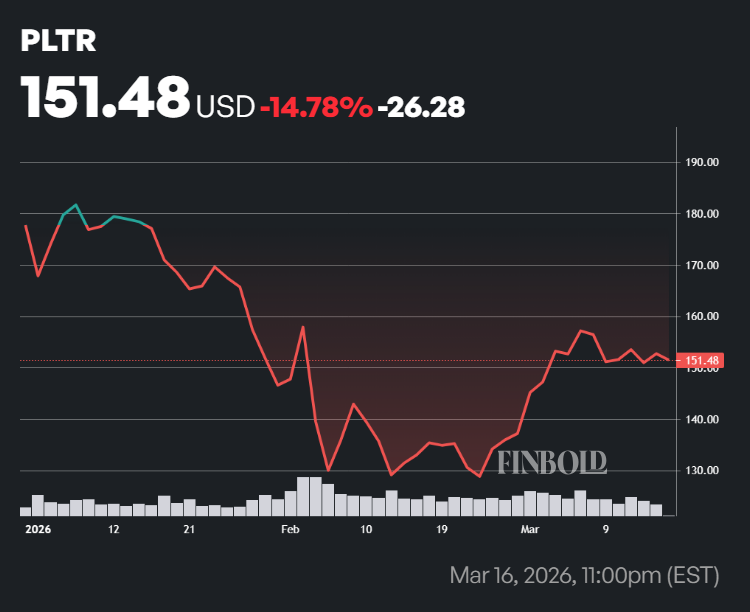
Indeed, while Palantir stock is 14.78% down in 2026, it rallied more than 11% since the last trading session ahead of the bombardment from $137.19 on February 27 to $151.48 on March 17.
Considering how embedded the company is with the U.S. military and how important its software, such as the Maven Smart System (MSS), is in aerial campaigns, it is unlikely that senior executives at the company were not aware of the war plans at least some days ahead of the campaign.
Featured image via Shutterstock