

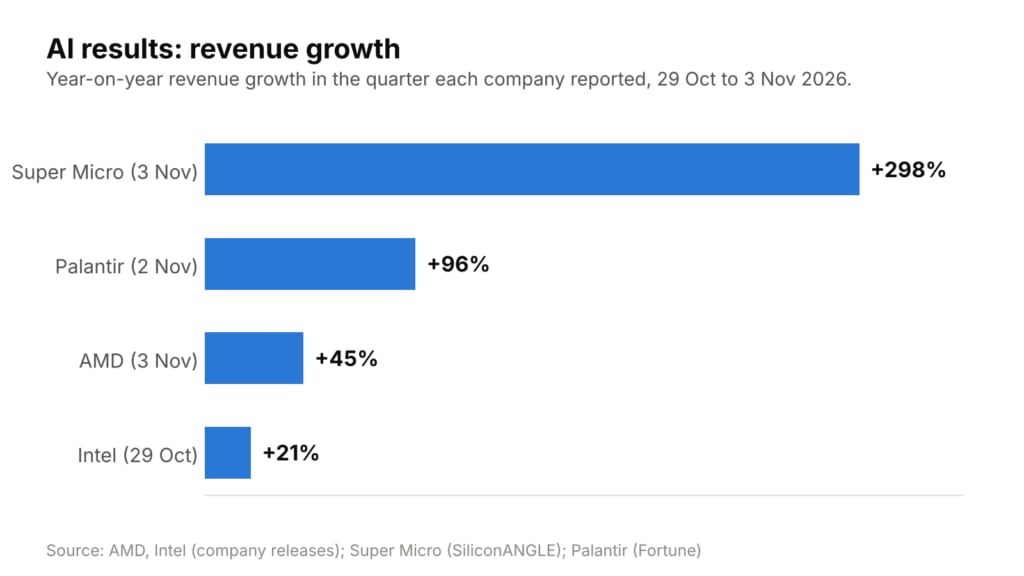
AI stocks remain a major driver of market sentiment, with crypto traders also watching closely as Bitcoin and other digital assets often move alongside the Nasdaq. AMD, Palantir and Super Micro each reported revenue growth of 45% or more in the latest round of AI results, and Intel, which grew 21%, still fell 28.6% in a day. The reaction showed that growth alone no longer moves these shares: guidance and margins mattered more.
Demand is growing fast, but not evenly
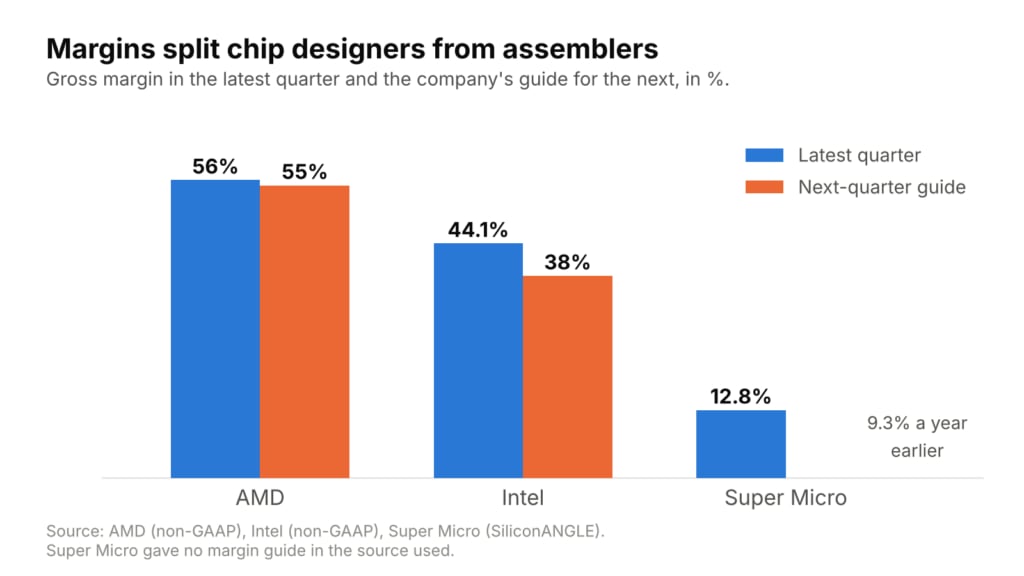
AMD reported on 3rd November that revenue rose 45% to $13.4 billion, a record and above the top of its own guidance. Data centre sales almost doubled, up 97% to $8.5 billion, and now make up about 64% of the total. Non-GAAP gross margin was 56% and non-GAAP earnings per share rose 74% to $2.09. For the fourth quarter, AMD guided to revenue of about $17 billion, roughly 66% higher than a year earlier, with gross margin of about 55%. The weak spot was gaming, where revenue fell 40% to $773 million. AMD shares rose about 8% in extended trading on PrimeXBT’s price, after falling about 17% over the three sessions to 2nd November. On 4th November, the shares gave up the whole of that gain before the US open and then recovered to close about 1% above their $483.90 close on 3rd November, on a day when the PHLX Semiconductor Index fell 3.1%.
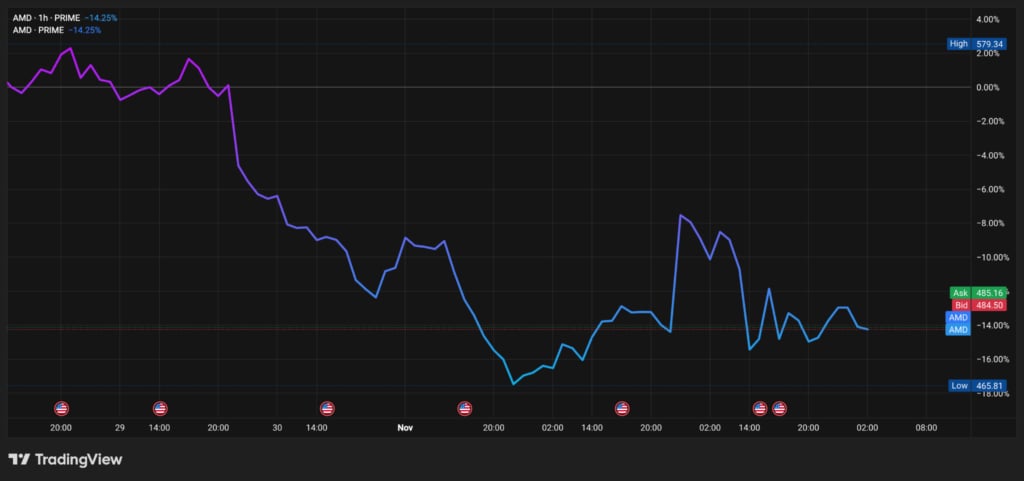
AMD hourly price on PrimeXBT, 28th October to 4th November, shown as percentage change from the start of the chart. The share fell to a low of $465.81 on 2nd November, jumped about 8% after results on 3rd November, then gave up that gain before the US open on 4th November. It ended at $484.50, down 14.25% over the period.
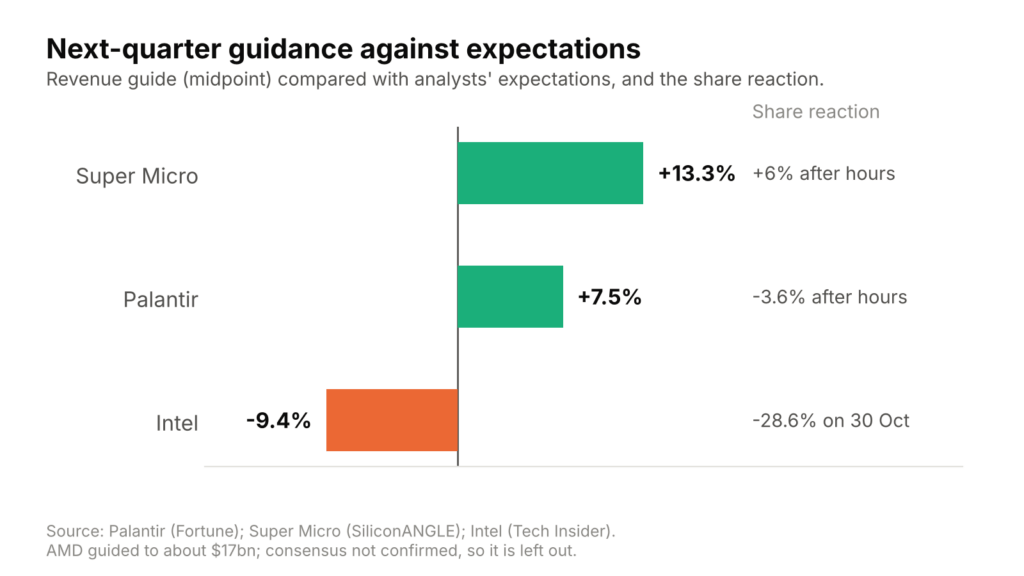
Palantir reported on 2nd November that revenue rose 96% to $2.3 billion, the fastest growth in its history according to its finance chief, and crossed $2 billion in a quarter for the first time. US commercial revenue grew 148% to $984 million and, for the first time, was larger than US government revenue at $953 million. Earnings per share were $0.44, against $0.41 expected. Palantir guided to fourth-quarter revenue of $2.64 billion to $2.65 billion, against about $2.46 billion expected, and raised its full-year forecast to about $8.53 billion. Its adjusted operating margin was 62%, on adjusted operating income of $1.427 billion. Even so, the shares rose about 1.5% after the report and then fell 3.6% as a wider selloff in AI shares weighed on the market.
Super Micro reported fiscal first-quarter results, covering July to September, on 3rd November. Revenue rose 298% to $19.95 billion, against $17.35 billion expected, and earnings per share were $1.81, against $1.23 expected. Gross margin improved to 12.8% from 9.3% a year earlier, still far below a chip designer such as AMD because Super Micro builds servers around other companies’ chips. It guided to second-quarter revenue of $19.5 billion to $21.5 billion, against $18.1 billion expected, and the shares rose more than 6% after hours. Arista Networks, which supplies networking for AI data centres, told a similar story: revenue rose 58% to $3.66 billion and its shares gained about 7% after hours. On 4th November, Super Micro shares gave up their after-hours gain before the US open and closed down 5.7%.
Intel‘s results were followed by a much sharper sell-off. The company reported on 29th October that revenue rose 21% to $16.5 billion, with data centre and AI revenue up 78% to $7.3 billion and Intel Foundry revenue up 58% to $6.7 billion. The shares still fell 28.6% the next day, Intel’s steepest one-day fall since 1974, and the move began after the US close, when they dropped more than 20% in extended trading. The reason was the outlook. Intel guided to fourth-quarter revenue of $15 billion to $16 billion, against about $17.1 billion expected, and to adjusted earnings of $0.25 a share, against about $0.43 expected. It forecast gross margin of 38%, down from 44.1% in the third quarter. Intel also said it expects the PC market to shrink 12% in 2026 and 10% in 2027, with memory costs rising as suppliers move capacity to AI chips, and its finance chief said the PC slowdown should last at least through the first half of next year.
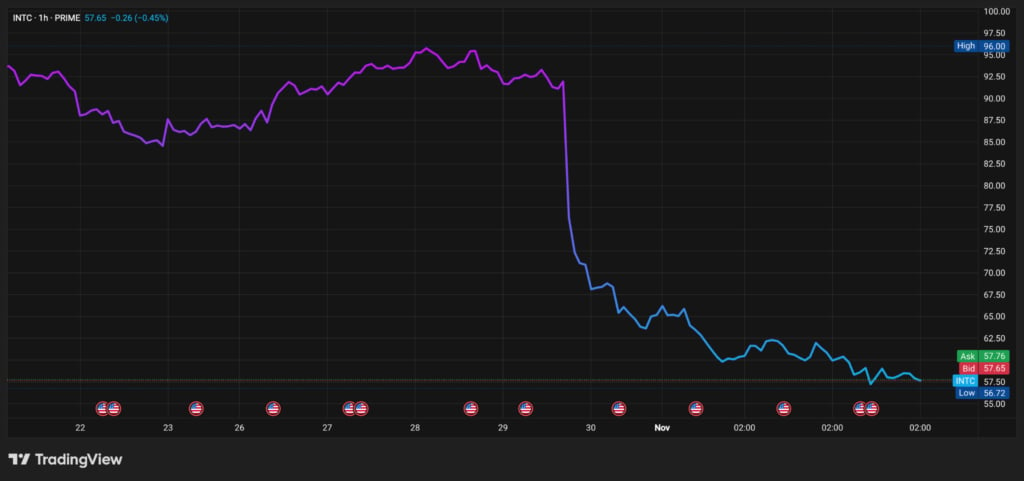
Intel (INTC) on PrimeXBT: down about 40% from its 28th October high to the 4th November close, with most of the fall coming after the 29th October results.
How the four compare
| Share | Revenue growth | Gross margin | Next-quarter guidance | Reaction |
|---|---|---|---|---|
| AMD (3rd Nov) | +45% to $13.4bn | 56% non-GAAP (guide: about 55%) | About $17bn, roughly +66% | About +8% in extended trading; +1% at the 4th Nov close |
| Palantir (2nd Nov) | +96% to $2.3bn | 62% adjusted operating margin | $2.64bn to $2.65bn, against about $2.46bn expected | +1.5%, then -3.6% after hours |
| Super Micro (3rd Nov) | +298% to $19.95bn | 12.8% (9.3% a year earlier) | $19.5bn to $21.5bn, against $18.1bn expected | More than +6% after hours; -5.7% at the 4th Nov close |
| Intel (29th Oct) | +21% to $16.5bn | 44.1% non-GAAP (guide: 38.0%) | $15bn to $16bn, against about $17.1bn expected | -28.6% on 30th Oct |
Growth. AMD’s data centre business, up 97%, and Palantir’s US commercial business, up 148%, show that AI demand is spreading from a few giant buyers into ordinary companies.
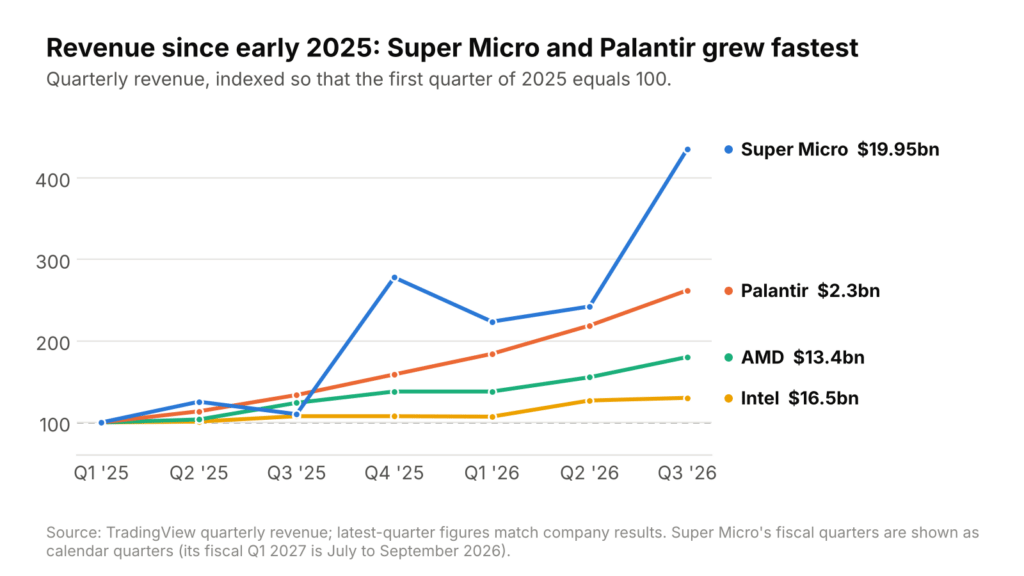
Margins. The results split into chip designers and assemblers. AMD keeps about 56 cents of every dollar of revenue as gross profit and Super Micro keeps about 13 cents, so Super Micro needs far more volume for the same profit. Intel’s guided drop from 44.1% to 38.0% shows what a weak PC market and higher memory prices do to a business that still depends on both.
Spending. The demand behind these results is mostly spending by the biggest cloud companies. Amazon said on 29th October that it still expects about $220 billion of capital spending in 2026, much of it for AI, and its free cash flow over the past 12 months was negative $42.4 billion. Investors are increasingly focused on whether major cloud companies can maintain this level of AI spending.
Forward guidance played a major role in how investors reacted to the results. Intel beat for the quarter and fell 28.6% on a weak outlook. AMD and Super Micro guided strongly and rose after hours, but by the close on 4th November AMD was up only 1% and Super Micro was down 5.7%. Palantir guided far above expectations and still slipped after hours, a reminder that a market-wide selloff can outweigh a strong report.
A sector selloff on 4th November. The PHLX Semiconductor Index fell 3.1% to a six-month low, as chipmakers and data centre operators sold off on fears that US election results could bring tighter limits on data centre expansion, especially in states such as Texas and Georgia, where public opposition to the build-out has been growing. NVIDIA fell 3.2%, Micron 7.0% and Super Micro 5.7%, while AMD closed up 1% and Arista Networks gained 5%.
What to watch in NVIDIA’s upcoming earnings
NVIDIA reports on 17th November and is the next test for the whole group. Its shares fell 3.2% on 4th November as chip stocks sold off. For the quarter it is about to report, it guided in August to revenue of $108 billion, against $104.2 billion expected, after revenue of $96.2 billion, up 106%, in the previous quarter. Three questions matter most:
- Growth: can NVIDIA clear its own $108 billion guide, at a time when AMD’s data centre revenue is also nearly doubling?
- Margins: NVIDIA’s adjusted gross margin was 75% last quarter. AMD is guiding to about 55% and Intel to 38%, so any slip in NVIDIA’s margin as memory costs rise would stand out.
- Spending: cloud customers’ capital spending plans, such as Amazon’s $220 billion, feed NVIDIA first, so any change in tone would show up in its outlook.
Trading AI earnings with PrimeXBT
PrimeXBT, a global multi-asset broker and crypto asset service provider, offers CFDs on shares of major AI and tech companies, including AMD, Palantir, Intel, Super Micro and NVIDIA. These are derivatives that track price movements, allowing traders to take long or short positions without owning the underlying shares. PrimeXBT has operated since 2018 and serves traders in more than 150 countries, combining competitive trading conditions with advanced technology and intuitive platforms designed for both beginners and experienced traders.
For NVIDIA, crypto traders can also gain exposure through the NVDA/USDT Tokenised Stock Crypto Futures on PrimeXBT’s native PXTrader 2.0 platform, which is quoted in USDT and trades 24/7, including at weekends and when US stock exchanges are closed. This extended access can be particularly relevant during earnings season, when major announcements often come outside regular market hours. For instance, Intel’s fall started after the US close on 29th October, hours before the next session opened. With execution times reported at under 30 milliseconds and 99.98% uptime, PrimeXBT provides the speed and reliability needed to navigate fast-moving markets, particularly when chip shares experience sharp price movements, as seen on 4th November.
Trading costs are another consideration, particularly during periods of heightened market activity. On the Crypto Futures side, fees start from 0.01% for makers and 0.045% for takers, with further discounts through the broker’s volume-based VIP program. At VIP level 5 (the top VIP tier), taker fees fall to 0.015%, and new clients automatically receive VIP level 4 pricing for their first 14 days, including a 33% discount on taker fees.
Accounts can be held in USDT, USDC, BTC or ETH, alongside USD, so traders can follow AI earnings from the same platform they use for trading Bitcoin and more than 170 other Crypto Futures. To support trading decisions and position management, the platform combines integrated TradingView charts with more than 100 indicators, stop-loss and take-profit orders, and cross or isolated margin. Traders can also test strategies on a demo account before moving to live trading, with no minimum deposit requirement and 24/7 live chat support.
The next major test
NVIDIA’s results on 17th November will be the next major test for AI stocks. After mixed reactions to earnings across the sector, investors will be watching whether NVIDIA can maintain its rapid revenue growth, protect its margins and show that demand from major cloud customers remains strong.
Trade Shares with PrimeXBT.
About PrimeXBT
PrimeXBT is a global multi-asset broker and crypto asset service provider trusted by traders in more than 150 countries. The platform bridges traditional and digital markets within one integrated environment, redefining versatility and innovation in online trading. Clients can access Forex, CFDs on indices, commodities, shares, crypto, and Crypto Futures, as well as buy, store and exchange cryptocurrencies. This unified experience extends across both the native PXTrader 2.0 platform and MetaTrader 5, supported by advanced risk-management tools and a wide range of funding options in crypto, fiat and local payment methods. Since 2018, PrimeXBT has focused on empowering traders through broad multi-asset access, fair and transparent conditions, professional-grade technology and dedicated human support. By combining expertise, trust and a client-first approach, PrimeXBT sets a benchmark of excellence in the financial industry and provides traders with the tools they need to trade, grow and succeed with confidence.
Disclaimer: The content provided here is for informational purposes only and is not intended as personal investment advice and does not constitute a solicitation or invitation to engage in any financial transactions, investments, or related activities. Past performance is not a reliable indicator of future results. The financial products offered by the Company are complex and come with a high risk of losing money rapidly due to leverage. These products may not be suitable for all investors. Before engaging, you should consider whether you understand how these leveraged products work and whether you can afford the high risk of losing your money. The Company does not accept clients from the Restricted Jurisdictions as indicated on its website / T&Cs. Some products and services, including MT5, may not be available in your jurisdiction. The applicable legal entity and its respective products and services depend on the client’s country of residence and the entity with which the client has established a contractual relationship during registration.


