

The S&P 500 faces a pivotal session on Monday as investors weigh renewed stock market crash fears against signs of a recovery.
Monday’s session coincides with the 39th anniversary of the 1987 Black Monday crash, when the Dow Jones Industrial Average plunged 22.6% in a single session.
Crash fears intensified following Friday’s broader market sell-off with the S&P 500 closing at 7,659 down about 1%.
Therefore, the benchmark index’s performance on October 19 could indicate whether last week’s losses are nearing a turning point or further declines lie ahead.
To this end, traders on cryptocurrency prediction platform Polymarket believe the market is likely to rebound with data retrieved by Finbold showing an 83% probability of the S&P 500 closing higher, up 33 percentage points.
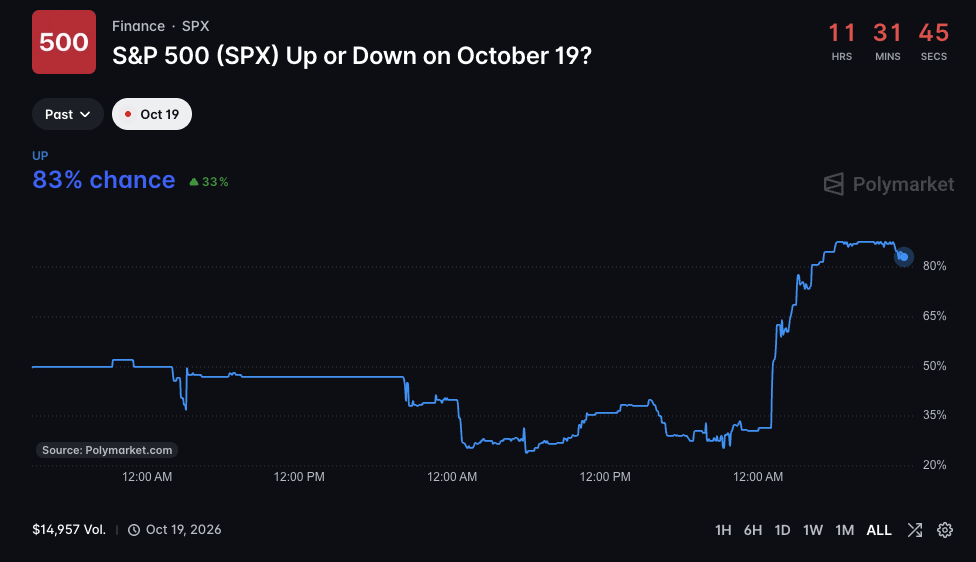
The bullish outlook coincides with a rebound in U.S. stock futures ahead of Monday’s opening bell. S&P 500 futures rose approximately 0.8%, while Nasdaq 100 futures gained 1.3% and Dow Jones futures advanced around 0.5%.
The recovery follows a technology-led sell-off as investors reassessed the financial risks of AI infrastructure spending. The Nasdaq 100 fell 5.5% over the previous week, while concerns about credit spreads and financing costs weighed on companies investing heavily in data centers.
Lower oil prices also supported sentiment, with Brent crude falling 1.8% to $107.83 a barrel in early trading after U.S. President Donald Trump moved to waive some sanctions on Russian oil.
However, geopolitical tensions, including concerns about shipping through the Strait of Hormuz, remain a risk. A renewed rise in energy prices could fuel inflation and complicate the outlook for interest rates.
Why Black Monday crash fears are resurfacing
Despite renewed crash fears, the circumstances surrounding the current market sell-off differ from those of 1987.
This year, concerns center on AI valuations, rising financing costs and whether massive investments will generate sufficient returns. Meta Platforms (NASDAQ: META), for example, expects capital expenditure of $130 billion to $145 billion in 2026.
Higher Treasury yields and wider credit spreads are raising borrowing costs, while the S&P 500’s reliance on a handful of major technology stocks leaves it vulnerable to further sector-wide selling.
However, the anniversary alone does not signal another crash. The 1987 sell-off had distinct causes, including computerized trading, while Monday’s futures rebound suggests some investors are buying after last week’s losses.
Wall Street S&P 500 outlook
Meanwhile, Wall Street’s outlook remains divided as investors weigh earnings growth against elevated valuations.
For instance, Yardeni Research cut its year-end S&P 500 target to 7,900 from 8,400, moving its previous target to mid-2027 while maintaining its 2027 earnings forecast of $425 per share.
On October 15, Yardeni also lowered its forward price-to-earnings ratio assumption to 18.6 from 19.8, reflecting the risk of further valuation declines as investors become more cautious.
Other analysts remain more bullish, with forecasts centered around 8,000, supported by expectations of strong third-quarter earnings, particularly from technology companies. S&P 500 earnings were projected to grow approximately 30.6% year over year, although much of that growth is expected to come from major technology firms.
This concentration leaves the index vulnerable to disappointing results and further valuation cuts.
Featured image via Shutterstock