
As important as June was for SpaceX (NASDAQ: SPCX), July has solidified itself as featuring multiple milestones, of which the fall to a new all-time low of $107.01 and a decisive plunge below the initial public offering (IPO) price are arguably the most important.
Moving forward, August is set to be a key period as well, with the company’s first-ever quarterly filing as a public firm scheduled for Tuesday.
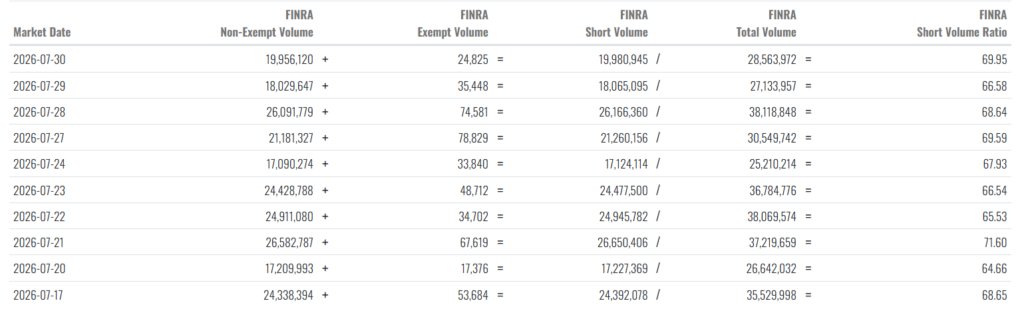
Examining the market on July 31, it would appear that the ongoing month had a greater impact on investors than the mid-June frenzy, considering that, on Thursday, SPCX stock saw its short volume ratio hit a 10-day high.
Specifically, the metric that measures the prevalence of bearish bets crossed above 71 on July 21 and then declined to the range between roughly 65 and 69.
Finally, despite SpaceX shares declining 0.31% to their latest closing price of $112.20 during the session, Thursday saw a new short volume ratio high of 69.95, signalling that traders expect little recovery and no strong tailwinds from the August 4 filing.
Why SpaceX stock is falling and SPCX short volume ratio is soaring
Meanwhile, SPCX equity’s 50% decline from the $225.64 high recorded on June 16 can largely be attributed to the firm’s exceptionally stretched IPO valuation.
Indeed, though the firm revealed it lost nearly $2 billion in the first quarter (Q1) of 2026 while accruing less than $5 billion in sales, it arrived at Nasdaq with a market capitalization of $1.77 trillion.
Though multiple analysts are forecasting a veritable revenue explosion in the coming years and Elon Musk himself speculated the number could hit $1 trillion by 2030, the sheer pace of growth has seemingly left more doubters than believers.
Much the same can be said about the nearly $30 trillion total addressable market (TAM) identified in the SpaceX S-1 filing and the Street high forecast of $800 – on that would see SPCX valuation soar to $10.5 trillion to represent roughly 30% of the total U.S. gross domestic product (GDP).
Under the circumstances, it is not difficult to see why some observers, such as professor and fund manager Patrick Boyle, came to reminisce about the now-banned Dot-com era practice of analysts publicly praising companies they privately consider worthless, nor why short positions appear to have maintained a lead with regard to SpaceX stock.
Is SpaceX stock a good investment ahead of the August 4 earnings?
Looking at the August 4 quarterly filing, it is also relatively easy to see why traders might trend toward bearishness.
Notably, though analysts are expecting a significant revenue expansion relative to Q1 and to above $6 billion, the number not only appears minuscule given the firm’s market capitalization, but seems entirely linked to the easily-cancelled compute deals with Anthropic and Google’s parent company, Alphabet (NASDAQ: GOOGL).
Furthermore, the data center deals themselves can be read as concerning in the long-term as they indicate that SpaceX has significantly more capacity than it needs despite positioning itself as primarily an artificial intelligence (AI) company and despite the majority of the growth projections hinging on AI.
Similarly, despite expecting sales to grow and frequently voicing a belief that Elon Musk’s newer public company is undergoing a transformation that will yield large returns down the line, Wall Street experts are not anticipating the firm to turn profitable yet and are calling for a $0.26 loss per share.
Lastly, while none of the projections necessarily mean SpaceX will not rally after the August 4 filing – an earnings beat, strong guidance, or an optimistic story told by the world’s first billionaire could all drive the equity higher – more trouble is likely to follow as the first insider unlocks are due mere days after the document is published.
Featured image via Shutterstock