

SpaceX (NASDAQ: SPCX) has erased approximately $1.2 trillion in market value within a month of its historic public debut, as a sharp selloff reversed much of the stock’s post-IPO rally.
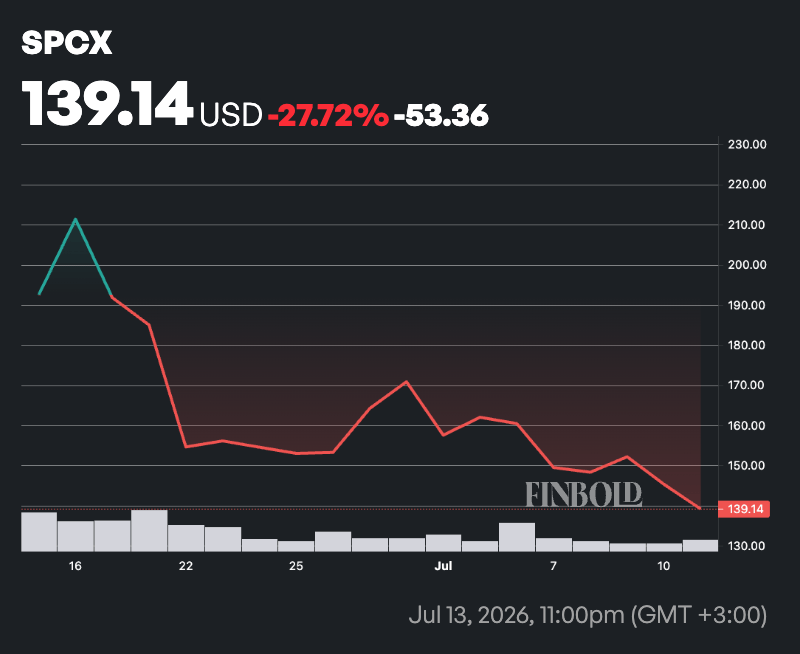
The aerospace and satellite communications company went public on Nasdaq on June 12, 2026, at $135 per share, briefly reaching a market capitalization of nearly $2.9 trillion just four days later.
However, the stock has since fallen sharply, reducing its valuation to about $1.83 trillion at Monday’s close.
The decline reflects growing investor concerns over SpaceX’s valuation following its record-breaking IPO and raises questions about whether the company’s long-term growth prospects can justify its current market capitalization.
Investor enthusiasm initially propelled SpaceX shares above $225 on June 16, making the company one of the world’s most valuable publicly traded firms.
The rally proved short-lived, with the stock entering a sustained downtrend marked by several steep daily declines, including a 16% drop in a single session.
By July 13, SpaceX shares closed at $139 after falling more than 4% on the day, marking a new post-IPO low. At current levels, the stock trades only slightly above its $135 IPO price, leaving many investors who bought during the initial surge facing significant losses.
Why SpaceX stock is declining
The selloff comes as investors reassess SpaceX’s valuation and financial outlook after the excitement surrounding its market debut.
The company generated $18.7 billion in revenue in 2025, up about 33% year-over-year, but reported a net loss of $4.9 billion as heavy spending on artificial intelligence infrastructure and Starship development weighed on profitability.
Starlink remains the company’s primary profit driver, contributing roughly $11.4 billion in revenue and serving more than 10.3 million subscribers as of the first quarter of 2026.
Analysts expect SpaceX revenue to reach between $34 billion and $43 billion this year, supported by continued subscriber growth and expanding AI compute contracts.
At the same time, the Federal Aviation Administration has closed its investigation into the Starship Flight 12 anomaly, clearing the way for Starship Flight 13 as early as July 16.
The mission is expected to deploy advanced Starlink V3 satellites and conduct additional reusability tests critical to SpaceX’s long-term growth strategy.
At the same time, concerns remain over insider share unlocks expected after second-quarter earnings in August, which could significantly increase the public float and add selling pressure.
Despite the sharp decline, SpaceX remains one of the world’s largest publicly traded companies. The stock’s next move will likely depend on the success of upcoming Starship milestones, Starlink’s continued expansion, AI revenue growth, and the company’s ability to balance aggressive investment with a path to profitability.