
Shares of Tesla (NASDAQ: TSLA) may be facing further downside pressure after the stock closed below a key technical level.
At the close of markets on Friday, TSLA shares were valued at $391, down almost 1% for the day. Year to date, the stock has plunged more than 10%.
The latest move marks Tesla’s drop below the closely watched 200-day moving average (MA) for the first time since September, signaling weakening long-term momentum.
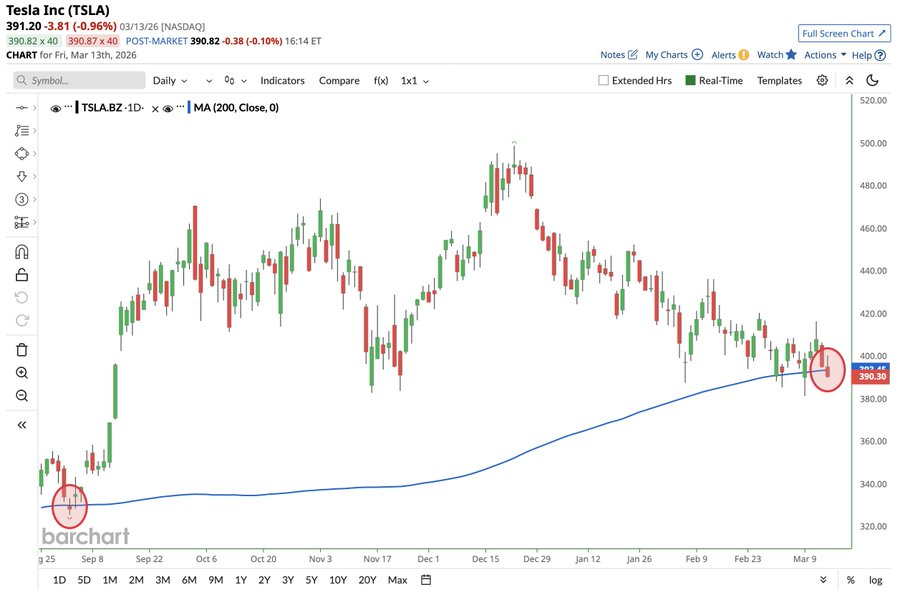
The breakdown comes after the stock has already fallen more than 20% from its December all-time high, a decline that places Tesla firmly in bear-market territory by traditional market definitions.
Notably, the 200-day moving average is a widely used indicator to gauge a stock’s long-term trend. Trading above it typically signals strong bullish momentum and institutional support, while a move below it often points to a broader downtrend.
Tesla shares have been declining since peaking in late December, forming lower highs and lower lows through January and February. The latest candles show the price breaking below the rising 200-day average near the $395–$400 zone, a level that previously acted as support.
Although the stock briefly dipped below this level in early September before rebounding, the current setup appears more fragile, as the broader pullback and persistent selling pressure suggest the potential for a deeper decline rather than a short-term shakeout.
Tesla’s bearish pressure
Overall, the electric vehicle giant has faced renewed pressure, extending a multi-week decline as investors weigh slowing core auto sales against ambitious bets on autonomy and humanoid robots.
For instance, in China, Tesla’s made-in-China EV sales rose more than 35% year over year in the first two months of 2026, reaching 127,728 units and outperforming rivals such as BYD, whose figures declined during the same period. This provides a bright spot in what remains a challenging global EV market.
However, analysts have sharply cut 2026 delivery growth forecasts, with some now predicting a third consecutive year of declining deliveries amid intensifying competition and margin pressures.
Tesla’s strategic pivot includes heavy investment, more than $20 billion planned in capital expenditures, toward artificial intelligence, robotaxis, and the Optimus humanoid robot.
Recent highlights include showcasing the upcoming Gen 3 Optimus at AWE 2026 in Shanghai, with mass production targeted by the end of the year, alongside public displays of the company’s Cybercab concept at various events.
At the same time, CEO Elon Musk has emphasized annual robot updates and transformative AI projects.
Overall, Tesla’s trajectory in 2026 increasingly hinges on execution in these non-vehicle segments as traditional EV volume growth slows. Investors are now awaiting first-quarter updates for clearer signals on the company’s AI-driven future.
Featured image via Shutterstock