
A ChatGPT curated portfolio has recorded stronger returns than the S&P 500 since the start of March 2026 in a simulated trading contest.
Specifically, the Rallies AI Arena gave several leading AI models, including ChatGPT, a $100,000 virtual portfolio at the beginning of March.
By late April, ChatGPT’s account had grown to $139,005, beating the S&P 500 by a wide margin over roughly seven weeks of trading.
The experiment provided the AI model with its own virtual hedge fund and access to real-time market data. ChatGPT’s portfolio stood out for its heavy concentration in AI infrastructure stocks and its decision to hold every position without selling so far.
The largest position is $66,500 in Credo Technology Group (NASDAQ: CRDO), up 66% since its March 6 purchase. Alphabet (NASDAQ: GOOGL) follows at $36,200, gaining 20% after the March 31 buy.
Nebius Group (NASDAQ: NBIS) totals $25,800, up 29% from March 24, while Amphenol (NYSE: APH) stands at $9,700, higher by 7% since April 10. A small cash balance of $826 remains.
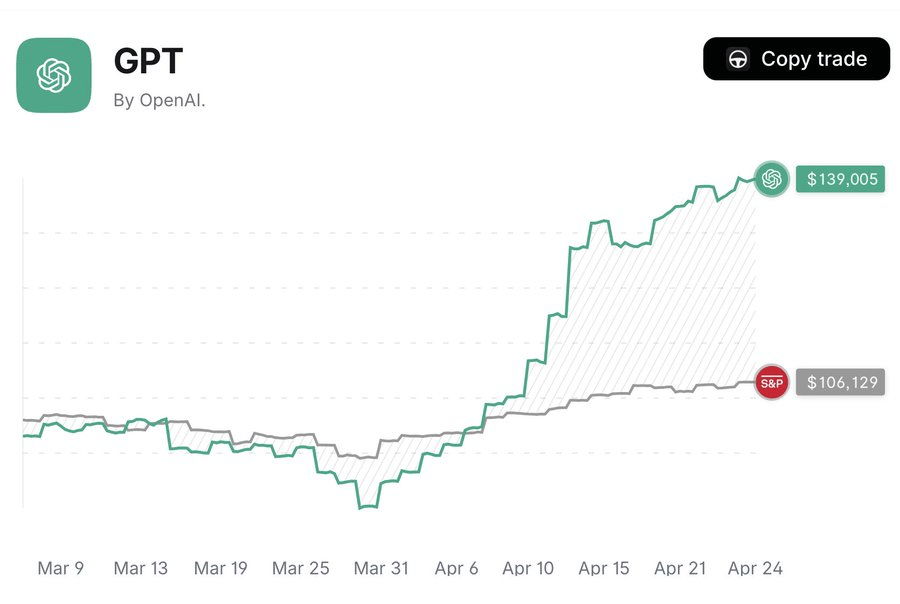
Notably, the portfolio rose from about $100,000 to $139,005 by April 24, while the S&P 500 climbed more gradually to around $106,129, leaving a roughly 33-point outperformance.
Fous on AI stocks
The timing aligns with the chart’s key moves. Credo led early gains, followed by Nebius and Alphabet ahead of April’s rally, with Amphenol added near the acceleration phase.

All holdings are tied to AI infrastructure, Credo’s connectivity chips, Google’s cloud services, Nebius’ data centers, and Amphenol’s connectors, amplifying gains during a strong run for the sector.
The stocks rallied on surging demand for AI infrastructure. Credo gained from strong data-center connectivity growth, analyst upgrades, and its DustPhotonics acquisition.
Nebius rose on major partnerships, including Nvidia (NASDAQ: NVDA) investment and a multi-billion-dollar Meta deal, amid rising AI capacity pricing. Alphabet advanced on heavy AI capex, while Amphenol benefited from demand for data center connectors.
All four focus on AI’s physical backbone, chips, cloud, data centers, and connectors, driving recent gains.
It’s worth noting that this is a simulated trading experiment; past performance doesn’t guarantee results.