

While investors have spent much of the past decade chasing artificial intelligence, semiconductor, and software stocks, one of the biggest wealth creators of the 21st century has emerged from the consumer goods sector.
In this regard, Monster Beverage (NASDAQ: MNST), the company behind Monster Energy drinks, has turned a $10,000 investment made before July 2003 into more than $21 million by August 2026.
That equates to a gain of approximately 210,000%, making Monster one of the best-performing non-tech stocks of the modern era. The stock’s cumulative return stands at roughly 210,079% over 279 months, representing more than 23 years of compounding growth.
Historical data indicates that Monster Beverage shares have climbed from near-zero levels in the early 2000s to trade at around $90 at press time.
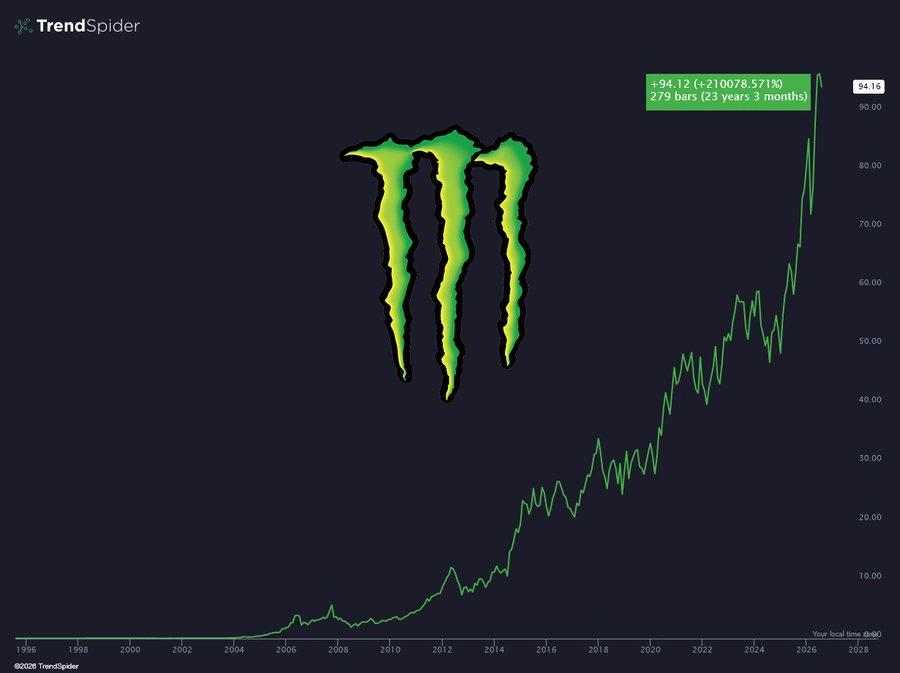
Notably, insights from charting platform TrendSpider show that Monster’s rise was far from linear. The company endured several significant pullbacks during major market downturns, including the 2008 financial crisis, the pandemic period, and broader market corrections.
Monster Energy stock’s rise
Monster’s breakthrough came with the launch of Monster Energy in 2002. By offering a larger 16-ounce can at a price comparable to rivals, the company quickly gained market share.
Growth accelerated throughout the 2000s as Monster expanded its product lineup and brand reach. Another major milestone came in 2015 when it partnered with Coca-Cola, gaining access to the beverage giant’s global distribution network while Coca-Cola acquired a minority stake in the company.
At the same time, Monster’s business momentum has remained strong despite its scale. The company generated $8.29 billion in revenue in 2025 while in the second quarter of 2026, net sales rose 20.2% year-over-year to $2.54 billion, supported by strong international demand and continued growth in zero-sugar products.
International revenue increased 34.6% to $1.16 billion and accounted for approximately 46% of total sales, reflecting the company’s expanding global footprint. Gross margins remained near 56%, while earnings continued to post double-digit growth.
Overall, the fim’s success has been driven by strong branding, product innovation, global distribution expansion, and consistent execution over more than two decades.