

Despite ongoing criticism of lawmakers trading stocks, members of Congress have continued to post profitable trades.
Data from a bot tracking congressional trades shows that average investors who mirrored politicians’ trades would be ending 2025 in profit, despite heightened market volatility.
Receive Signals on US Congress Members' Stock Trades
Stay up-to-date on the trading activity of US Congress members. The signal triggers based on updates from the House disclosure reports, notifying you of their latest stock transactions.
The strategy, known as Congress Buys and developed by Quiver Quantitative, tracks stocks purchased by members of the U.S. Congress and their immediate families. It weights positions based on disclosed purchase sizes and rebalances weekly, creating a systematic way to follow lawmakers’ trading activity.
In 2025, the strategy has delivered a year-to-date gain of about 31%, comfortably outperforming the broader U.S. equity market. The performance supports the view that aggregated congressional trading data can generate consistent excess returns.
That strength builds on a solid long-term record. Since April 2020, Congress Buys has produced a compound annual growth rate of just over 35%, with one-year returns exceeding 31%, highlighting its resilience across varying market conditions.
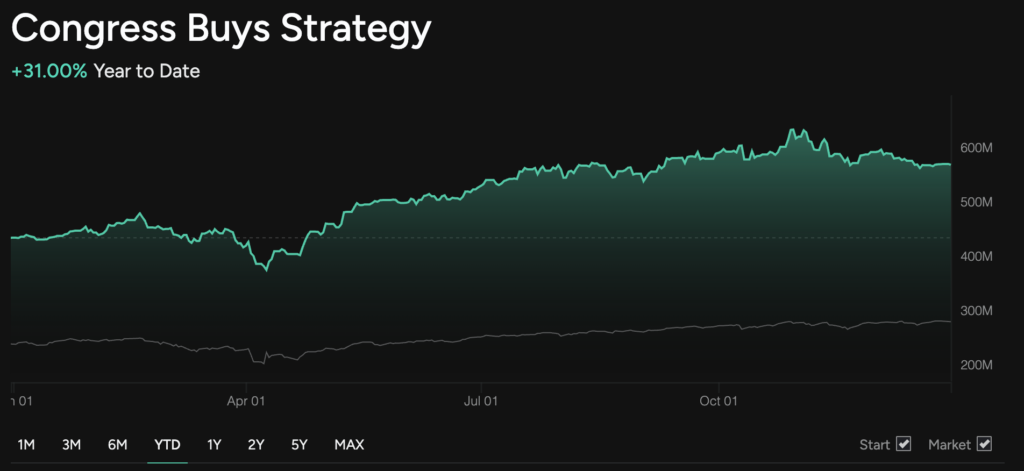
The strategy works by tracking stocks lawmakers are actively buying, aiming to capture conviction reflected in public disclosures, with weekly rebalancing to stay aligned with the latest filings.
Push to ban Congress trading
Its success comes as momentum builds behind efforts to restrict congressional stock ownership, amid concerns that lawmakers’ repeated market outperformance may stem from privileged access to policy and regulatory information.
Notably, as things stand, momentum is building in the U.S. Congress to impose a ban on stock trading by lawmakers, as bipartisan frustration grows over persistent conflicts of interest and public distrust.
Several proposals introduced in recent months would prohibit members of Congress, and in some cases their spouses and dependents, from buying or selling individual stocks while in office, instead requiring divestment or placement of assets into blind trusts.
The renewed push follows years of criticism despite the existence of the 2012 STOCK Act, which mandates disclosure of trades but allows lawmakers to continue actively trading with relatively minor penalties for violations.
Supporters of the ban argue that access to nonpublic briefings and committee work creates unavoidable conflicts, even if no wrongdoing is proven, while opponents cite concerns over scope and enforcement.
Featured image via Shutterstock