

Micron Technologies (NASDAQ: MU) could plunge to $400 by late February 2027 if a long-term technical pattern plays out.
The forecast comes after MU stock closed the last session at $933. A decline to $400 would represent a drop of roughly 57% from current levels.
Notably, the stock has enjoyed a strong run following a historic rally fueled by demand for high-bandwidth memory (HBM), data center chips, and artificial intelligence infrastructure.
The analysis by TradingShot, shared in a TradingView post on September 1, examined Micron’s monthly chart and highlighted a 20-year ascending channel that has guided price action since the 2006 market peak.
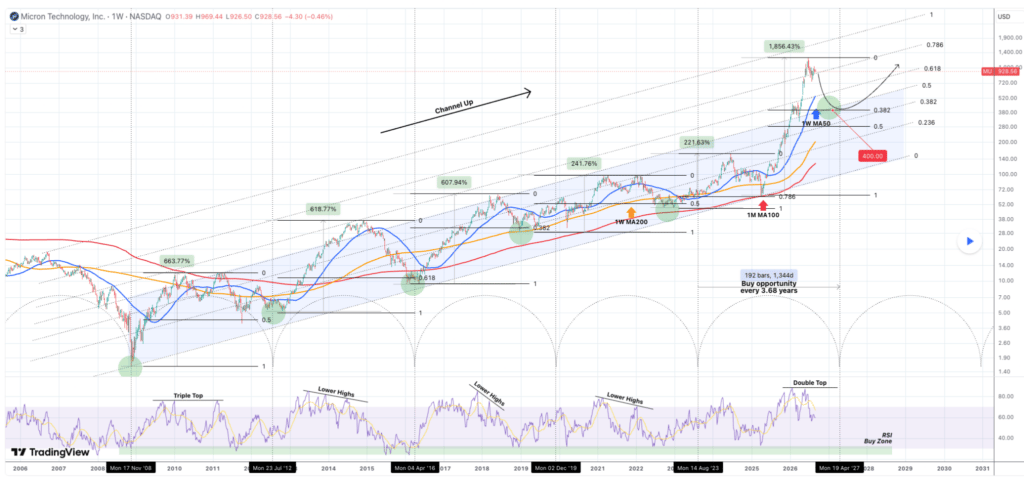
According to the analysis, Micron tends to generate major buying opportunities approximately every 3.68 years, or 1,344 days. The most recent long-term buy signal occurred on August 14, 2023, while the next is projected for April 19, 2027.
Before that buy signal emerges, the analyst expects Micron to enter a corrective phase. The outlook suggests the decline could accelerate toward late February 2027, when the stock may test its 0.382 Fibonacci retracement level near $400.
The projected move would see MU break below its weekly 50-week moving average (MA) and potentially approach the weekly 200-week moving average. The $400 target also aligns with the midpoint of the long-term channel, a region where the stock has spent much of the past 18 years.
Historically, every major bearish leg within the channel has reached at least the 0.382 Fibonacci retracement level, while deeper corrections have extended to the 0.786 level alongside the monthly 100-month moving average.
Micron stock fundamentals
While the technical outlook points to a potential correction, Micron’s underlying business remains strong.
The company is one of the biggest beneficiaries of the AI memory boom, reporting record fiscal third-quarter 2026 results. Revenue surged to $41.46 billion, up 346% year over year, while adjusted earnings per share reached $25.11.
Micron also guided for approximately $50 billion in fourth-quarter revenue, with gross margins expected around 86%, reflecting continued strength in AI-related memory demand.
A key factor supporting the business is its long-term supply agreements. In this line, Micron has secured multiple strategic customer contracts that provide greater revenue visibility and reduce some of the cyclicality traditionally associated with the memory industry.
Demand for HBM products remains robust, with much of the company’s capacity reportedly booked through 2027 as cloud providers and AI developers continue expanding infrastructure investments.
Featured image via Shutterstock