
Sandisk (NASDAQ: SNDK) is up nearly 4% in pre-market trading on May 13 as artificial intelligence (AI) demand continues to push the stock forward, which has already exploded nearly 430% since the beginning of the year.
Just a couple of days ago, on May 11, SNDK shares hit record highs after a fresh wave of Wall Street upgrades followed the company’s strong fiscal third-quarter earnings report.
The most notable one came from Susquehanna, when analyst Mehdi Hosseini doubled his 12-month Sandisk price target from $1,000 to $2,000 while reiterating a ‘Buy’ rating and pointing to the company’s shareholder return strategy as a key new catalyst.
More specifically, management now plans to allocate 50% of free cash flow toward share buybacks over the next two years. According to Hosseini, the plan could contribute around 10% earnings accretion.
New Sandisk stock price targets
The bullish outlook was echoed across Wall Street following the earnings release and is likewise shared by machine learning algorithms in the short term.
Bank of America Securities, for example, lifted its target price to $1,550 from $1,080, citing revenue and earnings per share beats.
Similarly, Cantor Fitzgerald raised its target to $1,800 after highlighting a new business model arrangement involving five customers expected to account for more than one-third of SanDisk’s total NAND bits by 2027.
Meanwhile, Bernstein increased its target to $1,700, likewise pointing to favorable NAND conditions and strong guidance. In the same vein, RBC Capital lifted its target to $1,000, citing NAND strength and gross margins nearing 80%.
Is Sandisk stock a buy?
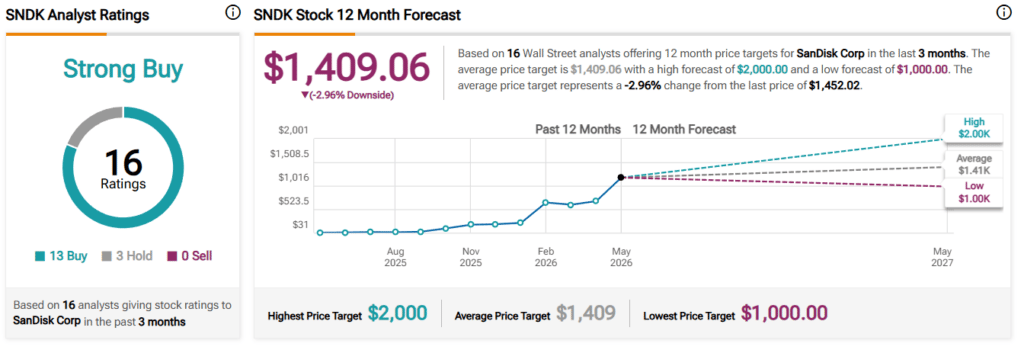
Across 16 analysts tracked by the TipRanks, Sandisk currently carries a consensus ‘Strong Buy’ rating, while the average price target stands at approximately $1,409, which sees a roughly 2.3% downside from the current price.
Worth mentioning is that some bullish forecasts suggest that if Sandisk reaches consensus fiscal 2027 earnings estimates of $168 per share, it could hit a valuation approaching $4,000 per share, applying a market-average price-to-earnings multiple of 22.
Featured image via Shutterstock