
Taiwan Semiconductor Manufacturing Company (NYSE: TSM) reported blockbuster third-quarter results, driven by robust demand for advanced artificial intelligence (AI) chips and high-performance computing (HPC). However, TSM stock fell sharply after the results.
Revenue rose 16.2% sequentially and reached $46.72 billion, comfortably above analyst estimates of $45.41 billion. At the same time, earnings per share (EPS) came in at $ 4.60, beating expectations of $4.42 by about 4.1%.
Despite the earnings beat, however, profitability showed signs of near-term trouble. Namely, gross margin declined 130 basis points from the previous quarter to 66.4%, while operating margin stood at 58.7%.
As investors weighed the company’s aggressive expansion plans, rising capital expenditures, and mounting pressure on profit margins, TSM shares closed the session at $430, down 3.4% from the previous close. The price then fell another 2.1% to $420.98 in after-hours trading, leaving the shares approximately 5.5% below the previous closing price overall.
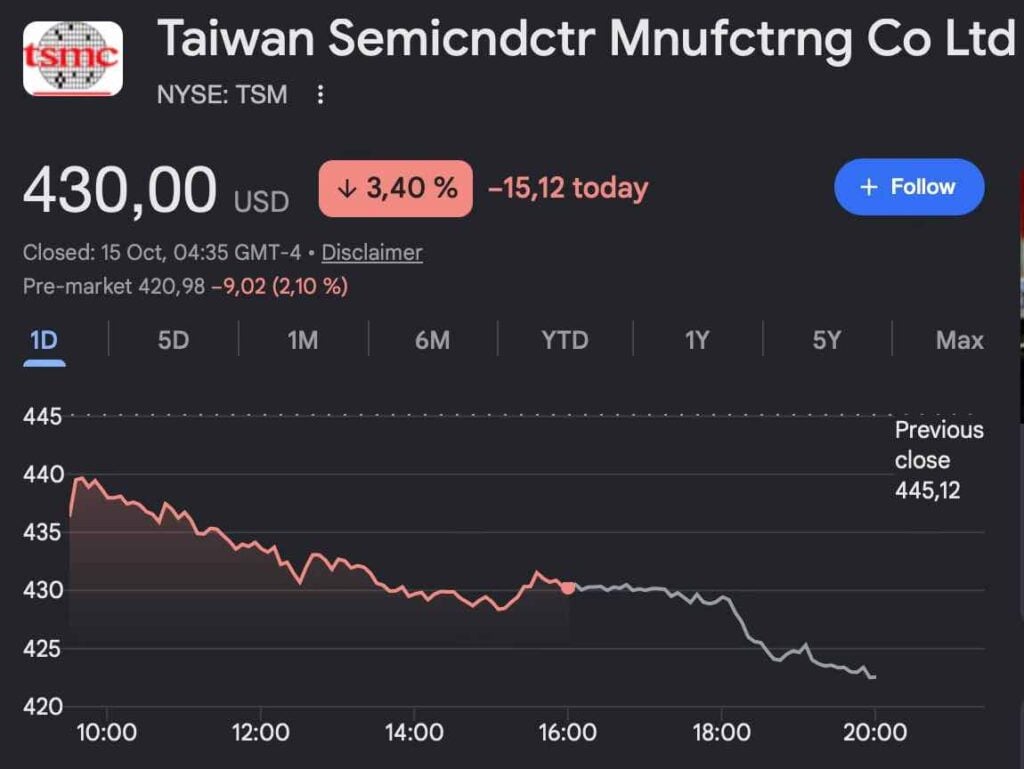
TSM stock falls as investors weigh near-term execution risks
The decline appears to suggest that investors are looking beyond earnings figures, focusing instead on the margins, future capital requirements, and the costs associated with international manufacturing expansion.
While TSMC shares remain within the upper half of their reported 52-week range of roughly $266-$487, the market reaction indicates that strong AI demand might not be sufficient to ease concerns about the company’s growth strategy.
Management itself attributed the pressure partly to the ramp-up of its next-generation 2-nanometer manufacturing technology and the continued expansion of overseas fabrication facilities. However, C.C. Wei, TSMC’s chairman and chief executive, still stressed the company’s expansion plans are going “full speed ahead:”
“We are moving full speed ahead to increase our capacity to meet our assessed demand, and stepping up our CapEx investment to support our customers’ future growth,” Wei said.
While confident, Wei’s tone probably did little to alleviate investor concerns, most of which were, as mentioned, focused primarily on unchecked expansion efforts. For now, then, management remains confident that demand will support further expansion, while the market worries whether TSMC can sustain its growth while managing the near-term costs.
TSMC’s fourth-quarter outlook remains positive
TSMC forecast fourth-quarter revenue of $52.3-$54.3 billion, implying approximately 14% sequential growth and 58% growth compared with the same period a year earlier. In addition, the company expects gross margin to range between 65% and 67%, while operating margin is projected at 56.5% to 58.5%.
As for full-year 2026 results, management expects revenue to grow by approximately 44% and reaffirms its capital expenditure budget of 60-64 billion. However, TSMC expects capital spending between 2026 and 2028 to be significantly higher than during the preceding three years, which is another reason the shares took a hit. After all, the expansion includes a substantial increase in next-generation manufacturing capacity. More specifically, TSMC expects its 2-nanometer capacity to double in 2027.
Featured image via Shutterstock