

A widely followed stock market sell signal has been triggered after institutional investors sharply reduced their cash holdings, according to Bank of America’s latest Global Fund Manager Survey.
The July 2026 survey showed average fund manager cash levels fell from 4.1% to 3.6% of assets under management. Conducted between July 2 and July 9, the survey covered 181 institutional investors overseeing approximately $484 billion in assets.
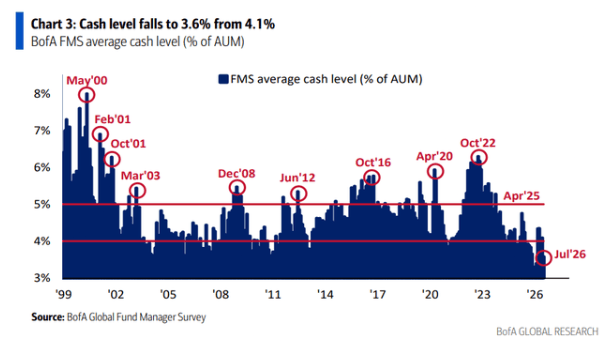
Under Bank of America’s Cash Rule, any reading at or below 4% triggers a sell signal, indicating investor optimism may have reached an extreme that leaves equities vulnerable to a pullback.
The latest reading is among the lowest recorded this century and marks the weakest cash position since early 2026.
Historically, such low cash balances have coincided with elevated market risk as investors deploy most of their capital into stocks.
Increased bullish positioning
Bank of America noted that investor positioning has become increasingly bullish. Allocations to U.S. equities climbed to a net 24% overweight, the highest level since December 2024, while global equity exposure increased to a net 42% overweight from 38% a month earlier.
The bank’s Bull & Bear Indicator also reached an extreme bullish reading of 9.4 out of 10, a level historically associated with limited upside and a greater risk of market corrections.
According to the survey, investors have been encouraged by improving economic expectations. Around 41% of respondents now expect above-trend economic growth and inflation, the highest proportion since February 2022.
Bank of America highlighted that there have been 16 previous instances since 2002 when fund manager cash levels fell to 3.6% or lower.
During those episodes, global equities declined an average of 1% over the following two weeks and remained down roughly 0.5% one month later.
In contrast, U.S. Treasury bonds generally outperformed stocks during the same period as investors moved toward safer assets.
AI stocks still favoured
The survey found that semiconductor and artificial intelligence stocks remain the market’s most crowded trade. About 82% of respondents identified long semiconductor positions as the most popular investment theme.
At the same time, nearly half of surveyed investors said aggressive AI infrastructure spending by major technology companies represents the most likely source of a future credit-related shock.
Despite those concerns, confidence in the AI sector remains strong. Most respondents do not expect major AI hyperscalers to reduce capital expenditure this year, while nearly half believe AI-related stocks are not currently in bubble territory.